
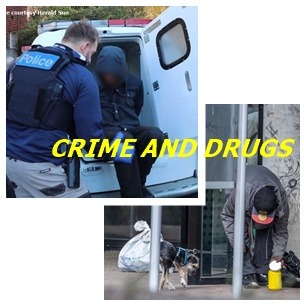
Depending on who you’re speaking to, the responsibility for managing drugs and crime in our community varies. While the issue should be clear, we can only assume that politicians, departmental mandarins, and executives in affected authorities are more interested in their own biases and statistics than in addressing the problems the community faces, with the dangers intrinsic in their lives.
Many in authority have a straightforward, divisive mantra: crime is a Law-and-Order issue, illicit drugs are a health issue. While that is true, it is a matter open for interpretation, and it shouldn’t be. At first glance, this seems unambiguous, but it is quite misleading. While the effects of illicit drugs on individuals are indeed a health matter, until the drugs are ingested, it remains a Law-and-Order issue.
Additionally, the act of ingestion is criminal, as are most activities leading up to it. The promotion of the drug issue as a health matter is a manipulation of reality by the pro-drug lobby, who are relentless in their quest to decriminalise the use of illicit drugs. The drug apologists are a clandestine group not easily identified until they start to pursue their agenda. It always concerns us that the enthusiasm and relentless wielding of influence by these people only serve the criminal cartels.
Their main aim is to legalise drugs; they then develop questionable legal activities off the back of decriminalisation.
The most significant concern is that these apologists are promoting the normalisation of the drug scourge, which leaves and multiplies the number, inflicting terrible scars on people in the community from which many will never recover. It is not just the users, but their families and the community at large who are ultimately the victims.
The ignorance of apologists who appear to live in a utopian world where legalising drug use will somehow be beneficial for addicts and users, and will somehow reduce or remove crime, is problematic. Aside from street-level crime, which will persist as addicts and users have built a way of life that legislation won’t change, why work when they can survive stealing from shops? However, the crime cartels will very quickly adjust and compete directly to ensure their river of gold keeps flowing.
What is rarely discussed or acknowledged is that drug users, whether addicted or not, are often hooked on the lifestyle itself, which they find thrilling and a place where they feel they belong. They have no responsibilities other than scoring drugs and, of course, funding these pursuits through crime, supplementing their welfare benefits, a consequence of which is another impact on society that is rarely discussed.
With this situation, the real issue remains unresolved.
We would strongly argue that intervention at an early age is the most effective way to make progress on reducing this problem, as prevention is the only cure, given that all other efforts to date have failed.
And on this issue, the authorities dodge and weave with feeble excuses.
Canada, which is arguably the leader in addressing the combined problem, has now concentrated on four key behavioural issues and has developed programs to teach their children as part of their school curriculum: anxiety sensitivity, sensation seeking, impulsivity, and hopelessness management skills.
These traits go beyond the either-or approach to drugs or crime, focusing on characteristics that a positive identity can help young people develop in their formative years, thereby reducing the likelihood of them seeking to negatively exploit any of these traits. The key point is that the main aim of reducing drug use and crime is never explicitly mentioned. Instead, the focus is on traits that could have an adverse influence on a young person.
The research on the effectiveness of this approach is very encouraging.
This approach, alongside or combined with ‘Resilience Training’, represents the way forward to achieving meaningful and measurable results.
What is unfortunate is the lack of leadership in advancing this approach.
While leaders argue over whose responsibility it is, it echoes the old proverb about Nero fiddling while Rome burns.
A legitimate question is what about those already caught in the cycle of crime and drug use? Our view is that current programs for these individuals should continue only if they reduce further drug use. Shifting the focus to prevention is the only sensible way forward.
Those who argue in favour of excusing existing addicts need to remember that the vast majority are in their predicament by choice, and therefore should accept responsibility for their situation.
We will publish more details of this new Canadian approach in upcoming articles. “Drugs and Crime.”

“Departmental mandarins”. Love it and their mantra is cause chaos, confusion and destruction until we get complete control by any means.