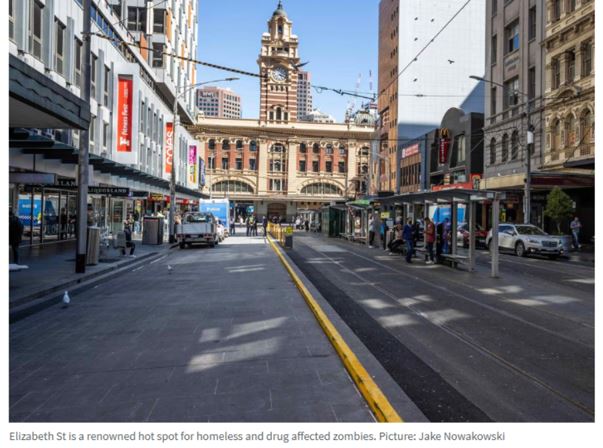
The latest crime figures released by the Insurance Council of Australia are not surprising, but the magnitude of the problem is nevertheless a shock.
‘3900 property theft and burglary claims last financial year- nearly as many as the total for the combined tally for NSW and Qld – a home hit every two hours.’
More importantly, it supports the repeated claims of the CAA of Victoria being in the midst of a crime tsunami.
There will be a lot of hand-wringing and excuses from those who are responsible; however, most culprits are long retired or have moved on, but they need to be named and shamed for their lack of ability to deal with and not recognise the problem – denial seems to be the infection and cause that the current leaders have caught from predecessors.
Over the last decade, the CAA has been addressing the issue, and we do not doubt that if it had been listened to seriously, we would not be in the current situation.
But what would we know? We only have 400 years of policing experience at an executive level and a broad cross-section of disciplines from the community who have been trying to be heard, over the denials and rejections and downright ignorance from those charged with the responsibility of addressing the issue.
One of the many solutions we have presented has been the G-Tag. A system that enables vehicles to be identified by police.
The system enables the avoidance of police pursuits and renders a vehicle a liability to thieves.
Imagine how many crimes would be avoided if criminals couldn’t access or use a vehicle- 90%?
It makes incredible sense to reduce the one essential tool criminals use to commit crime: a motor car.
Moreover, the danger to police and the community from high-speed pursuits or other high-speed events, without risking the lives of police, the community, and the perpetrator/s, must now be seriously examined with a view to implementation
It’s like organised crime, where the target is always the leader; targeting the foot soldiers of the group would be twice as effective – a leader cannot lead if nobody is willing to be led.
With the proliferation of Task Forces targeting the ringleaders of organised crime, over the last decade, there has not been any serious or sustained impact on the unacceptable crime rate, and a more pragmatic approach to policing and law enforcement is required.
While there will always be a need for some multidisciplinary Task Force groups, the number must be curtailed in favour of bringing all police stations back to full strength as a Force priority.
The Courts play an important role in crime prevention and in providing a fair legal system. While the conviction rate seems not to be a problem, with Police generally doing a good job, the reality is that their good work is undermined by woeful Court case management, and decisions that favour the criminal; the argument that the Court has a role to play in trying to discourage recidivism has clearly failed dramatically.
If the judiciary doesn’t change, legislators must intervene with solutions. Top of the list would be a Judicial Review Panel to manage jurists’ performance. They must learn to operate with accountability not only to the law but to the State.
This issue has been danced around for years, with nobody having the intestinal fortitude to tackle the niceties of the legal system to achieve a positive outcome for the community, not the criminal.
A cynic may conclude the whole court process is designed to favour the Legal fraternity and criminals in our society, leaving society miles behind to carry the burdens psychologically, physically, and financially.
The CAA has pressured the Force and the Government on the issue of reservists for over a decade, and we are delighted that the process and policy have begun, with initial feedback from frontline members of the initiative overwhelmingly positive.
This will improve service delivery for all victims.
Let’s hope some of our other initiatives can be addressed in less than a decade, given the unquestionable link between wrong-headed crime strategies and the shocking crime tsunami.
The CAA is and has never been about gaining credits or plaudits, but about guiding the State towards a better environment with effective policing and law enforcement to regain freedoms lost to crime for all society.
Critically, independent review panels need to be established across law enforcement sectors, with the power to bring about change.
The lack of effective use of computer technology is one glaring failure and wastes many staff hours through duplication of effort; the inability to integrate information means that data is recorded multiple times- inefficiency on steroids.
Specifically, policing needs to accept that crime prevention must be a priority, not simply an afterthought to do when they get around to it.
It doesn’t need new commands or the like, but clear, specific, accountable leadership from police executive managers to ensure this less-than-favourite management priority gets the attention it needs to lower crime rates.
Performance accountability, service delivery, and key performance indicators (KPIs) are not only anathema to police at all levels but are equally deplored in the justice system, and until these fundamentals are adequately addressed, we cannot expect to see signs of crime reduction any time soon.
Nobody seems to have worked out that what we are doing in this space isn’t working and that change is needed.
“Insanity is doing the same thing over and over again and expecting different results.”- Are we insane or just incompetent?
Co-founder and Deputy Chair/CEO of the CAA, a former Police Inspector with 32 years of service in Metro Uniform, Traffic Metro and Highway Patrol, Crime Cars, and CIB. Former Editor of Police Life and long-serving Public Relations Officer of VicPol. Founder and Life Member of the Blue Light Disco movement, Life Member of the Blue Light Federation, and completed his Police career as an Inspector after 6 years as a Patrol Officer. He then ran his own Business for 20 years until retirement. Ivan co-founded the CAA with former Victorian Chief Commissioner Kel Glare, and built the CAA into an influential voice for Victorians.
There is no escaping the impact of politics on policing, both good and bad, and we are now in for a time of uncertainty as the State heads for one of the most important elections this decade, in a few short weeks.
Although all elections are important, this one has a certain twist and will definitely be one to watch, with new serious players in the mix and a government that seems to be on the nose, with multiple challengers circling the main prize of winning Government.
A new Premier has recently swung the big stick, removing key stalwarts from their lucrative roles who were, in one way or another, responsible for the demise of this once-great State. This move was inevitable, regardless of who won government.
What we are concerned about is the impact on Law and Order and the Force’s ability to do its job.
One person to watch is the Chief Commissioner, who has been in the job for just over 12 months.
As we have already said, he was handed a ‘poisoned chalice’ appointment, given the state of the Force he was given, but be that as it may, the unarguable big political ticket item in this State is crime, and things don’t look the best for the Chief.
One indicator is that although we haven’t heard any criticism from any of the Political players, ringing endorsements are also missing, but that may be in his favour, as in the political arena, endorsement can be the kiss of death.
The risk of destabilising the Force comes from the crime rate, as it affects all parties in this election because most voters will focus on this issue.
There seem to be many positives coming from the conservative side of politics, and the Government is making some good noises; however, the proof will be in how these policies are applied, and who do we trust to implement their platform?
What is sadly lacking is clear planning objectives from the Police, the Courts and Corrections on how the crime will be reeled in, and voters look like they are going to the polls based on broad promises that have little weight.
The weight of these promises may well decide the election.
This is where the Chief Commissioner is at risk, as neither side of politics will have much faith in him if he doesn’t produce results quickly.
It is right that he stays out of the Political fray, but he takes a real risk by not providing leadership on each warring faction’s promises.
At this stage, the Force seems to be improving in the targeted approach to crime. Still, those who know are fully aware that this does not necessarily translate into crime reduction, no matter how the stats are massaged; a meaningful reduction can and only ever will be achieved by a Force that has the community on its side.
And that means proactive policing.
Policing is a service delivered to the community, and they are the first to notice failures and the first to let their politicians know about them, usually without fuss- the most effective weapon available to them.
We are sure the Chief is aware of this and also aware that the real impact of proactive policing cannot be produced overnight. The strategies need to be planned, implemented, reviewed and measured, and the results may not be seen for a few years.
Some initiatives will fail, and some will succeed spectacularly, and those are the ones VicPol must pursue.
The community, however, is being grossly underestimated, as they know this, and even if results are not immediate, if the planning is good and meaningful programs are implemented and properly explained, the community will accept them.
The community will quickly tire when they realise that all these big target operations, successful or not, have little to no impact on the service they expect to be delivered.
There have been, for example, a plethora of high-profile convictions and many more slayings of key crime figures by their own ilk; however, crime does not decrease. The community still has its cars stolen, houses robbed, children assaulted, and addicts running riot unchecked, and the fear of injury by criminals is real and reducing our liberty nearly as badly as we experienced during COVID.
Initiatives like the G-Tag, which we previously recommended, could have a substantial impact, was ignored, along with other technological advances that could make police more effective and the community safer.
It won’t be the politicians who cop the blame; they will only be in office for 4 years; however, the Chief may be in a far more tenuous position.
The last 10 years haven’t all been doom and gloom; in 2016, CAA heavily promoted the reintroduction of the Police Reservists and has taken every opportunity to promote this approach ever since.
Now the current Chief has introduced the Reservist concept, and lo and behold, we are getting positive feedback from serving members on how successful this initiative is, albeit early days.
But when many former police officers of all ranks, including Commissioned Officers, return in numbers, members welcome them with open arms to help with the drudgery of policing; furthermore, the expertise these Reservists can impart is invaluable, which members realise.
The community sees this move as a step towards reopening Police Stations, which will have a huge positive impact.
It only took us 10 years of pressure to achieve this result.
But it is initiatives like this that the community realises serve them well and build public confidence in the Force.
The Chief must look to the bag of tricks and produce a few more initiatives of this ilk, and that will not only help the State but secure his future, as politicians aren’t likely to move on success.
The Police In Schools Program would be another great starting point and would be ideal for Reservists to deliver.
Although there are currently quasi-Police school programs, the PISP in its purest form is another beast entirely, and its capacity to succeed has no peer.
…it was a sad day that the Police in Schools program ceased at my school. With over 40 years’ experience in a Primary School, I never understood why the program was discontinued. If Police were at my school, they might find out what is really going on in the community.
…Pearl Garland – Primary School Teacher.
…school principals are screaming out for help to deal with the problems they face. A huge frustration is that any effort they make must by definition stop at the school gate. A revamped Police in Schools program will be enthusiastically embraced.
…Kris Arcaro – Director Wellbeing, Health and Engagement Division DET
These two endorsements of the PISP come from a 2016 paper produced by CAA to create an initiative to stem the rising crime rate.
No action, and guess what? The crime rate has continued to climb unabated. It has become more deadly and dangerous, impacting citizens, if not directly, then indirectly, with the financial hit of huge insurance increases and the loss of liberty because of rampant crime.
We really need to get this one done.
Chief, you have the power and the resources; all that’s needed is leadership, and the results will flow.
Don’t let the naysayers within block you, and ignore the temptation of political expediency.
Co-founder and Deputy Chair/CEO of the CAA, a former Police Inspector with 32 years of service in Metro Uniform, Traffic Metro and Highway Patrol, Crime Cars, and CIB. Former Editor of Police Life and long-serving Public Relations Officer of VicPol. Founder and Life Member of the Blue Light Disco movement, Life Member of the Blue Light Federation, and completed his Police career as an Inspector after 6 years as a Patrol Officer. He then ran his own Business for 20 years until retirement. Ivan co-founded the CAA with former Victorian Chief Commissioner Kel Glare, and built the CAA into an influential voice for Victorians.
A well-hackneyed proverb sums up the current approach to reducing crime: insanity.
“The definition of insanity is doing the same thing over and over again and expecting different results.”
What makes this even worse is that this is the same strategy used and built upon over more than two decades, and Police and political leadership have never, it appears, been prepared to question it, albeit the impact on crime is negligible; the statistics prove it.
We are not claiming that Task Forces do not have an important role to play in managing crime; however, their overuse and use as a political tool needs to be substantially reigned in.
They have been used to replace many of the former Crime Squads, looking at a specific crime rather than a specific area within that crime category. The loss of specific knowledge and skill built up in a Squad approach is therefore lost over time.
This impacts the effectiveness of Detectives who can only specialise in a very narrow sphere.
The overarching reality is that as you build Task Forces or other like groups, both regionally and Force-wide, unchecked, the pendulum shifts even further from preventing crime to an overreliance on catching crooks to reduce crime – a spurious assertion.
It is morally wrong to wait for a crime to occur and another victim to be created when there are other options. There needs to be a balance struck.
Were all the resources put into getting a conviction against Tony Mockbel worth the effort, given those same resources could have prevented untold crime? A crime tsar, we were told, who now attends the races, seems to live a good life and deems not to have to work.
Another example is the Taskforce Hawke/CFMEU; where after two years there appears to be no convictions of ringleaders achieved.
The Task Force hierarchy was reported in The Age as bemoaning a lack of cooperation from victims, hindering the investigation. A recurring issue highlighted in reporting around the operation has been that many potential victims and witnesses have been unwilling to formally cooperate with police.
This reluctance is commonly linked to fears of intimidation, repercussions within the industry, and the influence of organised crime figures. Without victim statements and witness cooperation, investigators face difficulties gathering admissible evidence and laying charges
There was once a criminal offence of Misprision of Felony – knowing a felony had been committed and by whom and not reporting this to police. A modern version aimed at serious indictable offences may make some recalcitrant witnesses come forward.
Overriding these concerns would be a lack of trust in police, promoted by the criminal elements involved in the Big Build, but the Task Force has not applied resources to remedy this problem. Simply throwing more detectives at the problem will not change anything.
Traditional policing methods are the answer.
A sustained uniform presence in and around building sites like Big Build will give the Police a chance to build relationships with individuals and enhance the opportunities for victims to have a ‘quiet word’ with a Police member who has built trust. The same strategy should be used in all uniform Police work in the community. The Task Force is finding out you can’t Police without the community; only in this case, rather than the broader community, the construction/contractor cohort.
Making Building sites safer for workers would generate better results for the Task Force.
These resources need not be pulled from the Stations; a professional relationship between Task Force Commanders and Station Commanders should enable a team approach in which Stations can support the Task Force’s objectives.
Many Police involved in Task Forces develop an elitist attitude and would find it difficult engaging with a local station commander – this must change.
Furthermore, it is imperative that Police support other agencies with roles in the Building Industry so they can do their job, and they know it.
There are reports that Task Force Hawke has charged five individuals with blackmail, three with extortion and five with corruption. But how these successes help the safety of Victorians is questionable because, to use this mechanism, they would have to charge hundreds to have an impact on crime. What are the objectives and targets (KPI’s) set for the Task Force, and how do you know when it succeeds?
The current inflexible Task Force approach reminds us of the old joke,
“How many people does it take to change a light globe? “None. They just promise the old one is working.”
And that raises the question of how that Task Force has made the State safer; the Force has trouble enough delivering, or trying to deliver, its service to all citizens, but is ensnared in following perhaps political imperatives rather than its real role to the State.
Something is terribly wrong with our system when additional Detectives (number unknown) can be assigned to a Taskforce that serves the Government’s political needs and can’t keep Police Stations open for the rest of us.
That proposition has taken a downward curve with the announcement of four inner suburban Police Stations being permanently closed. The rationale is obscure, but a cynic might suggest this is a power struggle between the Force and the government – give us more or we will close more stations?
Crime is escalating both in quantum and severity, so arguably strategies have failed all of us, police and the public alike; crime is not diminishing but increasing as the fiscal and psychological cost in police resources is growing astronomically.
Task Forces have an important place in policing, and organised crime figures must be pursued and charged where possible, but a continued careful evaluation of resources allocated to each target must be ongoing to prevent Task Forces from forever gobbling up resources with no measurable improvement in obtaining results.
The Task-Force phenomenon has gripped the policing and political psyche as the panacea to the crime epidemic.
Task Forces appeal to Police administrations and Government as an easy way to appear to be doing something, even as crime rates climb rather than decline.
The alternative is creative and effective policing strategies and management aimed at the heart of criminal activity, and that can be found in every local Police area command.
The effectiveness of the Task Force strategy is never disclosed, but the crime statistics paint a picture of failure.
Moving police from street-level policing into a Task Force or similar is not only an inefficient use of resources but also of questionable value, since the Task Force outcomes are never made public, and we are never told at what stage the cost-benefit of these groups ceases to be worthwhile; or are they just allowed to wally along in the hope they get a result?
It is a political nicety for the police and politicians to announce another Task Force; all that means is the problem has been given only a political fix. Whether it solves the community issues is moot.
Every time we see another reference to a Task Force, Special Duties, or other such group (Police management have become very adroit in describing these functions to mask the number of Groups set up ) of police to tackle a specific crime or social issue into a unit, they all rapidly dress up like American Special Forces, ditching their uniforms for some unidentifiable rationale, raising an aporetic question.
Parading around in public in mufti while fully armed and decked out with Police accoutrements, sometimes including a ballistic vest with Police emblazoned across it, seems very odd indeed. Perhaps they think they are undercover? Doh!
Former Chief Commissioner Patton, addressing the CAA at an AGM, said that the Force had a huge problem with new members breaking their necks to get into a Police uniform and then, within three or so years, breaking their necks to get out of it.
Avoiding shift work might be part of the answer; as might a uniform not fit for purpose; however, more important is the matter of culture within the Force. If the leadership places such weight on the Task Force phenomenon, then that’s where the action is and where, for my career, I need to be. Diluting the importance of the uniformed frontline 24/7 policing role may be to blame.
It reminds us of a previous Chief Commissioner who changed the Force uniforms to black (Salute Blue) and allegedly claimed the reason was to make the Force look tougher, ‘or similar words’; an inane reason by any measure.
Moreover, where does everybody think the police come from to fill this plethora of units?
The only source of police is from the police stations, which has the effect of reducing policing at the local level, from where all crime, serious or otherwise, emanates.
Taking resources from Police Stations defies logic, aggravated by a general trend to take the best and brightest. You can imagine what that does to those not selected. A blatant demotivational strategy that management seems to embrace, and we wonder why some of our Police are less than enthusiastic about attending to our needs.
The move to a centralised hierarchical management model where the district Commander, usually a Chief Superintendent, had power that the higher echelons were jealous of has caused serious damage to Police effectiveness and efficiency. The regionalisation dismantled this localised command structure, which had previously been willing to challenge executive decisions when their actions adversely affected the communities they served.
But there can be nothing more frustrating for a member than looking at a new station roster where their shifts for the coming period are constantly weighted by afternoon shifts, quick changeovers and more frequent night shifts and weekend work. Moreover, the number of shifts allocated to catching up on the ever-present paperwork shrinks, which means more pressure from the bosses.
And while that is happening, more and more members from their station are seconded to a Task Force or other special duty group, and the numbers on the Station shrink further; the outlook for a member pursuing their new roster period, the first casualty is their culture, takes a huge hit – is it all worthwhile?
If crime and social disorder are adequately and effectively managed at a local level, focusing on preventing crime at its source, where it all starts, may not make headlines and make politicians and Police leaders stop puffing their collective chests, but it will reduce the crime that the community has to deal and live with daily.
The CAA has long advocated for the reintroduction of the Police Inspectorate that can oversee and evaluate, amongst other things, Task Forces to ensure their efficacy. Independently within the organisation, reporting directly to the Chief Commissioner, at the very least should ensure the Chief is getting the right advice, not advice from other senior officers serving their own purpose. The Putin phenomenon.
The CAA has been a staunch supporter of Chief Commissioner Mike Bush, but we are starting to have doubts about whether that confidence and respect was best placed.
Co-founder and Deputy Chair/CEO of the CAA, a former Police Inspector with 32 years of service in Metro Uniform, Traffic Metro and Highway Patrol, Crime Cars, and CIB. Former Editor of Police Life and long-serving Public Relations Officer of VicPol. Founder and Life Member of the Blue Light Disco movement, Life Member of the Blue Light Federation, and completed his Police career as an Inspector after 6 years as a Patrol Officer. He then ran his own Business for 20 years until retirement. Ivan co-founded the CAA with former Victorian Chief Commissioner Kel Glare, and built the CAA into an influential voice for Victorians.
The Herald Sun 13/08/2026 carries an article headed, “PSOs TO PATROL SHOPS” and reports that the Premier directs that PSOs will blitz crime-ridden shopping centres.
The Police Act 2013 is specific relating to the deployment of Police and PSOs.
Under Division 2 – Relationship with government, Section 10, Ministerial directions:
(1) The Minister may from time to time, after consulting the Chief Commissioner, give written directions to the Chief Commissioner in relation to the policy and priorities to be pursued in the performance of the functions of Victoria Police.
(2) Subject to subsection (3), a direction under subsection (1) cannot be given in relation to any of the following matters—(f) the allocation or deployment of police officers or protective services officers to or at particular locations;
Clearly, the Premier has ignored the Police Act and usurped the prerogative of the Chief Commissioner (CCP) to allocate operational police and PSOs.
The Act, unfortunately, had unintended consequences when it requires the CCP to follow directions as to policy which is interpreted as permitting Governments to interfere with personnel allocations, despite the specific prohibition of this in Section 10.
None of the requirements of Sub-section 3 is applicable.
A classic example of the folly of such a power to order the deployment of police by Government is when the Andrews Government, during the COVID Pandemic, ordered a “Ring of Steel” be imposed to curb people’s ability to travel and required Police to enforce this edict when effectively it was a direction impossible to effectively implement.
The politicisation of the Victoria Police that has occurred over the past decades must be curtailed if we are to have a Force that acts without fear or favour.
The allocation of police resources must be at the sole discretion of the Chief Commissioner.
Authur Kelvin (Kel) Glare AO APM, on behalf of the CAA, is Co-founder and Chair, a former Chief Commissioner of Victoria Police with over 35 years of service in uniform, as a fingerprint technician and expert, as a Police Prosecutor, OIC and creator of the Pollice Prosecutions Division, Divisional Inspector, first Assistant Commissioner of the then Internal Investigations Department, Assistant and Deputy Commissioner, Operations and CCP from 1987 to 1992. Kel has an Honours Degree in Law from the University of Melbourne and was Admitted to Practise as a Barrister and Solicitor in 1977. On retirement, for seven years, Kel was Executive Director of a leading Security Company conducting both national and international investigations. Kel remains committed to helping others who need a voice.
Victorian Police were known colloquially in the 1980s as the ‘People’s Force ‘, ironically the title of the book by VicPol Police Inspector, Dr Robert Haldane, chronicling the History of the Force.
It is sad that some 40 years on, the title and its function have been lost and, even worse, the positives that created the ’ People’s Force’ are seen as irrelevant to today’s Policing and ridiculed by many within the Force.
The cost to the community has been high, having to deal with reduced public safety and the consequence of an out-of-control crime rate. Apart from the social cost, the fiscal cost must run into Billions.
A comparison of VicPol performance to NSW, a comparable State, is a good place to start.
NSW, for example, maintains some of the lowest violent and property victimisation rates across all Australian States and Territories.
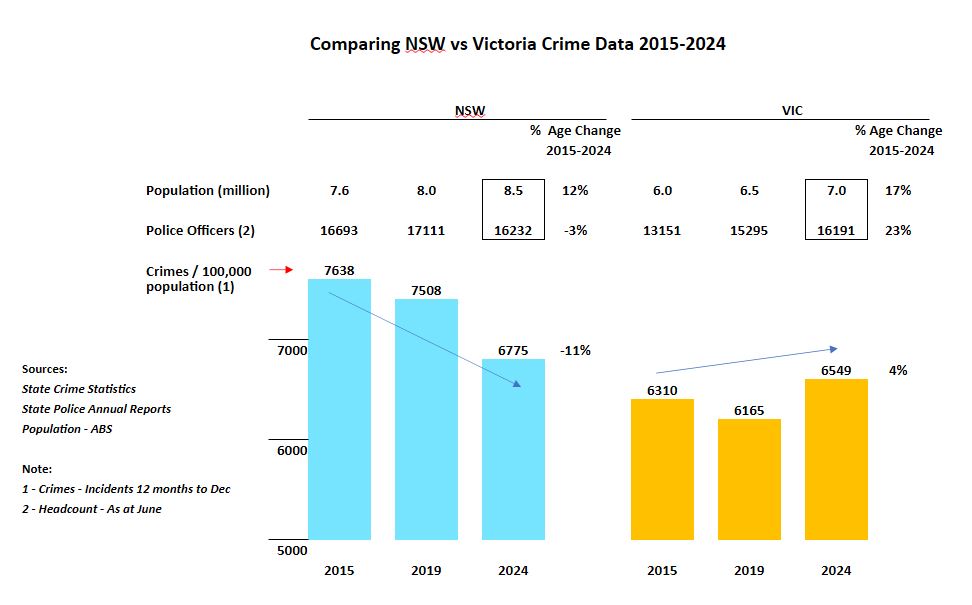
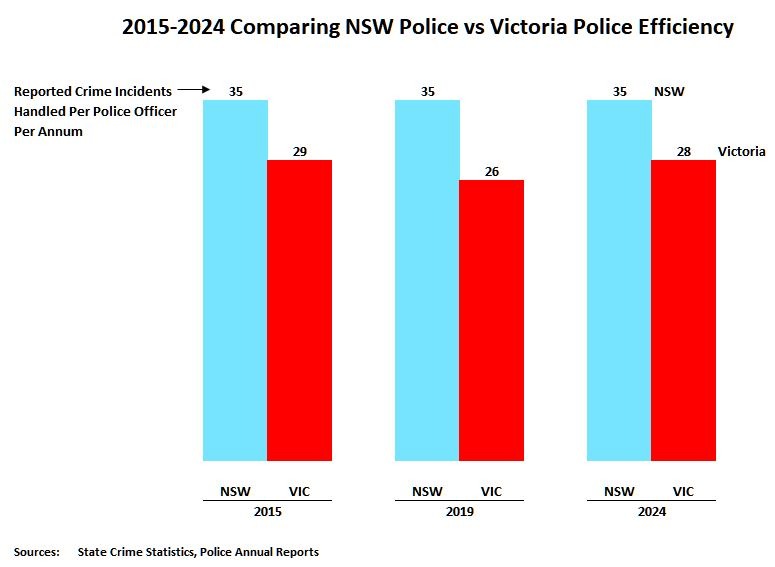
Comparing police per capita ratios between Vic and NSW is relevant to measuring the overall Police Force’s performance relative to each State’s crime rates.
The risk of anarchy rises and falls in direct proportion to the crime rate.
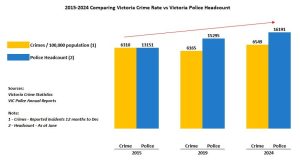
This graph is an eye-opener for all Victorians, and Police administrators in particular.
This comparison must be assessed in light of the geographical difference between the two states. NSW is roughly 3.5 times the size of Victoria, and the tyranny of distance places greater demand on Police resources and Police operational planning, making the differences highlighted in the graph substantially more impactful.
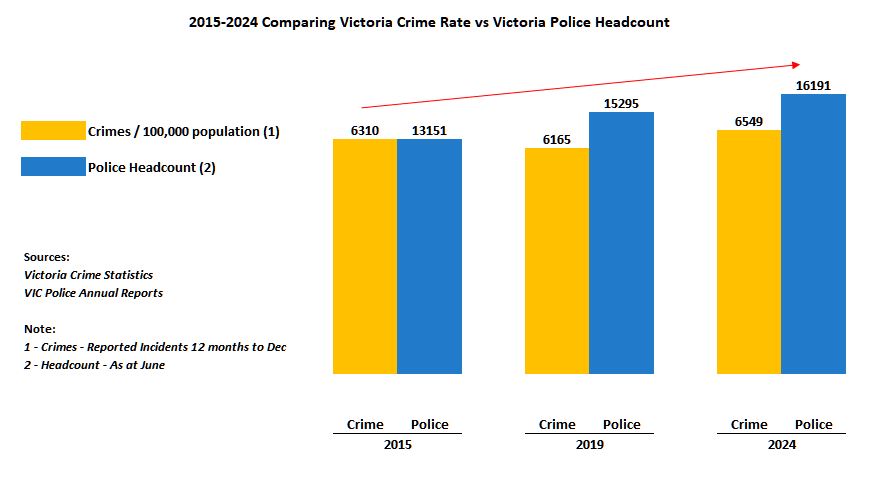
From 2000, there was a decline in both States’ crime rates, but around 2013 the wheels really fell off in Victoria; the impact of 2000 Administration moves kicked in. A rapid increase in crime remains unchecked, and you will note that since about 2015 there has been a substantial increase in Force numbers where NSW numbers have remained relatively static, which highlights the concern that throwing 1500 more Police members at the problem is very unlikely to achieve any meaningful impact on the crime issue.
There is a real likelihood that they will be thrown into inefficient Task Force Operations so high-profile arrests can give the illusion of effectiveness. High-profile arrests have little or no impact on crime figures.
Graph prepared by Adrian King of AXS Partners.
More dollars out of our pockets for no meaningful return.
As a priority, the poor management of crime and social disorder in Victoria is a critical factor that negatively affects all of our lives; this didn’t happen this year or last, but it is a culmination of poor executive appointments incapable of running a Police Force since about 2000, excluding the current incumbent who has been handed a poisoned chalice.
A failure in this critical area of Government can and does break our society.
As our political system relies heavily on Law and Order to function properly, irrespective of a Government’s political persuasion, all politicians have a vested interest in ensuring Law and Order is maintained, as the adverse impact of failure is profoundly deleterious to all Government and societal functions.
We are now questioning the politically favoured solution promoted in Victoria of ‘more police numbers’ as the panacea for this issue.
We accept there are numbers of police at any given time who are on sick leave or vacancies that have not been filled. But there is no reason to suspect that NSW doesn’t face the same issues.
We are also cognisant of other pressures that affect effective policing, such as poor legislation, the abysmal performance of the Courts, and natural or manufactured disasters.
Probably one of the most significant issues is corruption within the Government and the private sector. Clearly, legislation is way behind in arming police with the capacity to do much about it.
Even with these headwinds, it is time to accept our Force is not up to par and needs a major overhaul, particularly to its culture.
Making excuses for failure no longer washes.
There is no guarantee that providing Victoria with 2000 more police or the 1500 announced will result in a comparable reduction in crime and social disorder, or, more importantly, a return of a feeling of safety to the community.
The question is what happens if we are in the same place ,crime-wise, in three years; very likely on current trends, it will be a place far worse than where we are today.
There is nothing in the public space about VicPol forward planning and, critically, how these plans will be implemented, but even more importantly, how they will be empirically measured to give us confidence somebody knows what they are doing.
The community is entitled to demand that information; we pay the Force’s bills including the Police salaries.
Graph prepared by Adrian King of AXS Partners.
Although this graph focuses on the individual members, the Graph is a macro look at the organisation, and as an organisation Victoria falls well short of our neighbours north of the Murray River.
Even with the VicPol’s focus on Reactive Policing, this does not translate into less crime.
It has long been recognised in policing and criminal-justice circles that “you can’t arrest your way out of a crime problem”—a maxim often used to stress that arrests are only one part of crime reduction, alongside prevention and community engagement,
Our take on the statistical data is that VicPol has substantially failed to deliver its services, and a direct comparison with NSW suggests that VicPol management needs urgent and frank discussions with its NSW counterparts to determine how they have succeeded, even with the additional challenges of a much larger geographical area 3.5 times larger than Victoria.
Most revealing are the graphs showing a huge rise in criminality we can reasonably attribute to COVID-19, but NSW has achieved laudable results given its ratio per capita. Victoria urgently needs to discover their secret.
Victoria is leading the charge on out-of-control crime and doesn’t look capable of reining it in. We garner this is also the view of the community more generally, translating into a growing lack of confidence in the Force.
Since 2000, we have seen a dramatic decline in proactive policing, which involved working with the community rather than being isolated from it. The focus has now shifted much further toward the Reactive function, and the numbers prove it.
VicPol has lost sight in recent years that the effectiveness of policing correlates directly with its relationship with the community it is supposed to serve.
Central to this police-community disconnect has been the strategy of isolationism by successive police administrations.
Recognising that Police serve the community rather than the other way round is a cultural shift the Force must implement.
Implementing that shift will be hard; however, the additional byproduct will be that Police will be working in a more conducive environment, lowering pressure on them and reducing the likelihood of stress-related injuries among members.
Moreover, the need to adjust the pendulum, which has moved too far towards the Reactive function, back to an equilibrium with the Proactive functions is a critical, long-overdue change, and the reason we are rapidly falling into an unchecked spiral towards anarchy.
The task of turning around VicPol’s failures is daunting, as the problems have been allowed to fester under years of poor administration.
To redress the failures, there needs to be a properly resourced Inquiry that can provide the Chief Commissioner with the guidance, advice, and tools to improve the Force’s performance for the benefit of all Victorians.
Simply throwing money at the Force without addressing the problems won’t work.
It must include input from NSW Police command-level officers, and VicPol must, if necessary, eat humble pie, as NSW have shown how it is done.
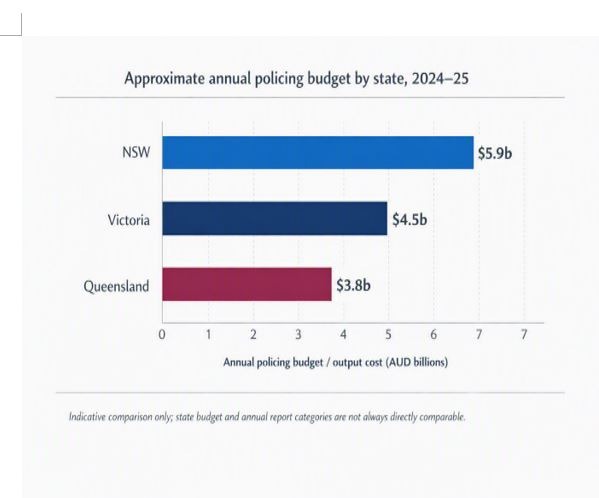
This graph of the comparable budgets for the three Eastern seaboard states is an important indicator on this issue.
The budgets, with NSW having a $1B+ break on Vic., suggest NSW has invested in advanced technology and other resources rather than blind member-number solutions. Which have proven in Victoria not to work and are unlikely to in the future.
The CAA stands ready to assist in achieving the required transformation; we have 400 years of policing experience across various levels and eras, supported by a wide cross-section of non-Police Victorians, all of whom combine to form a formidable body of experts.
We can speak with authority from a policing and community perspective.
Co-founder and Deputy Chair/CEO of the CAA, a former Police Inspector with 32 years of service in Metro Uniform, Traffic Metro and Highway Patrol, Crime Cars, and CIB. Former Editor of Police Life and long-serving Public Relations Officer of VicPol. Founder and Life Member of the Blue Light Disco movement, Life Member of the Blue Light Federation, and completed his Police career as an Inspector after 6 years as a Patrol Officer. He then ran his own Business for 20 years until retirement. Ivan co-founded the CAA with former Victorian Chief Commissioner Kel Glare, and built the CAA into an influential voice for Victorians.
Yesterday, 28 July, a new Premier for Victoria, Ben Carroll, was appointed, and a couple of announcements ‘right off the bat ’ had some merit. But with all these types of announcements, the devil will be in the detail and the application; at least there should be some credit for recognising the problems. A cynic may say that these announcements are a blocker to the criticism in the media of this Government and are the two major issues that are ‘cutting through’ with the electorate. Unfortunately, in the vein of the announcements, there was a big miss.
The first major announcement was the Premier’s intent to appoint a Royal Commission into the Big Build criminality that has been widely made public for years. Although this may steal some of the Opposition’s thunder, that’s politics. The value of this Commission will not be known until we see the terms of reference, and, given the previous inquiries of this nature set up in recent years, they each seem to have been politically expedient, and even findings are selectively applied; therefore, we have some scepticism for an outcome that properly addresses community concerns and whether those responsible are held to account, which paradoxically, is not a ‘strong suit’ for this Government based on past performances. So, what may on the surface appear to be a bold move may in reality be another whitewash in the making. To give the Royal Commissioner scope to investigate the circumstances properly in the best interest of the State, the role of individual politicians and Public Servants in any corruption must be included in the terms. Otherwise, the best we can expect is that some low-hanging fruit may get plucked. We will wait and see the Terms of Reference with interest.
The second and probably the most significant, for direct impact on all Victorians, was that the new Premier announced having called the Chief Commissioner before his press conference to advise that the Government would support the Police both financially and legislatively. This will no doubt have a positive impact on policing resources and give the Chief Commissioner the flexibility to instigate more proactive activity preventing crime before it happens, and this would be warmly welcomed by all Victorians, who would rather not be victims of crime. Although very encouraging, we should not get too excited until we see positive actions. It may be just political manoeuvring so the failure of law enforcement in this State can be blamed on the Chief Commissioner rather than the Government. The old, ”It was not us, it was him over there,” retort applies.
The Big miss from this announcement was that the other call the Premier should have made was to The Hon. Sonya Kilkenny, the Attorney General (AG). The major problem is that no matter how much money the Government throws at the Police, it is all wasted if the hard-working Police are continually thwarted by lenient sentencing and other legal paralysis in the Courts. The inefficiency of the Courts is also a disgrace and works against good jurisprudence. The first move must be for the Courts to be told to accept their responsibility for the crime tsunami caused by their failure to enforce the Law. Announcing that the crisis of the Courts is to be addressed by the AG, whereby the performance of jurists is made accountable and enforceable by a Judicial Review Panel, would go a long way to reducing criminal activity. Under the present system, criminals hold sway in court proceedings at the expense of victims.
The pendulum has swung too far to socialist philosophy and needs a substantial correction. Accountability for individual and organisation-wide performance is one of the most serious issues facing the Government and the various arms of Government, with a correction starting at the top being the most effective. Until employees of the Government accept this and are managed and promoted based on performance and ability, all political protestations will be of little value.
Political nepotism never works in the best interest of the State or the people that pay for their lack of service, us. The failure of successive administrations of this State has been not to recognise that failing to hold State employees to account (as happens in the private sector) for performance is a ‘slap in the face’, and a demotivator, for those who are genuine hard workers contributing to the State’s fortunes. Individual and corporate accountability may be a seismic shift, but one that will pay dividends not only in performance but substantially to the budget bottom line for this State. Premier Carroll, we wish you well.
Co-founder and Deputy Chair/CEO of the CAA, a former Police Inspector with 32 years of service in Metro Uniform, Traffic Metro and Highway Patrol, Crime Cars, and CIB. Former Editor of Police Life and long-serving Public Relations Officer of VicPol. Founder and Life Member of the Blue Light Disco movement, Life Member of the Blue Light Federation, and completed his Police career as an Inspector after 6 years as a Patrol Officer. He then ran his own Business for 20 years until retirement. Ivan co-founded the CAA with former Victorian Chief Commissioner Kel Glare, and built the CAA into an influential voice for Victorians.
For quite a period, the politicisation of Victoria Police has been evolving, and no more so than during the COVID pandemic, when it became so prevalent that it seemed the norm.
During that time, however, there was always an endgame, when the pandemic was over, that offered some solace to those aware of the insidious nature of politicising the State Police Force.
Apart from COVID, the political interference in Police operations has been all too evident for nearly two decades.
This interference is not always overtly evident, but when you look at these major criminal matters, there is a common thread that reeks of politicisation.
The major criminal activities we refer to are,
George Pell – prosecution, where it was found that a conviction was not upheld; however, there should never have been a prosecution in the first place.
Importantly, you will recall the work done by journalist Andrew Bolt, who demonstrated how it was highly improbable that Pell had the opportunity to offend, let alone actually offend.
A reasonable and indefensible Reasonable Doubt.
Despite the alarm bells that Bolt raised, doubting the validity of a prosecution, the police and the Director of Public Prosecutions (DPP) went ahead anyway. Neither the DPP nor VicPol were held to account for a miscarriage of justice. The question is, why?
Slug Gate – was a prime example where normal Police practices were set aside when there was ample evidence to prosecute perpetrators involved in what can only be described as an ideological political stitch-up of a small business operator who after many years of providing food services to Local Government and other entities, had the misfortune of a Government deciding to enter into the industry with a government funded competitor hell bent on success.
There was ample evidence of a number of prime facia criminal offences committed by the promoters and operators of this Government-funded competitor, but none were ever prosecuted – Why?
Nicolla Gobbo Affair – cited by a Jurist who described the Gobbo affair not merely as professional misconduct, but as a corruption of the criminal justice system itself, involving fundamental breaches by both Gobbo and Victoria Police.
Even with such a damning indictment from the High Court, no person has been charged or made to answer for their behaviour or role in this matter, which included many in the highest echelons of Victoria Police, including a number of Commissioners and Chief Commissioners, and the members of the Victorian Bar.
There has been a rumour that some of the lower-ranking Police involved were to face accountability, but this would be a supreme travesty given the rank of the architects of this debacle. They are the ones who must atone, not those who operate under their instruction or supervision.
That many involved have left the force for whatever reason; that must not be the get-out-of-jail-free card that many have dealt themselves.
There would be absolute and justifiable community outrage if a criminal responsible for egregious crimes were able to escape investigation and accountability by playing a similar card to the Police in the Gobbo matter.
We need to know why?
Bike Boy – All matters are not historic, and the Bike Boy incident, where Daniel Andrews, leader of the Opposition’s car, struck and severely injured a young boy, has never been properly resolved. No proper investigation was undertaken, and it has taken a number of retired Police to conduct a detailed examination without the resources available to serving police, to compile a very solid brief of evidence against Daniel and Catherine Andrews. Adding to that, media reports painted the attending Police as failing to fulfil their professional obligations. The two suspects in this case were the then Opposition Leader of the State of Victoria and his wife. It is no wonder that crime in this State is rampant when the dignitaries are placed above the law, setting an example for the rest of the criminal community.
Miscreants must be charged and face a court, as we would expect to happen to any other Victorian.
If not, we must know why?
Tobacco Wars – The so-called Tobacco Wars are like all crime, driven by greed, with little or no consideration of Victims. The Government has quietly sat on its hands, failing to take decisive action against the criminals and organised crime driving the problem. The State Government has seen this as a Federal excise Tax issue, and there is some truth to this; however, the state is responsible for law and order, and the criminal behaviour needs to be excised from the excise tax issue, and sufficiently strong legislation enacted to arm the police to deal with criminality.
It is no coincidence that weak anti-organised-crime laws have encouraged bikie-linked organised crime to shift to Victoria, where such laws are the weakest in the country.
There is also the growth of lawlessness on building sites, and this is not just an unfortunate coincidence but the result of being soft on crime by hamstringing the Police, and a Judiciary in lockstep with the failed Restorative Justice ideological dream. The public is entitled to know. Why?
Gang violence – another community and law professionals’ sore point. It has become very apparent that Victoria Police are very effective at bringing the perpetrators to justice, but there, effectiveness hits a brick wall.
Jurists responsible for delivering justice have embarked on a campaign over the last decade or so to do just the opposite. Yes, and again, it is restorative justice embraced by so many of those charged with delivering justice that has failed.
It has not been lost on those who are interested that the Restorative Justice push coincides with the evolution of the Crime Tsunami.
The Government has got nobody else to blame but itself for listening to ill-informed people who thought the idea of providing an amnesty to allow for the surrender of edged weapons into bins outside Police Stations was a good idea.
Understanding the psyche of those who carry these weapons, one would think it would be a strategy, one-O-one.
The weapons are a status symbol amongst many of the youth cohort and give them some misguided power to let it be known amongst their peers they are armed, so they are not going to relinquish their ‘ protection’ or ‘strength’ in a bin outside a Police Station. Remember, we are dealing with juveniles who have no respect for the law.
If you thought this might work to reduce the number of weapons carried by youths, from the immortal classic, ‘The Castle,’ “tell em they’re dreaming”.
But we, as a community, are not privy to what strategies (if any) will be implemented to tackle this problem. Why?
The latest news, however, is that a top secret agency (until now – if it is supposed to be top secret, why announce it – doh! ) would target gangland-related activity that has sparked a wave of fire bombings, extortion and other serious crime in Victoria.
Whoop-de-doo, a fat lot of good that will do when all the other outstanding matters listed herein are not being seriously addressed and resolved.
And more importantly, how do they plan to staff this agency?
Presumably, it will be Police, but where are they going to come from?
One guess- your local Police Station.
The Chief Commissioner is reported as supporting the idea, but he must have grave fears that this sort of decision or thought bubble is going to be foisted on an already overstretched Force.
Unless there is a plan to ensure that the Judiciary will support this approach, the whole idea is rather moot.
Our view is that we have an excellent and very competent Chief Commissioner, and the Government should butt out and, instead of announcing ‘mind sparks’, provide the Force with adequate resources and remove the recruiting cap for both full-time Police and Reserve Police.
We know that you cannot arrest your way out of a crime tsunami; the only effective strategy is to prevent crime before it happens, and to do that, you need sufficient police. We are confident that the Chief Commissioner understands this approach.
Like many political activities, the question remains: has this thought bubble any meat on the bone?.
The lack of detail reported is bordering on scary.
Announced as a Top-Secret Agency implies it will be an autonomous body, A Government agency: A public body that administers programs or regulations. Example: The Environmental Protection Agency (EPA).
This is getting perilously close to a secret government law enforcement body that can operate at the will of the Government of the day.
The ultimate politicisation of law enforcement is the path to a Police State.
Co-founder and Deputy Chair/CEO of the CAA, a former Police Inspector with 32 years of service in Metro Uniform, Traffic Metro and Highway Patrol, Crime Cars, and CIB. Former Editor of Police Life and long-serving Public Relations Officer of VicPol. Founder and Life Member of the Blue Light Disco movement, Life Member of the Blue Light Federation, and completed his Police career as an Inspector after 6 years as a Patrol Officer. He then ran his own Business for 20 years until retirement. Ivan co-founded the CAA with former Victorian Chief Commissioner Kel Glare, and built the CAA into an influential voice for Victorians.
Our article on One Up patrols certainly drew some attention across the spectrum of social media.
There was substantial division across the comments made, with a strong tendency for comments to come out in favour of the concept of one-up patrols, particularly for highway duties. And those comments came from current and former members who actually worked in this space.
The critics in the ‘no way’ camp, unfortunately, missed an important point. Not only that, I suspect that some of the comments were from people purporting to be Police with little idea of Policing realities.
The Chief Commissioner was not advocating a blanket one-up rule but putting forward a sensible Opt-in proposal.
In other words, contrary to what some have said, the plan is not to compel unwilling members to work one-up.
What is worrying is that some comments, either in the social media or wider media arena, have been emphatic ‘no’. It seems that those commentators didn’t read the fine print either.
We suspect there is a very strong reasoning behind the Chiefs’ view, and it is not a lot to do with increasing risks to members, but the reverse.
Moreover, the office of Police Constable, which all members voluntarily sign up for, comes with certain powers.
A significant power is the ability to exercise discretion in performing their duties, and here we have a number of critics paradoxically claiming that Police should not have the power to exercise discretion in relation to their own safety.
The power of safety should transcend all others.
The power to walk away from a confrontation is the single best defence a member can exercise; however, this is unlikely with the peer pressure of other Police present.
There was plenty of criticism aimed at the retired members by the critics who fail to understand that while many retired members did serve in a different era, just as many served in recent times, and all acknowledge that the current environment for policing is inherently more dangerous, but the police of today have advanced technology and numerically more support specialists than their forbears ever would have dreamt about.
Many retired police officers were equipped with a small rubber baton, a set of handcuffs, and occasionally a .32 mm Browning pistol or an even older .32 Colt pistol (most stations only had a few of these weapons, certainly not enough to arm the Station patrols fully). They were so obsolete, rumour has it, you could hear the bullet rattling down the barrel before falling at your feet. If the thing fired at all, the chances of hitting the intended target from more than 1-2 meters were remote. The weapon failure was generally down to ammunition that had been around for decades. Notably, this was also pre-ballistic vests for members.
I remember having a conversation with the former Chief Commissioner Mick Miller, who was waxing lyrical about the introduction of Police Utility belts, when he said,
“My gravest fear is that with the utility belt and all the Police paraphernalia hanging from it, it will cause members to push the belt through the door to solve a problem instead of using their brains”.
Although the current issue predominantly refers to Highway Patrol, the broader application exists where the approach to Patrol duties needs review.
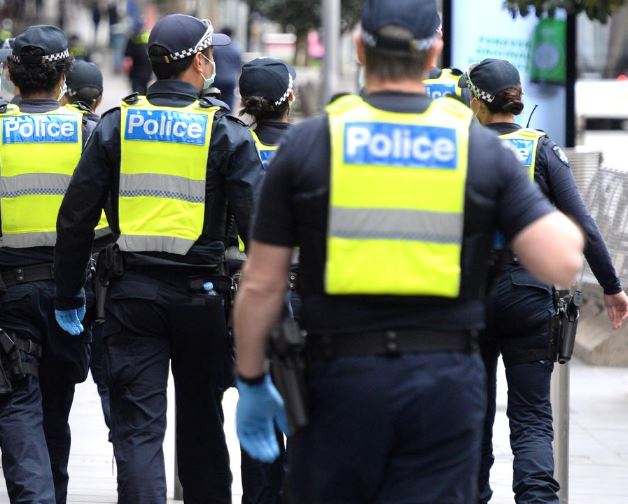
Foot patrols- it is inherently unsafe for members patrolling two up to walk side by side conducting their patrol.
They are often too easily engaged with their partner rather than the public, and their ‘situational awareness’ is severely compromised.
Two up or any multiple of Police on the beat should be spread out on either side of the street where practicable or at reasonable intervals.
This not only projects a wider Police presence but also preserves members’ safety and the effectiveness of their patrol.
Local Mobile Patrols – It is common for Stations that field a Divisional Van on the 24-hr rotation to be two-up, and that is sound; however, the additional resources that a Station can apply to their community can be substantially multiplied by general duty patrols being one-up.
How that can work safely is that each member of a local mobile patrol has their own vehicle. The Supervising Sergeant works one up, and the normal Supervisor’s driver could man yet another car, putting four cars patrolling and one supervising, 5, instead of just 3, increasing the visible Police presence substantially.
That means when a job is allocated, the capacity of 5 cars can attend. It adds substantial weight to the Police presence, reducing the likelihood of violence towards the police or the community.
It is not a matter of members attending dangerous situations on their own, but they are backed up by multiple members and units.
Moreover, the Supervisor can detail one of the single-member patrols to deal with reports at the scene when any danger has passed, and relieve the other vehicles, improving the capacity of the Force to respond to demand.
To make this work, the supervisor’s role and capacity to manage resources are paramount.
A new protocol needs to be explored in which jobs are assigned to the Sergeant for distribution to their units. Decision-making at the lowest operational level possible.
If this approach were extrapolated across every station, that would translate into literally hundreds more police cars projecting the deterrent effect of a highly visible police presence on crime and other anti-social behaviour.
Car manufacturers would jump with glee at the prospect of providing VicPol with hundreds more vehicles.
On a pragmatic note, providing two to three additional vehicles to a Station would be cheaper than recruiting additional police and more effective.
Cars generally don’t take sickies, come late to work or get bogged down with paperwork.
The issue of Patrol efficacy has not been addressed for some time and follows a pattern that has changed little over 50 years. A review and update are well overdue, if for no other reason than to improve members’ safety.
Co-founder and Deputy Chair/CEO of the CAA, a former Police Inspector with 32 years of service in Metro Uniform, Traffic Metro and Highway Patrol, Crime Cars, and CIB. Former Editor of Police Life and long-serving Public Relations Officer of VicPol. Founder and Life Member of the Blue Light Disco movement, Life Member of the Blue Light Federation, and completed his Police career as an Inspector after 6 years as a Patrol Officer. He then ran his own Business for 20 years until retirement. Ivan co-founded the CAA with former Victorian Chief Commissioner Kel Glare, and built the CAA into an influential voice for Victorians.
All Police work can be dangerous; every police member knows that, and denial would be inane. However, the risk must be considered in a historical context, and the murder of Police in Victoria is historically low. We categorically believe that any death of a Police member is one death too many, but we need to deal with the reality. Unfortunately, the Police Honour Roll is very short on detail, and we have to rely on estimates to determine the actual impact on Police members. What we can say for certain is that since 1853, there have only been 178 members who are recorded as losing their lives in the line of duty during those 173 years, and of those, there is a relatively small number who have died at the hands of a Felon. Best estimates have the number in the lower tens, rather than the hundreds. Motor vehicle crashes were the largest contributor to Police deaths. When it comes to Police on one-up patrols resulting in a member’s death, we could only identify 1 since 2000; therefore, most deaths have occurred when multiple members are involved in an incident. 17 Victoria Police members have been added to the Honour Roll for line-of-duty deaths from 2000 to 2025; of those, only 7 involved deliberate criminal acts. So that tells us where the danger lies, and it is not in one-up patrols. Having worked in traffic for a period during my career, I spent time in Metro Melbourne, predominantly two-up and occasionally one-up, without issue. I then spent time on the Hume Highway working out of Seymour, always one up. The closest police assistance was often 30 minutes or more away.
As an example, I was working the Goulbourn Valley Highway near Murchison East one-up when a call came through from Shepparton reporting two offenders leaving a scene with stolen property in two separate stolen cars, heading for Seymour along the Goulbourn Valley Highway.
I parked the Police car out of sight and waited.
Sure enough, the first car described went past, and the second car came past some five minutes later.
I advised Seymour by radio, took off, intercepted the second car, handcuffed the perpetrator without conversation to the steering wheel through the quarter vent, and took off after the first car.
I intercepted the first car quite a few kilometres down the road near Nagambie. I was able to convince him to comply while we waited for the Seymour Van, which took nearly 30 minutes to reach me.
With that crook secured, I retrieved the second one and my handcuffs.
It wasn’t until both crooks were safely in the Seymour Station that the crook in the first car admitted that, when I pulled him up, he had been waiting for the second car to arrive, hoping that the two of them would then effect an escape at my expense.
That I didn’t tell the crook in the first car I had already secured his mate saved my bacon; experience tells.
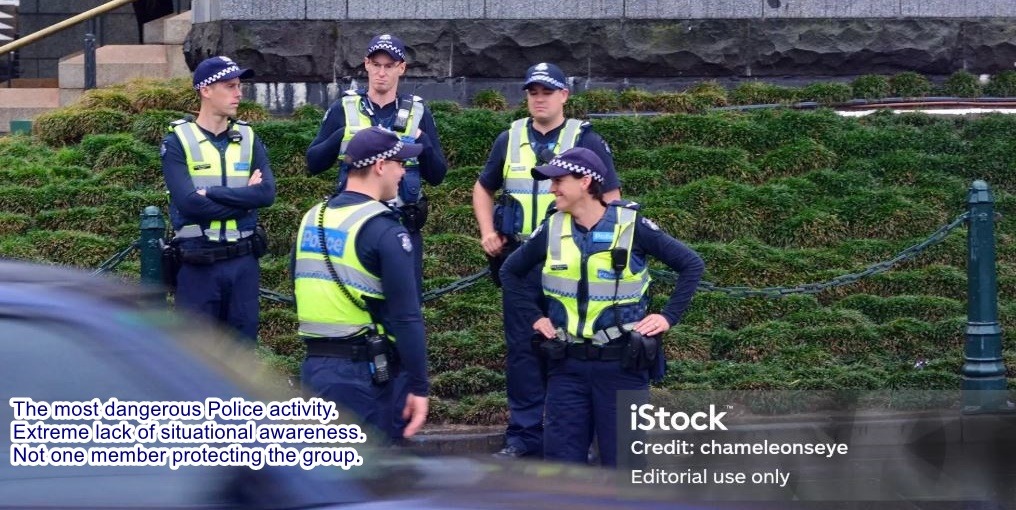
Later in my career, I worked one-up as a Patrol Officer in Melbourne, a circumstance I preferred, as working two-up always, in my view, increased the risk of getting distracted. The key to working safely as a Police member is not the number of colleagues you have around you, but your own survival skills, and that is predominantly ‘Situational Awareness.’ There used to be a strong emphasis on this skill at all levels of training, as it is an essential policing tool. Police graduates from training were assigned to Police Headquarters and were detailed for one-up foot patrols of the city. An invaluable learning experience for survival in a dangerous occupation. Unfortunately, many of the basic Policing skills seem to have been lost. Notably, we regularly see Police in the operational sphere in multiples, with their focus inward rather than on the environment they’re in, and that is dangerous, whether they are two-up or 10-up. The more Police that are grouped together, the bigger the target. It is clearly a lack of training and/or ineffective supervision that has been allowed to evolve in policing, making policing more dangerous. When you look at the hard numbers and compare them to the vast increases in the population and an apparent ‘laissez-faire’ approach as to who enters the country, police deaths are remarkably and thankfully rare. The voices opposing Chief Commissioner Mike Bush’s move to introduce one-up patrols are from the usual suspects trying to usurp the Chief Commissioner, as is the trend among naysayers and knockers. None of their criticism is based on empirical data. Their bleating is more about trying to exercise power over him than about looking seriously at the issues in a pragmatic way, something they are highly unlikely to succeed in, as they continue to underestimate the man. They are aggrieved that we have a Chief Commissioner who is a leader, not a head bobber. The decision is neither brash nor reckless, and what a Coroner may have determined many years ago. According to available research, the coroner was scathing of the Police Command about leaving in service a faulty holster, susceptible to gun grab, when they were aware of the issue. The problem with the police-issued holster was its gun retention ability. However, we were unable to find any reference in the public domain to the issue of one-up patrols in the Coroner’s findings. The CAA encourages the Chief Commissioner to continue with this pilot scheme and acknowledges that not all Police members would be comfortable working alone, with nobody to talk to, let alone any safety aspect. The opt-in of the one-up proposal recognises this and will allay any fears members may have. With this opt-in rider, the Police Association doesn’t have a role to play in this matter; it is up to each member. We encourage the Force to review its training and ensure that ‘Situational Awareness’ and other survival skills receive priority not only for frontline members but also in evaluating members for promotion to supervisory ranks, thereby saving police lives.
Co-founder and Deputy Chair/CEO of the CAA, a former Police Inspector with 32 years of service in Metro Uniform, Traffic Metro and Highway Patrol, Crime Cars, and CIB. Former Editor of Police Life and long-serving Public Relations Officer of VicPol. Founder and Life Member of the Blue Light Disco movement, Life Member of the Blue Light Federation, and completed his Police career as an Inspector after 6 years as a Patrol Officer. He then ran his own Business for 20 years until retirement. Ivan co-founded the CAA with former Victorian Chief Commissioner Kel Glare, and built the CAA into an influential voice for Victorians.
These new revelations in the Herald Sun of June 10 2026, under the headline
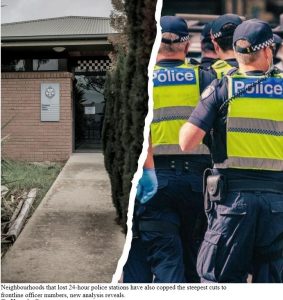
“’Shattered’: Data reveals Victorian areas with closed police stations also lost the most frontline officers.” is not big news to serving and former Police.
Fashionable activities like Task Forces and other special duties have been staffed at the expense of the Local Police Station.
What is often overlooked by Police management is that it may look good in the media that a task force or some other special unit has been created to deal with a particular criminal activity, but where are the staff drawn from to initiate the special unit – the Police stations, of course, where else?
There is an argument that the best and brightest are selected for these tasks, but this is talent and experience extracted from the Police Station, which can be very damaging to a Station and not only on the Roster.
These strategies damage, sometimes irreparably, the fabric and effectiveness of a Police Station. And members taken prematurely from Station rosters before they have gained essential experience will rarely evolve into useful leaders if they only know the Special Duty/Task Force genera of Policing. Good policing is more than just catching crooks.
Members overlooked for these positions, justifiably or not, can become despondent and lose their enthusiasm for policing. This can affect swathes of a Station’s staff adversely. A demoralised workforce, even if only a percentage, adversely impacts the overall performance and output of the infected unit and the most impacted is the community.
The visible Police presence (crime prevention) is continually eroded as any Police extracted from a station roster quickly adopt the dress-up look of the American Special Forces.
There is a concept decried by experienced police –we must build a Police force of specialists generalists, rather than a force of specialists, the trend of the last decade.
Not only will it build a more efficient Force, but job satisfaction will be elevated substantially.
By way of a practical example, we are aware of a Police response to an attempted car theft from a vehicle parked on the front lawn of a suburban residence.
Two Uniform Police vehicles attended, with one member speaking with the vehicle owner, taking the report, and the other three members standing in a group talking (with situational awareness, at zero, police at any scene are in the danger zone).
About 20 minutes after the first police car arrived, a Crime Scene vehicle turned up with another two members, a total of six for an attempted car theft during the previous night.
With the arrival of the Specialist Crime Unit, the group chatting increased by one, the member taking the initial report, and they all just watched as the Crime Scene crew fingerprinted and photographed the vehicle subject of the attempted theft and the crime scene crew then proceeded to do a door knock in the neighbourhood, not the other four police just hanging around.
Traditionally, one of those number would be responsible for investigating the crime, or in this new modern force, are all investigations just passed off.
If this is how modern policing is supposed to function, therein lies the key to the problems the Force faces.
The first of the two crews of General Duties should have been well capable of dealing with the crime scene and doorknocking, but they obviously do not see that as their role; it is a job for a specialist – that is absurd.
The time and resources wasted were incredible, and all the while, if other people were waiting for a police response in the area, bad luck, and as for crime prevention patrol- forget it.
This is but one incident that highlights poor supervision and the need for the Police to become specialist generalists rather than report takers.
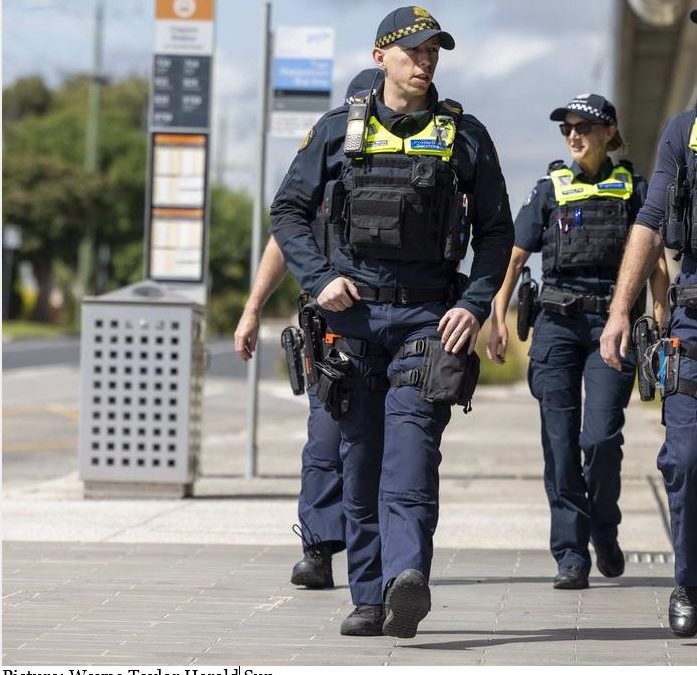
Add to that, how can it be useful for policing to have operational members dressed up out of uniform, wearing all the normal police paraphernalia? A Police-Issue ballistic vest (usually emblazoned with POLICE), a utility belt with the full range of equipment, O/C spray, including a firearm often strapped to their leg, wild-west-esque.
There can be no tactical or other advantage in this dressing down or dressing up to mimic American Special Forces (ASF) for members performing a police task. Excluding covert operations, this half-in, half-out approach must be reined in – it’s one Force. Police members must learn to be proud of their uniform, which portrays professionalism.
Anybody in the vicinity of, generally, a large station, around lunchtime, will regularly see police in this dress-up rig going to buy lunch wearing full kit.
We didn’t know buying lunch was so dangerous. Do you really need all your trinkets to get a chicken sandwich?
Competent Police win the respect of the community, wearing their uniform with pride, and it shows.
A previous Chief Commissioner told a CAA meeting once that new members these days break their necks to get into the uniform, and after 2-3 years, do everything they can to get out of it.
We assume he experienced severe headwinds trying to resolve the problem and failed.
Perhaps the uniform itself is less than fit for purpose; it looks scruffy on many police, but more likely, the junior members, barely out of probation, are seeking status or the supposed thrill associated with specialist work. If that’s their motivation, they will never make a good Police member, as we continue to remind the Force that there is more to policing than catching crooks; crime prevention is a greater priority, just ask the community.
When the free-for-all of taking staff from Police Stations grew dramatically under previous police administrations, those leaders forgot one imperative – all crooks and their families live in a Police Station area of responsibility, so it should therefore be no surprise that areas where police numbers have been decreased, the crime rate has grown proportionally as a direct result, just like night follows day.
Importantly, the number of Police at a station can be misleading with the allocation of Police to a Special Duties group, usually hidden under a number of aliases, District Support, DSG, etc. (A force Inspectorate would sort this in short order), while the position still remains on the Station Roster, it looks like there are more Police than there are. On paper only.
We are the first to acknowledge that there is a need for specialists to focus their efforts on a particular crime or criminal, but targets must be selected with great care, and each task Force must have an end date, weighed against advances in their inquiries.
Chasing one crook with a team does not stop any group, whether loosely or formally organised. As the police knock off the kingpin, there is a conga line of deputies to fill the void, so the net gain for the community is close to zero; not always, but often enough to instil greater care in Police strategies.
Furthermore, it appears that being incarcerated does not interfere with a criminal’s criminal endeavours; it’s just a bit more inconvenient.
And all that time and effort does nothing to stop more young thugs from being recruited from the local police areas, and the local police are so busy just responding to the community’s direct concerns that they cannot take action to redirect some of these junior thugs from crime.
Police can do that; they did it regularly in the past.
A solution is not easy, but the Chef Commissioner could do no worse than a recommendation of the CAA to establish a Police Inspectorate attached directly to his Office that will ensure his policies are implemented.
The Inspectorate would field a team of senior Officers who would actually visit Police operations and locations to ensure policy is being implemented and that the operational supervisors of all ranks are providing adequate supervision and support for the front line. If they are not, they should be immediately removed from their position.
Patrolling and checking young individuals or groups is a powerful tool that is underused because of poor resource management and a lack of members’ skills.
Interestingly, police managers could learn from the Ukrainian conflict.
Ukraine is currently having some success in its defence against Russia to prevent it from capturing more of Ukraine’s territory, early days, but the tide is turning in favour of Ukraine, because they deal with the frontal assaults in a conventional manner and focus on the logistical support that maintains the enemy. They have changed strategy from focusing on eliminating the Russian leaders to focusing on the logistics. That is not to say that if a Russian General is stupid enough to put himself at risk, he will more than likely be eliminated. But focusing on Logistics will grind the enemy army to a halt. Severely depleting food, fuel and ammunition, forcing capitulation
Any army, no matter its size or strength, cannot operate effectively without a reliable logistics supply. According to reports, the effectiveness of the Ukrainian Army in severely hampering logistics has had a large adverse effect on the Russian ability to attack further.
There is an argument for a similar approach in the war against Crime, particularly crime that is organised.
Like Ukraine, VicPol’s effectiveness in reining in crime lies with the development of new innovations, both technically, administratively, and in personnel/resource management. A role coordinated and managed by an effective Force Inspectorate.
If a Police member is promoted to a new rank, they must accept accountability for their subordinates’ performance, and the current practice of blaming them must be substantially tempered.
A system to reinforce accountability across all ranks will go a long way toward creating Force-wide improvements in operations and staff morale.
The reality is that the community’s discontent with Policing will continue to grow with the inevitable pressure on Politicians to implement a Royal Commission into Policing in Victoria, if only to take the heat off themselves.
A Royal Commission will take years, and the management of Policing will inevitably be impacted and wrested from the Chief Commissioner’s control.
That outcome will be a bad day for Policing and the Victorian community.
We are not adverse to a Commission of Inquiry to assist the Chief Commissioner
We have already seen the adverse impact of political interference in Policing during COVID, and it must not happen again.
We have a competent Chief Commissioner; we should do everything to support him.
Co-founder and Deputy Chair/CEO of the CAA, a former Police Inspector with 32 years of service in Metro Uniform, Traffic Metro and Highway Patrol, Crime Cars, and CIB. Former Editor of Police Life and long-serving Public Relations Officer of VicPol. Founder and Life Member of the Blue Light Disco movement, Life Member of the Blue Light Federation, and completed his Police career as an Inspector after 6 years as a Patrol Officer. He then ran his own Business for 20 years until retirement. Ivan co-founded the CAA with former Victorian Chief Commissioner Kel Glare, and built the CAA into an influential voice for Victorians.
The Herald Sun journalist Grace Frost has ‘blown the gaff’ on the crime impact of Police Station Closures, in another embarrassment for Victoria Police.
Rather than accepting the fact that there was a simple error in the calculations that VicPol was relying on to justify the Police Station closures, VicPol doubled down initially until the journalist forced an admission that the figures the Force was relying on were not only misleading but blatantly false, feeding a false narrative that closing police stations had no negative effect on crime.
The Force response suggests that the error could have been deliberate rather than accidental. “It was just a typo”, doesn’t wash at all.
Typos get checked if anybody cares to take accountability for their command/management responsibilities.
It was reported that the response to the error being identified to VicPol indicates that this was no accident.
The response from the VicPol or Government spin doctors was,
“Reducing counter hours ensures police can continue patrolling each of these communities to prevent and quickly respond to crime.”
The truth is actually the direct opposite. Doh!, as the Simpsons would say.
Graphics courtesy Herald Sun
No matter how the spin doctors might try to fudge the numbers, a 22% increase in crime in areas where stations are closed or have reduced opening hours is a monumental law-enforcement calamity.
It also goes some way to reinforce the problems faced by the Chief Commissioner when this sort of thing is allowed to occur under the watch of his senior officers.
The executive officers who presented the argument of closing police stations to the Force Command, on the basis that it will allow police to reduce crime, is a completely ill-informed crock, and they must be held to account.
It also shows how out of touch the Executive can become when ensconced in the Command environment, losing sight of the realities of the police role in the community.
This incident is a gross failure of the Senior Command responsible, and there is just no coming back from the conclusion that these nefarious data claims were either politically or internally created to justify a failed policy shift. Trying to cover someone’s exposed buttocks.
Most disturbing is that the authors of this blunder or mischief do not understand the community they serve and the role the local Police Station plays in crime prevention.
It cannot be dismissed that the introduction of Super Stations, generally around the early 2000’s, and the demise of smaller community-based stations coincide with the start of the crime tsunami we now endure.
We would have thought most senior people would be aware of this trend; if not, they should have been.
.A simple explanation of the roles of Police Stations and how they have changed gives proper insights.
.Super Station:
Often referred to as the Fire Brigade approach, where Police exit the Station to attend events, similar to how the fire brigade responds, and return after the matter is resolved or they are redirected to another problem.
Less “front counter centric” a “less service delivery strategy”.
Focus on backend policing capability. Whatever that means, is clearly not working.
Public contact may be centralised, reduced or eliminated to favour electronic contact (the impersonal call centre approach). Dealing with traumatised citizens by a call centre is an unconscionable and cruel policy.
Standard Station:
Strong local visibility, connection, and ownership of their community.
Community-facing (reports, walk-ins, local issues) “Increased service delivery”.
The problem with the Super Stations and the demise of the Local Station breaks the contract between the Police and the community.
The bridge between the community and the police has been fractured, and we are now paying the price.
The impact of 22% increase in crime, reasonably attributed to Station closures or restricted hours, takes the heat off the Judiciary, as this number, a 22% increase in crime, is something the Courts have not achieved, although by their performance, they seem to be trying to.
There is a role for a Super Station or a Headquarters Station, but not at the expense of the Local Station, where the community has ownership, and there is a reciprocal connection between the Police and their community, a sense of ownership and responsibility for their community, not achieved in Super Stations, which are often many kilometres away from the fringes of the area they are required to Police..
The problem is that decision-makers within the Force and the Government lack a clear understanding of the immeasurable impact that an open Police Station has on the community, particularly on those involved in the commission of crimes. Equally, the importance of having somewhere to go if in danger cannot be dismissed as inconsequential; having the option is the key.
The argument that the Stations are not really closed but only the front counter is flawed, as what the community, including the crooks, see is what faces them.
The solution is blatantly obvious and has been at the forefront of CAA recommendations for many years. The move to recruit former Police as Force Reservists will provide an opportunity to reverse the current strategy.
It must be introduced as a matter of urgency.
Moreover, the Reservist postings must also be open to serving members who are struggling with operations and can move to the reserve list after an initial period of 5 years of front-line operations – a better option (and cheaper) than having them crumble and be boarded out.
Although unlikely, the Police Association should be very vocal on this issue, supporting struggling members.
The Chief Commissioner must put pressure on the Government to remove an upper limit on the number of reservists that can be employed. The numbers would only be limited by the overall Force authorised strength.
The current allocation of reservists is 200+, whatever that ‘+’ means, and the functions for Reservists as part of Service delivery are only a third-tier priority.
So, the likelihood of substantial gains in the number of Police Stations opening is very problematic.
The anticipated work for reservists includes:
Front desk enquiries
Non‑urgent reports
Public assistance and referrals
Victim follow‑up contact.
Add to that, telephone inquiries and their impact may be more substantial; however, the numbers are of great concern and need to be closer to 1000 to enable 24/7 functions to cover reservist leave and rest days rather than just 9-5 pm. This will allow more reservists to be attracted and accommodate part-time commitments.
Simply providing the low numbers anticipated will have little material effect on Police Station opening hours.
This raises the question of at what stage in the growth of crime will activate the Government and the Force to address the problem with the available resources sitting in the community, the ubiquitous Reservist.
Co-founder and Deputy Chair/CEO of the CAA, a former Police Inspector with 32 years of service in Metro Uniform, Traffic Metro and Highway Patrol, Crime Cars, and CIB. Former Editor of Police Life and long-serving Public Relations Officer of VicPol. Founder and Life Member of the Blue Light Disco movement, Life Member of the Blue Light Federation, and completed his Police career as an Inspector after 6 years as a Patrol Officer. He then ran his own Business for 20 years until retirement. Ivan co-founded the CAA with former Victorian Chief Commissioner Kel Glare, and built the CAA into an influential voice for Victorians.
The annual Police Community Survey has opened, but you need to be quick as it closes at the end of this month. See https://engage.vic.gov.au/vicpol-2026
The strategy for these surveys has been carefully crafted so that there is a guaranteed minimal response, the important questions are omitted, and there is very little marketing of the Survey’s existence. You may find out about it if you are in the know, but it’s hardly a reliable strategy to monitor community sentiment.
The 2025 Survey only attracted measly 7,600 responses, a number not far from less than half the overall strength of the Force and with a population served by the Force of 7 million people, the best they can do is this meagre amount. a number so small that it is statistically useless.
Although equally useless, it would have looked better if the whole Force had taken the survey.
We are not suggesting that the Police themselves provided all the answers, but it certainly looks like they may have had substantial input; they knew of its existence.
Outside of the Police employees, the reach would have been very limited.
With Law and Order, such a topical issue in the community, this response number is embarrassingly pathetic.
The 2026 survey is the 4th annual one, and it is generally a waste of time and money. Money that could be well spent elsewhere.
The same top two priorities from the initial 2023 survey have remained consistent every year. The top 5 issues raised by respondents in 2025 are the same as those in 2024, and surveying and achieving results that are already, or should already be, bleeding-obvious, is also an embarrassment and the next best thing to pathetic.
An extract from the report on the 2025 survey reinforces the issues raised in this piece.
Key safety concerns (2025 survey)
‘Safety in public places’ and ‘safety of my property and possessions’ have remained the top two safety concerns for Victorians since 2023. The top five safety concerns in 2025 remained the same as those reported in 2024.
Victorian residents have told us their top five safety concerns in 2025 are:
Safety in public places
Safety of my property and possessions
Drugs and alcohol
Road safety
Serious and organised crime
Your ideas
Respondents were given the opportunity to share their ideas on how to make them feel safer. (Putting the responsibility on the community, diverting from the Force is weakness personified) The top theme that emerged from these comments relates to visible policing, including a desire for increased foot patrols, night patrols, 24/7 station staffing, and more Protective Services Officers on various types of transport and at community locations. Other themes that emerged relate to judicial and legislative reform, community engagement, road policing, and infrastructure improvement.
But what did the Force do with all these ideas, and what was the success or community feedback?
Although we are not privy to the relationship or consultation that occurs between VicPol and Engage Victoria, the Government quango responsible for the survey, it might be an idea to have a statistician represent the Force in the design of a decent survey to make it more meaningful.
Additionally, the way the Survey is marketed seems aimed squarely at Police apparatchiks, making its data output highly questionable.
We have not seen the use of general media to reach the broader community (yes, paid ads); however, what is a huge embarrassment for VicPol is that, in their 4th year, nothing has improved.
There are quite a few waffle words on the website implying success, but we all know that there has been little improvement, but rather deterioration in how safe we feel.
Do not, however, assume that this is the fault of the Police altogether, as we have a Chief Commissioner with a Herculean task of bringing a demoralised and deteriorated Force up to an adequate standard, and this sort of garbage survey doesn’t help him or the Force.
A fundamental tenet of any survey should be to help guide the organisation toward effectiveness.
So why were there no questions about Service Delivery?
Why wasn’t the role of other agencies that influence community safety measured?
Why wasn’t the role of the Courts included?
There is a plethora of other issues that should be measured; however, the whole exercise should have one focus, and that is to identify mechanisms to implement measuring techniques of Force outputs, Members’ and Management performance at all levels measured against a process of benchmarking all aspects of the Force’s functions.
Catching crooks is not the only role of policing, but it is the easiest to measure, hence things like a sense of safety and well-being in the community are ignored and, in part, seen as not a police function; arrant rubbish, preventing crime is far more desirable for the community than the alternative, ask them.
And when you start measuring the organisation’s performance, an adage comes to the fore:
‘What gets measured gets done’.
As is our normal practice, when we solicit, we always provide solutions for consideration.
If you want to build community trust, you need to engage.
For many police officers, unless they are dealing with a crook, to some extent, engaging with the community can take a long time to master and can be very difficult. You cannot assume successful engagement is automatic. However, there is an easy and extremely effective way to bring the community on board.
Design a series of one-page B5 handouts on how to make your house, your car, and your family safe.
Provide them to Stations to be handed out by foot patrols or left with retailers for distribution.
As important as simple content is, the design must be capable of attracting the reader. The flyer also needs a phone number that citizens can call to reach their local Police Station for further advice.
To further benefit Policing overall, the newly recruited Reserve Force members should be deployed alongside Probationary Constables to deliver the flyers.
This has the benefit of experienced reserve members with their community knowledge and experience imparting to newbies engagement techniques, as well as issues around their personal safety in the public space.
Members who are used in this exercise need to be given ownership of the area they are allocated, which allows easy and accurate measuring of the program so that it can be modified if necessary to improve efficiency, and the bonus is that the probationer can devote any of their spare patrol time to their community.
This program provides Probationers with the opportunity to begin learning job satisfaction, an outcome for the community that they can own and be proud of. This will serve them well when they face the less-than-savoury matters the police must deal with during their careers.
This is called Crime Prevention, Community Engagement, or whatever title somebody sees fit; however, one thing is for sure: it will work with minimal impact on resources.
All the Force has to do is manage the nay-sayers within.
This survey doesn’t need to be a secret, but a useful tool if done properly.
Co-founder and Deputy Chair/CEO of the CAA, a former Police Inspector with 32 years of service in Metro Uniform, Traffic Metro and Highway Patrol, Crime Cars, and CIB. Former Editor of Police Life and long-serving Public Relations Officer of VicPol. Founder and Life Member of the Blue Light Disco movement, Life Member of the Blue Light Federation, and completed his Police career as an Inspector after 6 years as a Patrol Officer. He then ran his own Business for 20 years until retirement. Ivan co-founded the CAA with former Victorian Chief Commissioner Kel Glare, and built the CAA into an influential voice for Victorians.
It is now essential that Victoria Police review their operational approach to the prevention and detection of crime.
We accept they are working under staff pressures; however, the time for using that as an excuse has passed.
A St Kilda Chemist was assaulted in his shop in the middle of the day, trying to protect his staff and his property, the shop stock, from a light-fingered, aggressive male many years his junior.
Several things are very disturbing, not least of all, it took twenty-four (24) hours for the police to respond to the 000 calls for help.
That makes the ambulance ramping times look positively rapid in comparison.
But if the police were doing their job well, this incident would probably not have occurred at all, and that is the frustration with the current mindset of policing.
The Chemist shop located in St. Kilda has been targeted on many occasions by apparent drug-affected individuals, over a very long period, and the behaviour necessitates the owners to use 000 very regularly. This was the longest no-show of police, and it was just good luck rather than good police work that the assault did not continue to escalate further.
The injuries sustained by the Chemist are bad enough, but do they have to wait until it is a fatality before the Police respond?
Given the age of the victim, he is extremely lucky not to have suffered fatal one-punch injuries.
The CAA membership is well aware of the trauma associated with a one-punch death as experienced by another of our members, who is a strong advocate for legislative change.
The two owners of the business have made every effort to encourage the police to make their neighbourhood safe for everyone and have been regular attendees at the Police information forums to provide feedback on the issues.
We note that, when interviewed by the media, Charlotte, Russell’s wife, corrected the Secretary of the Police Association, who was claiming the percentage of Police unavailable was much lower than the truth, which is closer to 25%. A very embarrassed Secretary had to admit on live TV that her figures were more accurate. Charlotte is a member of the CAA and actively works for the good of others in her community.
But the situation that they found themselves in is aggravated by the amount of effort the couple put into making St. Kilda a safer place.
VicPol has made as many promises as they have had management turnovers, and each wants to put their own stamp on the territory.
The promise of more patrols (proactive crime-prevention strategies) can happen for short periods if they are lucky, but are generally ineffective, as this incident demonstrates. It begs the question: where was the foot patrol when this incident happened, and why did it take 24 hours for the police to attend?
Had the Police attended when the first alarm was made, it may have prevented the assault.
But if there had been a foot patrol doing its job in the vicinity, then the assault would not have occurred at all.
The answer probably lies with the attitude of local police and their command, with a questionable attitude to preventing crime. They can’t see past reported crime.
They haven’t worked out that they can reduce what may be a serious work overload by reducing crime in the first place.
The numbers game will again be trotted out as a defence. Still, the community is sick of hearing this mantra and wants the Police management to provide leadership and exercise creative strategies to reduce crime.
The available Police resources can be used to maximum efficiency to address problems like this, and there are a plethora of options open to police commanders to use resources more effectively, but little public knowledge that they are even trying.
They just keep playing the same staffing refrain.
The public would accept some problems in resourcing if they are satisfied that management is trying to resolve them, and this hinges on open and frank discussions with the community, not on the traditional excuse mantra.
It looks very much like nothing much will happen until the Chief Commissioner issues directions to achieve the reduced crime environment.
It will need some Police managers to be held to account for failing to manage the volume of reported crime under their geographical area of responsibility due to a lack of proactive measures.
Being held to account and sanctioned would change attitudes overnight for the betterment of the Force, the Police members and the community.
The Community Advocacy Alliance (CAA) is funded by the members and the generous donations from the public. Please consider donating to help us continue to work for you. Simply click on the button below. Thank you – your generosity is very much appreciated.
Co-founder and Deputy Chair/CEO of the CAA, a former Police Inspector with 32 years of service in Metro Uniform, Traffic Metro and Highway Patrol, Crime Cars, and CIB. Former Editor of Police Life and long-serving Public Relations Officer of VicPol. Founder and Life Member of the Blue Light Disco movement, Life Member of the Blue Light Federation, and completed his Police career as an Inspector after 6 years as a Patrol Officer. He then ran his own Business for 20 years until retirement. Ivan co-founded the CAA with former Victorian Chief Commissioner Kel Glare, and built the CAA into an influential voice for Victorians.
One Policing art that has been disappearing over the last decade has now reached a point where it poses a real and ever-present danger to Police on the beat, extending to Police mobile patrol units and is reflected in the crime statistics that show clearly that the proactive function of police patrols is ineffective.
The Art of the Police foot patrol has all but disappeared, replaced by a quantitative approach that is endangering the lives of the police involved.
Central to this new, increased danger is the loss of the skill of Situational Awareness.
Today, you are more likely to see a gaggle of police walking along a city street than police members on patrol. Still, the gaggle is in response to a perceived need by management, mistakenly believing that numbers create a deterrent rather than an individual well-trained police member properly performing Patrol with well-tuned situational awareness and community engagement skills.
To increase the deterrent impact, if there are four or five members detailed for patrol, they must be spread out to cover greater areas, and that is effective deterrent Policing, metaphorically a police presence on every corner.
An effect achieved by properly trained supervisors.
It is surprising that the Police Association (TPAV) is not very vocal on this issue; in fact, their silence is deafening. The skill of patrolling directly relates to Police members’ safety, an issue we presume is of critical interest to the TPAV.
What we don’t know is whether these patrol skill deficits are a lack of training of members and or supervisors, or just the easy way out for supervisors.
We would hope this is not Force policy; we credit the Police administration as being smarter than that.
What you will see with these skill deficits is police engaged with each other, perhaps talking about babies, station gossip, or football, who knows, but what we do know is that this practice is very dangerous. These groups, inwardly focused, are a bigger target for terrorists or organised crime gangs, or rogue individuals, and these risks should not be discounted.
The gaggle phenomenon should be known as the ‘non-patrol ’.
The members in conversation have no Situational Awareness, so they will not see danger coming.
You can’t dodge a bullet (metaphorically) if you don’t see when it is coming.
In this era of heightened risk of terrorism, the Police groups make easy targets all bunched together out in the open, walking at a leisurely pace, not concentrating on their function, is a recipe for disaster in lost Police lives.
One of the most dangerous activities reported to us has been groups of members convening a meeting, perhaps by a supervisor, in public places with their backs to where any threat may eventuate.
Sitting Ducks is an appropriate analogy.
Probably the misguided two-up policy of years ago has never been fully corrected.
Policy Introduced in 2015:
Near-total ban on solo public policing.
Now:
Two-up is strongly enforced for high-risk and Highway Patrol duties. Multiple exemptions based on risk assessment, location, urgency, and staffing realities—functionally a risk-managed policy, not a universal rule.
The problem is that members have become entrenched in the need for the company rather than ensuring operational effectiveness.
And while on members’ safety, supervisors must intervene to manage gawkers at incident scenes.
Far too often, we see in media footage at incident scenes, gawkers standing around, apparently enjoying the event, and we are not talking about the public, but other police.
Gawking, not keeping an eye on the background to protect themselves and the members directly involved, must be addressed before any real harm occurs, apart from being unprofessional.
It will take strong leadership to turn this around. Something we are confident Chief Commissioner Bush could provide.
It does not seem logical that a well-trained police officer cannot undertake foot patrol or mobile patrols one-up.
If there are two members available, one should patrol either side of the street, multiplying the visible Police presence.
This allows for community engagement, the most potent proactive Police function. And when it comes to mobile patrols, the same logic should apply.
When a supervisor is tasking their shift, vehicle availability is a critical consideration.
It seems illogical to have one or two vehicles two up when the Station has other vehicles idle.
Three or four vehicles, one up, are far more effective than the apparent holy grail that Police vehicles must be two-up.
The concept of an observer in a Police vehicle in practise means the passenger has eyes down on a phone or other electronic device, making the role of observer moot.
The role of the supervisor is to manage all vehicle crews, so the allocation of resources to a public call may require two or three, or more, one-up vehicles to respond.
Often, as the case may be, once the matter is under physical control, resources can be peeled off, making patrol more efficient in any geographical area, reducing initial response times and increasing patrol visibility, thereby reducing crime. On many occasions, leaving just one member to complete the administration.
The two-up policy, even though it has been diluted since its inception, must be rescinded so lame-duck excuses cannot be used to maintain the status quo.
Although introduced as a safety issue, the risk to members has not diminished since its introduction but has increased.
More members have paid the ultimate sacrifice during the two-up period than at any other time, including multiple deaths not seen since the Kelly ambush of 1878 at Stringy Bark Creek near Mansfield.
The most effective safety strategy to reduce fatalities and injuries to Police in the Patrol environment is Situational Awareness, but what is it, and why is it so critical for Police?
Simply put, it is the art of looking at the bush and seeing the trees.
Ask anybody to look at the traffic and explain what they see. Usually, the answer is a lot of Cars.
Ask a trained Police member what they see, and they will report the types of vehicles and any obvious anomalies, such as passenger-side windows wound down when all other vehicles have them closed, erratic driving, avoiding being blocked in, a very young driver with similarly aged occupants in a high-end car.
And the real giveaway is that all occupants are paying attention to the police vehicle.
All these things, and more, justify checking out the vehicle.
A trained member on patrol will engage with the public, but, more importantly, will focus on the faces of every individual they pass. They are looking for body language that may indicate unlawful intent.
These are just a small part of the many aspects of Situational Awareness.
None of this happens when a gaggle of Police, or even just two, stroll around, talking amongst themselves.
We are confident that the Chief Commissioner is across this issue, and we hope, for the benefit of members, that the Police Association becomes proactive in this approach, given the benefits to members.
The Community Advocacy Alliance (CAA) is funded by the members and the generous donations from the public. Please consider donating to help us continue to work for you. Simply click on the button below. Thank you – your generosity is very much appreciated.
Co-founder and Deputy Chair/CEO of the CAA, a former Police Inspector with 32 years of service in Metro Uniform, Traffic Metro and Highway Patrol, Crime Cars, and CIB. Former Editor of Police Life and long-serving Public Relations Officer of VicPol. Founder and Life Member of the Blue Light Disco movement, Life Member of the Blue Light Federation, and completed his Police career as an Inspector after 6 years as a Patrol Officer. He then ran his own Business for 20 years until retirement. Ivan co-founded the CAA with former Victorian Chief Commissioner Kel Glare, and built the CAA into an influential voice for Victorians.
The announcement in the Herald Sun, 12th of April 2026, ‘Victoria is haemorrhaging police officers’, by the Leader of the Opposition, Jess Wilson, to increase the Police numbers by 3000, is very welcome news indeed. Long-suffering Victorians can at least have hope that, with a change in government, the issue of law and order, particularly the Police capacity, in this once fine State would be seriously addressed. At last, our safety is a priority.
What concerns us most is the methodology the Opposition proposes to achieve its targets.
Establishing overseas recruiting centres and the associated marketing to attract recruits could be a very expensive option, especially if no suitable ‘sunset’ clause for this process is included.
It also has the potential of the Force, believing the problem is fixed and fails to address the problems within, the root cause of the current issues.
It is worrying that no real effort has ever been made to recruit Victorians.
It is true that well-trained personnel from the countries listed and interstate will help, but it is not the solution; rather, it is a welcome stopgap.
The problem, as we understand it, is that there are plenty of Police applicants; it is the training and processing that is the bottleneck.
The CAA has raised this issue before and proposed a solution.
The first step before we head overseas is to examine and review the selection process of Recruits to ensure they’re fit for purpose from selection to retirement.
Failing to do that adequately is kicking the can down the road.
Poor recruitment selection today creates the problems of tomorrow.
The epidemic of resignations as Police exit in alarming numbers is more than likely to be, in large part at least, the manifestation of poor selections in the past as much as poor management today. Perhaps focusing on a quantitative rather than a qualitative outcome is the problem.
It is critical that applicants are screened more effectively to minimise the risk of non-physical injuries during their service, and investment in this area would be money well spent, provided the outcomes are monitored.
It would also be a good investment to properly examine the exit avalanche to identify causes and address those. Failing to do that will only mean the causes are still there, and the problem will reignite at some point in the future.
One of the major failures is that VicPol has outsourced recruitment application training, so the potential recruits are not being evaluated on their merits but ona taught response from independent contractors.
That is a major recruiting flaw, regardless of how dedicated the applicant trainers may be.
Outsourcing this process is the result of the Force seeking greater efficiency, rather than understanding that effectiveness should never be compromised for efficiency.
We are advised that a potential recruit may need to pay up to $2,000 to complete the application process and training before assessment.That has to be a major disincentive for many suitable people considering a career with Victoria Police.
Victoria Police must take back control of this process and be responsible for all aspects of it. It seems disingenuous to ask people to join and pay for the privilege of being considered.
The Force must also review management accountability, not only for staff functional performance in the field but also for their ability to deal with the non-physical stress that the police service exposes them to.
In summary, there is a need for overseas recruiting, but recruiting in Victoria should be the first priority, as it will be substantially cheaper, enabling world-class training to be developed and implemented across the Force to improve the organisation’s overall performance and the conditions in which personnel are forced to work.
We have seen in recent years vast improvements in the employment conditions of Police in this state, but this has been overshadowed by the large numbers leaving the organisation. So simply improving tangible benefits of themselves is not the answer without the non-tangible benefits being developed.
Although we do not begrudge any improvements, given the conditions that police work under, the provision of new buildings, better equipment, and improved conditions can be counterproductive to the organisation’s efficacy.
Tangible rewards do not replace effective management; however, rewards used judiciously may solve the current problems.
Rather than spend millions overseas, why not invest in the current staff to slow the retention exodus?
Retention bonuses will go a long way to stem that tide and encourage others to join. It would also attract interstate serving Police seeking a reward for service.
Additionally, this scheme, which can be spread over many budgets, would be easier to maintain.
A bonus system starting with Graduation, then two years of service, five years, then ten-year increments would overtly reward service and discourage those considering an exit plan from Policing.
Investing in the current members, showing appreciation for their work, can be a cost-effective strategy as the scheme has many attractions, particularly if the bonus is linked to performance.
It would be disheartening for hardworking members to see lazy, incompetent members rewarded simply for turning up for work.
Senior Police and political leaders should have a look at the Hawthorne experiment undertaken by Elton Mayo, although it was many years ago; it is as relevant today as it was then and relates to Policing, as is currently evident throughout the Force.
The Hawthorne experiments at Western Electric’s Hawthorne Works plant demonstrated that worker productivity increased not only because of physical conditions (such as salary, leave and other conditions) but also because workers felt valued when observed and given special attention, a phenomenon known as the Hawthorne effect. Led by Elton Mayo, the studies highlighted the importance of social relations, employee morale, and management attention over strict physical working conditions.
By all means, we encourage overseas and interstate recruiting of serving Police officers as a short-term fix, but what is desperately needed is a serious effort to recruit locally and retain existing staff.
We would like to be assured that if the Opposition wins government, they can walk and chew gum simultaneously.
The Community Advocacy Alliance (CAA) is funded by the members and the generous donations from the public. Please consider donating to help us continue to work for you. Simply click on the button below. Thank you – your generosity is very much appreciated.
Co-founder and Deputy Chair/CEO of the CAA, a former Police Inspector with 32 years of service in Metro Uniform, Traffic Metro and Highway Patrol, Crime Cars, and CIB. Former Editor of Police Life and long-serving Public Relations Officer of VicPol. Founder and Life Member of the Blue Light Disco movement, Life Member of the Blue Light Federation, and completed his Police career as an Inspector after 6 years as a Patrol Officer. He then ran his own Business for 20 years until retirement. Ivan co-founded the CAA with former Victorian Chief Commissioner Kel Glare, and built the CAA into an influential voice for Victorians.
With all the boo-hoo-hah about our wonderful city and how it is being overrun with druggies and the homeless, it has taken Steve Price, a Melbourne Herald Sun journalist, to really nail the issue and perhaps indirectly provide a solution.
Steve recently got himself down to the alleged epicentre of the Melbourne problem to see first-hand what is going on.
This was what gave his article (Herald Sun Saturday 4th April 2006) real authenticity and demonstrated to decision-makers that they should also get off their butts and go down and get firsthand experience.
Then we might get some strategies and decisions that actually work.
“A couple of weeks ago, during mid-morning on Elizabeth St, a confrontation between a couple of police officers and three obviously drug-affected people outside a liquor store had a disturbing outcome.
The three had decided paying for booze wasn’t necessary, so they simply walked out of the shop with any expensive alcohol they could lay their hands on.
Sadly, for them, there were two police on foot patrol right out front. One of the three had already collapsed onto the pavement and was swigging away at whatever she had stolen, one of the others – a bloke – was shirtless, clutching a bottle along with his mate.
What happened next, though, shows there is more than one way to solve a crime problem.”
To avoid confronting this issue, those responsible jump to the avoidance fallback, with great enthusiasm, ‘this is a Community Health problem’. Effectively diverting the focus from the reality that this problem is primarily one of Law and Order, the health component, although important, is secondary.
First and foremost, the community leaders need to accept that there is a problem and that none of the current strategies is working.
Moreover, the problem is not isolated to Elizabeth Street but also affects other areas in the city, inner-city, metropolitan, and rural areas. In other words, it is a Statewide problem.
It is also arguably a National problem; however, shifting responsibility to the National approach only ensures that nothing effective will be done, other than blame shifting.
Recognising the depth and breadth of the issue is but part one, and no solution can be achieved if those who are our community leaders don’t accept reality but remain blissfully oblivious in their comfort zone of denial.
But back to Steve Price’s work.
“As I stood listening to the exchange between the police officers and the thieving druggies, I was amazed when one of the uniformed officers got into the face of the two that were standing and pointed toward a stationary tram at the stop on the corner of Elizabeth and Flinders streets. He told the pair, “Go and get on that tram right now, and catch it to the end of the line and f— off out of here”.
Tactically, not strictly out of the Victoria Police handbook and not doing much for the idea that if you are a homeless druggie, you shouldn’t be stealing from Liquorland, but it solved the immediate problem.
The moral of the story is that despiteall the promisesfrom the state government and Melbourne City Council, they still haven’t addressed theissues haunting Melburnians,desperate to claim their once great city back. Broken promise after broken promise and useless media spin-driven solutions are a joke and simply don’t achieve anything”..
The actions of the Police member involved were laudable, exercising his lawful discretionary power in that it immediately resolved a problem, but unfortunately, only relocated it, albeit temporarily. We cannot help but wonder whether the Police member was unduly influenced, given that, in the current administrative climate, charging these thieves was a waste of time.
Which raises the issue of whether it is right both morally and legally for the three druggies not to face court for their thievery.
The theft is distinct from their drug sobriety and must be treated independently, and the impact of drugs on their behaviour must be ignored; drug addicts must not be allowed to blame drugs for their crimes.
Deal with any criminal matters as the priority and then deal with their health issue as a result of their poor life choices separately.
The Courts are not the referral point for treatment, as that lies with Corrections.
In the unlikely event that they are jailed.
The Courts are responsible for instilling accountability. Corrections are responsible for rehabilitation and referring the addict’s health issues to the responsible authority, Health.
Being under the influence of any addiction must never be an excuse for criminal activity.
We have no hope of resolving this blight on society unless the Police can do their job and the Courts do theirs, and once those two sectors are working, then the issue of dealing with the perpetrators’ health can be addressed.
The health approach hasn’t worked and is not likely to, no matter what the apologists for drug addicts committing crimes may think and, unfortunately, espouse.
Compassion for addicts/users deprives those innocent of any wrongdoing, the victims, of justice. It’s the Victims whodeserve compassion from the courts, not the perpetrator of a crime.
The solution, as in the case witnessed by Steve Price, has become clear: the health argument has failed, and the only option is a law-and-order approach.
Unfortunately, the police member exercising his discretion failed the sector of the community most impacted by this activity, the victims.
The Police must be encouraged to charge any person associated with the drug scourge for even what is considered a minor crime. If they commit an offence, they must be arrested (assuming there is a power of arrest for that offence) and brought before a court.
If the offence is proven, then the Courts must be directed not to consider their sobriety at the time of the offence as a mitigating factor in sentencing.
This strategy will imbue accountability in the users, the lack of which is a major contributor to the drug epidemic.
Building up convictions for minor matters will eventually end up with the addict being sentenced to prison, if the Courts are doing their job, instead of trying to be social engineers.
This social engineering approach generally leads to failure, failure for the victim and the addict.
Unless there are consequences for unacceptable (criminal) behaviour, there is no motivation for the addicts to change their behaviour or seek help, remembering that they are as addicted to the drug lifestyle as much as their drug of choice.
Tackling the lifestyle by instilling accountability, there is a chance of substantial change for the better, and health outcomes will become effective.
Well done, Steve.
The Community Advocacy Alliance (CAA) is funded by the members and the generous donations from the public. Please consider donating to help us continue to work for you. Simply click on the button below. Thank you – your generosity is very much appreciated.
Co-founder and Deputy Chair/CEO of the CAA, a former Police Inspector with 32 years of service in Metro Uniform, Traffic Metro and Highway Patrol, Crime Cars, and CIB. Former Editor of Police Life and long-serving Public Relations Officer of VicPol. Founder and Life Member of the Blue Light Disco movement, Life Member of the Blue Light Federation, and completed his Police career as an Inspector after 6 years as a Patrol Officer. He then ran his own Business for 20 years until retirement. Ivan co-founded the CAA with former Victorian Chief Commissioner Kel Glare, and built the CAA into an influential voice for Victorians.
While Police Command and the Police Association dance around each other, trying to score points, the crime rate is either stabilising (not according to the statistics) or that an injection of 1,500 replacement members will solve the problem.
It would be nice, and good for policing and the community if these two would at least adopt a common approach rather than lock heads. That approach does not provide solutions, just more grief.
The Herald Sun report on the 20th of March 2026 exposed this imbroglio.
If anyone thinks an injection of 1500 will solve the problem, they need to take a serious look at what they are saying. At current rates, the replacements will take longer than many of us will live.
At the accelerated rate of 70 + per annum, over attrition, the shortfall in Police graduating from training will be reached in about 20 years, provided attrition does not continue to accelerate.
Given the current realities of policing in this State, the chances of stabilisation are extremely low.
20 years is a long time to wait for sufficient police to attend to your problem.
Shortening courses is a band-aid fix, as less police training translates into poor police performance. If these few weeks were scuppered so easily, why were police trained to the full measure for so many years?
Probably because the Force collectively thought it was necessary to produce effective, efficient police. Surely it wasn’t being done for the hell of it.
You can see the claims coming thick and fast in the future, where members blame the lack of training that caused their mental health to deteriorate.
Additionally, VicPol’s argument that the crime rate will plateau is unrealistic, because how would they know unless their crystal ball works better than ours?
Telling the public that the Police Stations shuttered across the Mornington Peninsula has limited effect because victims ringing 000 is arrant rubbish, as there is no evidence that Stations weren’t being contacted before they were closed.
The problem with the Station closures is that they are misleading the public, as the majority of those stations are actively operational; they just don’t provide a forward-facing inquiry counter.
That people do not attend Police Stations during certain periods is well known, and closing the inquiry counter during these periods is reasonable, but a 24-hour approach results in the Force failing dramatically in an important function of Service delivery.
One of the most outstanding and embarrassing claims attributed to Deputy Commissioner Hill in this Herald article justifying the station closures was –
“and (officers) weren’t answering the telephone, because no one was ringing.” ‘Doh,’
It may well be more accurate to say that nobody answers the telephone, so nobody rings.
The Police Advice Line (not operated by Police)and the 000, also non-police systems, have major service delivery failures, frustrating callers. Police simply supervising call takers is not enough.
Add to that Crime Stoppers, which seems never to provide callers with feedback, and the whole of the forces and allied communications systems need to be reviewed and updated to be fit for purpose, whether you’re the caller or the recipient.
There is a desperate need for a change in attitude within the Force Command.
The Force is there to serve the community, not the other way round.
As to what can be done.
The Police Association and the Force need to be on the same page and come up with solutions, not more rhetoric, butting heads, and blame shifting.
Here are but a few matters to consider.
a) G-Tag
The spike in stolen vehicles would be dramatically reduced by implementing the CAA G-Tag project. A pilot run some years ago that failed because the onus was put on the car owners, and the police abandoned their role again, and the Pilot did not follow the G-Tag proposal.
b) Training efficiency
Training could be accelerated by accommodating training off campus from the Police Academy. Recruits start for a number of weeks at the Academy, then move to an off-campus facility for theory training, returning in the last fortnight of their training at the Academy and for graduation. When operated properly, this initiative could triple the number of recruits processed each year, and there would be no need to reduce training timeframes. Judicious planning may be required to coordinate this scheme, but the outputs justify the work.
c) Reduce Night shifts.
To alleviate personnel shortages, each member of every Task Force or other specialist group should remain on their station-of-origin roster for the night shift. With fewer night shifts, members’ overall welfare will improve, with little impact on the groups from which this resource is sourced. Additionally, the Task Force or Special Duties members can keep in touch with operations at their station of origin.
d) Administration efficiency
The streamlining of administration plaguing operational members is being addressed; however, the members are generally not aware of progress. Reporting on what is being done and accountability to front-line members will give them hope that things will improve. Reversing the negative effects of admin overload, particularly if a reporting mechanism includes opportunities for members to provide feedback, will help develop members’ ownership of the changes. Accountability to frontline members by those charged with fixing the problem will expedite results and improve overall morale.
e) Increase operational staff by 10,000 days.
Another mechanism to improve staffing levels is to introduce a leave buy-back scheme. All members currently enjoy substantial leave entitlements, whether they are working in the frontline or elsewhere. A voluntary scheme available only to frontline police, if it attracted 500 participants for four weeks, would create an additional 10,000 on-duty workdays per annum.
This scheme would be attractive to members trying to get into the property market, recovering from a financial hardship, or just the added income as a valuable tool to improve their lifestyle. A voluntary scheme such as this will be the most cost-effective way to increase the Force’s capacity in the short term.
f) Role of leading Senior Constables.
Our understanding of the Leading Senior Constable (LSC) was akin to that of a Master Police Patrolman (MPP), experienced and equipped, capable of any police operational undertaking, including the more difficult or complex tasks than the rest—a cut above the others.
They do, however, seem to be treated as just another member and their skills are not recognised.
LSC’s should be capable of one-up patrols as first responders to determine the additional needs required for the reported incident.
One key area that would have an immediate impact is the reintroduction of one-up Highway patrols, doubling the number of Police Highway vehicles on the road.
If implemented, it would increase the number of patrolling vehicles by a factor of two across the Force.
g) Two-up patrols
Rescinding the two-up patrol mandate of 2015, based on a heightened terrorism threat, was, in hindsight, an overreaction that has limped along, reducing the force’s capacity to respond to community needs for a decade. This policy coincides with the rapid escalation of crime over the last decade. Halving Police patrols was a major contributor to the crime spike, which would go a long way to impacting crime and the road toll.
The instruction has been debunked as a safety issue for police, as more Police have been slain in that decade in incidents involving multiple officers than any recorded death of a Police member working alone. Public records indicate eight Police deaths since the policy was introduced, none of them working one up. Therefore, it can be safer for members to work one-up. The additional Police freed up should be detailed to other vehicles (There seems to be no lack of them as you drive by Stations and see police cars parked doing nothing for hours) or other patrol functions to increase the Police presence by 100%.
h) Police proactive youth programs
If you want to make inroads into the crime statistics, then police working with children in targeted areas is the only strategy that will work. It’s no good relying on the Court system, and a piecemeal approach is problematic.
A revamped and targeted Police Schools program where Police are actively involved in Schools at the age target level of year 7.
Part of the industrial action currently being undertaken by Teachers and Principals is the danger they regularly face. A Police presence in schools will alleviate some of these concerns and make schools a safer place for staff; students will also benefit from a safe environment that promotes better learning outcomes. All contributing to a reduced crime rate.
The in-school work of the police, apart from building bridges on a personal level with students, is to deal with, assist, and guide any child who is heading toward a future in crime. What won’t work is random school attendance for students to play sports with the police. Perhaps enjoyable for both, but effectiveness is severely limited. A more formal approach with structured learning, however, would be a more effective use of Police resources.
It is time the pendulum swings to a proactive youth focus and stop blaming everybody else for the crime surge when creative planning would address the problem overnight. It’s called Crime Prevention.
These initiatives would go a long way toward creating a more functional Force, and the 1,500– 2,000 police officer number shortfall, depending on who you talk to, could be largely addressed by these initiatives.
And, more importantly, take pressure off members, slowing the attrition rate as the job becomes more result-driven, increasing job satisfaction.
For the Force and the Association to have a public spat is not helpful to either side.
The recent matter we became involved in with a member being forced back to the frontline with a serious health issue should never have happened, but shows that the Force has a long way to go to ensure the welfare of its police members and the Police Association must review their function, given those who helped the sick member, sought our help rather than the Association is embarrassing.
The welfare of Police must be the highest priority for both the Force and the Association.
The Community Advocacy Alliance (CAA) is funded by the members and the generous donations from the public. Please consider donating to help us continue to work for you. Simply click on the button below. Thank you – your generosity is very much appreciated.
Co-founder and Deputy Chair/CEO of the CAA, a former Police Inspector with 32 years of service in Metro Uniform, Traffic Metro and Highway Patrol, Crime Cars, and CIB. Former Editor of Police Life and long-serving Public Relations Officer of VicPol. Founder and Life Member of the Blue Light Disco movement, Life Member of the Blue Light Federation, and completed his Police career as an Inspector after 6 years as a Patrol Officer. He then ran his own Business for 20 years until retirement. Ivan co-founded the CAA with former Victorian Chief Commissioner Kel Glare, and built the CAA into an influential voice for Victorians.
If “service efficiency” is relevant to how well VP trains its members, and “service effectiveness/delivery” relates to how well those members do the job they have been trained to do, it seems to me that there is a loss of memory and a big hole in the thinking of the senior VP management presently concerned.
Consider the older methods of training, way back before the rubbish about worrying how efficient the Instructional members of VP and the many public servants doing the training are, in turning out “street police” – what matters is the fact that police turned up to do whatever job was necessary. NOTE THAT – enough police turned up to do whatever work was needed at the point of intersection with the public. There were just about enough trained and operational members to cover the needs of the jobs.
Let’s go back to the training at the Academy about 1970: when I did it, it was twenty straight live-in weeks at the St. Kilda Road Depot. In those 20 weeks, we were SATURATED in POLICE work, behaviour, experiences, laws and structure – nothing else! With the two limited “outsiders” exceptions for Social Studies and Typing instructors, the only people we dealt with were POLICE members, all of whom were senior in rank and experience to us trainees. Nietzsche said, “What doesn’t kill me makes me stronger”, and that was appropriate when the POLICE Depot was active.
We learnt only from POLICE persons, thus we knew and learnt only POLICE behaviours – there were NO outside opinions from biased Government-body “teachers” or other politically-motivated do-gooder opinions to change or challenge proper POLICE learning behaviours and beliefs.
Therefore, POLICE recruits graduating from the Depot acted and thought like POLICE. At the Depot, the Squad Law Instructor was God, and from him, [a carefully-selected and very experienced, properly-trained POLICEMAN], we learnt the LAW and POLICE beliefs, and were examined on our knowledge depth, and breadth of subjects, many times during those twenty hard weeks.
Then we went out, mostly to POLICE Stations, and learnt more the hard way from our superiors in rank and experience, on how to do the job properly. AND in two years’ time, we went back to the Depot to do what was known as RETENTION – many more weeks of POLICE learning, instruction, and knowledge updating, and exams, to make sure we were really doing well enough to be kept on as REAL POLICE, and if we passed, we were confirmed as POLICE!
I would argue strongly that, unlike the “woke” ideas currently used, this idea and system turned out REAL POLICE!
BUT in later years, training moved to Glen Waverley, and the learning system changed a lot.
Firstly, it went over to a program called PCETS or Probationary Constable Extended Training Scheme – that was the start of VP going downhill, because by then, non-police “outsiders” were brought in to “teach” recruits, and thus the POLICE attitude was beginning to be lost!
Members being produced from then on were not really POLICE; mostly they were nice, kind persons trained to help little old ladies across the pedestrian crossing, and to speak politely and kindly to motorists, and were also hatless persons wearing irregular or poor uniform clothing standards who sometimes walked down the street, whilst not looking at anyone! (a euphemism for foot patrol)
Being nice to people was more important than being an actual POLICE member, and operational performance figures, even before the change of this Century, began to show this. The job kept slipping downhill… and has kept on digging downwards since then. It may not have reached the bottom yet!
Hard, efficient work by some police members wanting to be POLICE has plainly been affected, even negated, at all levels since then by poor VP management not biting back. This has allowed interference by Legal persons and the media, and allowed Court rules to prosper fully on the side of offenders.
Hamstrung and frightened police, caused by obstruction, negative mobile phones, and media interference that is everywhere at public demonstrations, have themselves added to the widespread weight dragging current VP members down.
Internal low-grade support from self-aggrandising VP management and gutless operational supervisors has limited and worsened the abilities of operational members. Lowered VP standards of recruitment acceptances, TAFE and other non-police outside study and examinations, external video and phone influencing, TV and print media interference, even writing “Police” on vehicle doors instead of “POLICE”, and political interference affecting police recruits, have all been allowed by senior VP management to drag REAL POLICING down to the low stage VP now is!
Back about the late 1990s, the print media in general, video influencers, TV media and the general public had absolutely no say or effect in POLICE training. A loud and blunt return to those rules and behaviours might just return VP to the way it needs to be to do the policing job properly. Just as it’s taken years for police to dig and slide down to the poor standard VP has now reached, sadly, it will take years to improve and repair, assuming CCP BUSH is left alone to do his job, and that he actually has the capability to renew VP.
No longer is it the once-proud Victoria Police Force – and until it’s repaired, it can only be known as Victoria Police SERVICE!
The Community Advocacy Alliance (CAA) is funded by the members and the generous donations from the public. Please consider donating to help us continue to work for you. Simply click on the button below. Thank you – your generosity is very much appreciated.
Co-founder and Deputy Chair/CEO of the CAA, a former Police Inspector with 32 years of service in Metro Uniform, Traffic Metro and Highway Patrol, Crime Cars, and CIB. Former Editor of Police Life and long-serving Public Relations Officer of VicPol. Founder and Life Member of the Blue Light Disco movement, Life Member of the Blue Light Federation, and completed his Police career as an Inspector after 6 years as a Patrol Officer. He then ran his own Business for 20 years until retirement. Ivan co-founded the CAA with former Victorian Chief Commissioner Kel Glare, and built the CAA into an influential voice for Victorians.
“ Jacinta Allan has repeatedly conceded the crime crisis that has gripped Victoria is unacceptable. She’s tried bail reform, tougher sentencing, and machete bins, but it now appears there’s a new hunt for someone to really fix it.
The Department of Justice and Community Safety is on the hunt for a Director, Police Policy and Crime Prevention, a senior executive role paying up to $298,488 if you don’t mind, to provide “expert policy and strategic advice” on policing and community safety.
The five-years fixed term position will oversee crime-prevention programs and help guide policing policy across government. With crime dominating the political agenda and continuing to rank chief among the concerns of Victorians, the new recruit might quickly discover the job description could be shortened to just two words: good luck.”-Herald Sun 15/013/2026- Backroom Baz
This proposed appointment is downright offensive, not only for all police, but also for the broader community. We definitely don’t need another high-paid expert telling the Police what to do. A function that may well be illegal, as VicPol is an independent authority or is supposed to be.
But it is interesting who this position may attract, but given past performances, the Government has already offered the job.
It surely wouldn’t be one of the former Chief Commissioners, given that of the eight, still around, the field is very narrow. Of those that aren’t already in highly paid jobs, there is only one or perhaps two at a pinch who would have the ability to do the job, but probably wouldn’t want it.
Dropping down the hierarchy, there is more to choose from, but if they couldn’t, as senior executives address these issues when they held the executive positions, what would make any clear thinker imagine that they could do any better, even with a big salary?
The salary package would cost the government somewhere North of half a million per year. When adding operational and functioning costs of staff, this little venture is going to cost the taxpayer somewhere north of $1-3 million.
For a government of its fiscal knees, this is outrageous.
If this is so, then for a fraction of this cost and far more effectively, the funding of a formal curriculum-based Police In Schools Program across the education system, which, apart from anything else, will make the schools safe for our kids.
It could also fund the redevelopment of the Blue Light Discos, a favourite with the kids (and parents) that gives them somewhere to enjoy themselves free from the tyranny of violence and intimidation. Learning how to enjoy themselves safely is a critical skill.
Operation New Start could be expanded to have a real impact. A program designed by teachers and the police to ensure all children get an education. Closed down by Police management, on the basis that it was not efficient and didn’t deal with large numbers of young people.
That it worked brilliantly was seen as irrelevant, go figure?
The new role will be Director, Police Policy and Crime Prevention, to ‘oversee crime-prevention programs and help guide policing policy across government.’
The Chief Commissioner may just tell the Director to but out, and would be well justified to do so, as the position directly conflicts with the role and duty of the Chief.
This appointment is a flat-out opportunity for nepotism, and the return on investment for Victorians is extremely questionable; it certainly does not reduce the pain and suffering of the many crime victims – the Directors’ spin will only aggravate them.
Paying somebody a huge salary does not always guarantee success and is not all that clever by one important metric: why start all over when programs that have an undeniable advantage over what may be dreamed up; – they actually work?
The Community Advocacy Alliance (CAA) is funded by the members and the generous donations from the public. Please consider donating to help us continue to work for you. Simply click on the button below. Thank you – your generosity is very much appreciated.
Co-founder and Deputy Chair/CEO of the CAA, a former Police Inspector with 32 years of service in Metro Uniform, Traffic Metro and Highway Patrol, Crime Cars, and CIB. Former Editor of Police Life and long-serving Public Relations Officer of VicPol. Founder and Life Member of the Blue Light Disco movement, Life Member of the Blue Light Federation, and completed his Police career as an Inspector after 6 years as a Patrol Officer. He then ran his own Business for 20 years until retirement. Ivan co-founded the CAA with former Victorian Chief Commissioner Kel Glare, and built the CAA into an influential voice for Victorians.
This headline in the Herald Sun on the 12th of March 2026 refers to a recent Machete attack in Melbourne. It happened in Melbourne’s East, where a group of youths started throwing rocks at the victim’s house before the attack.
It was reported that a Mooroolbark man said he was “lucky to be alive,” after he was slashed across his face, hand and back as he tried to defend his home – located just two minutes from a (closed) police station – from a machete-wielding gang.
We, like all Victorians, are getting sick of the ‘Argy-bargy’ over police numbers and the closure of police stations. It is misleading the public and causing additional stress on an already stretched Police Force.
It is time to air some issues that seem to miss the point of Law and Order and the policing role.
First and foremost, and ‘make no bones’, there are some very serious problems within Victoria Police, but they didn’t pop up at the same time as the Machete scourge. The problems took some time to develop and are now manifesting as a serious problem. Unfortunately, too many within the Force are in denial and entrenched in their comfortable offices.
The cause has been a combination of poor management of the Force, a Court system that dispenses social reform rather than justice, and a government’s extremist agitators that are happy to see the Police hamstrung or defunded by stealth.
This has caused huge frustration among police members and made the policing task just so difficult that many have decided Policing is not a career for them, and, frustratingly, with a little bit of foresight and sage advice to the Government (if they would listen), could have avoided the problems the Force now faces.
So, combining poor management with reduced resources has got us where we are today. With a Force that is not meeting the community’s needs, the measure of any effective police service.
Nothing is achieved by ‘raking over cold coals’, any spark is well departed and beyond recovery, but we must look forward to creative solutions.
Importantly, the public must realise that closing a Police Station (inquiry counter) doesn’t mean the Station isn’t functioning as normal; it just doesn’t have a forward-facing inquiry counter.
It is highly unlikely that if the Mooroolbark police station had been open at the time of this attack, police would have attended any earlier.
The problem might be more to do with the management of available resources rather than the quantum of police rostered at that time—a Force-wide issue.
It all comes down to training and the accountability of managers and supervisors in the operational resource space. Training Sergeants to proactively manage staff in real time and avoid wasting resources is critical.
Depending on the nature of the call and the circumstances, what may at first blush seem very serious and dangerous can, once the police are on the scene, dissipate very quickly. Still, inevitably, the additional resources are only cleared at their discretion, where a supervisor should step in and clear unnecessary resources.
If you take note of many Police incidents, there are those directly involved and usually a number of police spectators, a major resource management failure.
The point made is that efficient and well-trained frontline supervisors will go a long way to improving the police service.
Another glaring anomaly is the number of Police who are ‘Acting’ or upgraded for whatever reason. Still, Acting Sergeants through to Acting Commissioners mean that the fully trained and accountable Police at all ranks are replaced by members who may be experienced and, to a degree, capable, but they are not the trained, the real deal.
Most importantly, as a temporary custodian of a position, they are not responsible for the overall performance of the position they fill.
Inevitably, this must lead to substandard supervision and operational management.
What is obvious from the plethora of Acting supervisors is that there are insufficient qualified members at the various ranks to cover sick leave, Annual leave or other rostering challenges; bad planning.
A review of the quantum of members at the various ranks needs to be undertaken as a major step in making the force better and fitter for purpose.
The Operational members deserve no less than competent, trained supervisors. Non-operational areas, the issue is not so critical.
There could also be a strong argument to rethink how Police communications are delivered and managed.
There is no sugar coating that being an operational police member on the road can be dangerous and stressful, and that includes the various line supervisors (Sergeants). Every effort must be made to provide the very best support for these members that the organisation can muster. An issue that must be addressed by the Police Association in the interest of all members.
The tendency to look to technology for a solution has often been counterproductive, as the focus on the technology belies the need for sound experience and skill for the source input operators.
Operational Police didn’t understand the introduction of unsworn staff as radio Operators (D24) some time ago, as it can take years for even Police operators to develop a basic skill set in Police operational practices and procedures to assist and support members in the field.
If you are chasing crooks over back fences, it was always D24 who had your back.
Most current Police do not know any difference, therefore accept the status quo; however, the Force could do a lot worse than re-examining this process, and while technology is important, it cannot replace experience and skills that years of policing achieve.
It’s similar to AI – there are really great things that can be achieved with it, but not at the expense of competent human input.
The Police radio is not simply a communications tool; it also provides support and comfort to members in the field and is an important resource for ensuring the right services are dispatched to help members perform their tasks.
Experienced Police operators can second-guess the operational needs of the members as they evolve, something that technology (and AI) cannot.
This part of the policing process, in addition to being critically important for operational effectiveness, also supports members’ welfare. The detached voice of an experienced Police operator can make a hugely positive impact on the effect that tragedy can have on the members in the field.
Clearly, a key aspect, and of equal importance to the operational effectiveness and the welfare of the police, is the impact on and response to victims.
The Force has been driven by budget constraints and a lack of corporate management skills to pursue efficiency, which is treated as some holy grail that all managers must aspire to.
Whether that is because of poor training of senior ranks or a need to have efficiency achievements writ large on their CV, it needs to be explored, but efficiency is not efficient if it adversely affects the output of the organisation’s Service delivery.
The CAA has been amazed at the number of Senior Police who do not understand and or confuse the two concepts.
Just a portion of the outward-facing service where efficiency has trumped Service delivery.
Police Advice Line– marked as effective, but Victims and the general public find it substantially lacking in delivery.
Crime stoppers– similar failings discourage the public from using the service – no caller feedback.
Police exercising discretion – must complete multiple administrative functions requiring the repetitive recording of data, distracting Police from Operations.
Recording Call response times – so adequate resources can be relocated to service areas of need. This must be benchmarked.
Victim feedback –a priority that must be measurable to ensure proper function.
Police numbers –creative use of Government space created by WFH to be converted into training facilities to at least double the projected training output of 77 per annum to somewhere north of 150.
Police Training efficiency -Recruits can start training at the Academy, covering Operational Safety Training (OST), and then move to a Training building off campus for Law and procedural training and return to the Academy for their last few weeks for exams and graduation, increasing the output without the need to reduce the training timelines and compromise the critical initial training phase.
The Force needs to undertake a structural review to address not only what we have identified; there is no doubt that many other areas could be improved, with a priority on Service delivery over Service efficiency. It should be all about effective outcomes for the service the Force is responsible for, not what efficiencies can be created inwardly.
It is worth noting that the corporate sector, which widely followed a trend of locating call centres overseas to achieve efficiency (reduce costs), is now reversing that trend, with more call centres being relocated onshore.
The overseas option wasn’t delivering the service needed and was hurting the businesses that adopted it. We are now seeing more corporate players using the fact that their call centres are onshore as a marketing advantage.
The solution for Victoria Police starts with addressing and updating the Planning Function currently in vogue to be fit for purpose.
The planning function of Victoria Police currently involves:
Developing annual corporate plans with a 4-year outlook.
That has been a failure given the current situation.
Setting strategic priorities based on community safety and government direction.
Setting Strategic priories have failed dramatically.
Allocating resources effectively to meet current and emerging demands.
That has also been a failure of dramatic proportions.
Monitoring organisational performance to ensure goals are met.
It depends on whether you measure relevant data or only data that supports performance.
Engaging stakeholders and communities in shaping police responses.
Community consultation is an exercise in deflecting community concerns, with attendees at forums very disappointed in the attitude of the police.
Ensuring organisational capability through workforce and asset planning.
A glaring omission from the planning process is the plight of Victims.
– That is where planning should start. To omit them from the process says it all about force priorities.
If this function was being performed correctly, we would not be facing the crime the community is experiencing or the lack of police service.
.All very good, but by any matrix, the planning process is failing; the current staffing imbroglio proves that, either planners were asleep at the wheel, or were measuring the wrong data, or the correct data hadn’t been collected.
This current staffing and response capacity of the Force did not occur overnight but took years to achieve its current abysmal level. It will take years to recover completely; however, in the short term, the focus must be on delivering the services the public wants and needs, not what some Police bureaucrats think they need.
To find out, all they have to do is ask.
A good place to start may be the victim from Mooroolbark.
Chief Commissioner Bush has a monumental task ahead. We wish him well.
The Community Advocacy Alliance (CAA) is funded by the members and the generous donations from the public. Please consider donating to help us continue to work for you. Simply click on the button below. Thank you – your generosity is very much appreciated.
Co-founder and Deputy Chair/CEO of the CAA, a former Police Inspector with 32 years of service in Metro Uniform, Traffic Metro and Highway Patrol, Crime Cars, and CIB. Former Editor of Police Life and long-serving Public Relations Officer of VicPol. Founder and Life Member of the Blue Light Disco movement, Life Member of the Blue Light Federation, and completed his Police career as an Inspector after 6 years as a Patrol Officer. He then ran his own Business for 20 years until retirement. Ivan co-founded the CAA with former Victorian Chief Commissioner Kel Glare, and built the CAA into an influential voice for Victorians.
An article by journalist Justin Smith in The Herald Sun, 2nd of March 2026, exposes the failure of the Police Advice Line (PAL) and prompts memories of retired police involved at the management level in the introduction of 11444 in the 1980’s -1990’s.
It also exposes the inability, often referred to by the CAA in the Force, to understand Service Delivery or Service efficiency concepts accurately.
The CAA has been amazed at the lack of understanding of the concepts and their application by executive Police, let alone lower but still senior people.
This lack of understanding is embarrassing for the Force, where changes intended to improve Service Delivery are blatantly Service Efficiency masquerading as Service Delivery, as Smith has exposed in this instance.
The PAL does not do what it is purported to do; it is a failure. All the claims about saving Police time may be efficient if the Service is still delivered, but that is clearly not the case.
In the kindest interpretation, all the claims about why the public should use the PAL are blatantly misleading.
When you ring 131444, you will not get Police advice; you will be connected to a console operator who will refer you elsewhere. With all the good training and intent, they are not the Police and cannot, and should not, be touted as providing advice and taking crime reports, etc.
That is the role of sworn police, and, surprisingly, the Police Association is not more vocal in protecting the Police profession.
It is a classic example of service delivery and service efficiency failure when someone with good intent rings the number and a crime report is taken, or advice is given by a non-police operator.
Any wonder that the pride in policing is waning when, as a noble and specialist profession in society, it has been relegated to a job anybody can do.
The community is entitled to be aggrieved when they thought they were talking to a police member, and trust and confidentiality are blown away when they discover that they were not talking to a police person after all.
Taking the example of a theft being reported via 131444, firstly, the person taking the report has no policing skills or experience and can only tick boxes, so that when the file is forwarded to a Police Station for investigation, the member who is allocated the crime must start from scratch, making the report taken redundant.
The problems with this process are,
That the attending member must start from scratch again makes the claims of efficiency false,
The savings alleged in Police time are nonsense if work has to be repeated, just duplication at another place.
Time-critical intelligence may not be obvious to call takers and may be lost to the investigator when the report makes it to the attending member from the 131444 operators.
While there are delays in getting the report to the appropriate Police for attention, the crook may escape, or a crime scene may be decimated or compromised.
Local knowledge of crime trends is not apparent to console operators, and what may seem an innocuous crime of itself may be critical to a wider investigation. This can only be identified by police with current local knowledge of crime trends.
So, for all the money expended on the PAL line, it is neither efficient nor provides even minimal service delivery, but does produce false efficiency figures, as Jason Smith’s report highlights.
Although it is claimed that the PAL was introduced in 2019, it was preceded by Police Advice Line 11444, which retired Police members of the CAA were involved in at the management level.
The Courier (Ballarat)reported (Feb 14–15, 2019) that in the 1980s–1990s Victorians used 11 444 (Police), and that Telstra had decommissioned those numbers by 2002.
And why was 11444 selected as the PAL number? The telco at the time researched the most easily recalled numbers and found that 11444 was the most easily recalled number, and in particular, it was suitable for people using it in stressful situations because of the proximity of the numbers on a keypad.
The original 11444 was manned by sworn Police and seen at the time as essential for the effectiveness of the service.
It is interesting to understand the mindset of the creators of the launch of PAL (mark 2) in 2019; that the number change by the inclusion of a 3, meant that calls to the police were charged to the caller, not the police, as was the case with 11444. And then a large amount of money had to be spent promoting the alleged new service number; questionable economics writ large.
It does seem the changes wrought were an example of fixing something that was not broken.
Having said all that, and what has been written over the years about the PAL line, much of it now exposed by Smith as propaganda, a very exhaustive search of the Internet has failed to identify one critical aspect of this sorry tale.
Without reviewing, how can management understand whether a project is performing well?
Failure to measure the effectiveness of the service from the end users’ perspective (who it was designed to benefit) is or should have been designed /undertaken into the service before the new contracts were agreed to. An embarrassing ‘faux pas’.
The solution may be painful initially, but the only way to resolve the issue is to automate the exchange so that all incoming calls to 131444 are directed to the nearest open Police Station.
It would be up to the Station Commanders to ensure the service is delivered at the lowest possible levels, a philosophy in modern management and currently embraced by Force Command. Decisions closer to the function.
Supervision, accountability and training at that level will ensure the calls are answered and actioned promptly and properly.
To achieve the resources necessary to implement this initiative, broadening the recruitment of former members on a part-time basis would be an obvious solution.
Even some ex-members who have retired and are medically unfit for general duties should not be ignored, but, subject to medical assessment, may perform this duty and benefit from regaining a sense of purpose in life.
This is not a matter of apportioning blame for the failure of PAL, as that is pointless, but advancing a solution as to how the situation can be rectified.
And it all starts with proper evaluation of performance, not from an efficiency perspective alone, but for the function or service delivered to the community.
The introduction of effective Key Performance Indicators (KPI) give management at all levels the ability to ensure Police output achieves its purpose.
Footnote:
After completing this article and explaining it to my local Hot Bread girl, who was interested in knowing what I did in my retirement, she related a very disturbing story.
She had occasion to notice a car apparently dumped near her home, so she rang 131444 to report the vehicle. As she saw it her civic duty. The operator who took the call claimed the car wasn’t stolen, and nothing could be done. Later, she had the local police knocking on her door, telling her the car was stolen and asking if she had seen anything or any other person from the vehicle.
She was most distressed when she was told that the person who took the original call was most probably not a police officer.
As she said, “I could have told that non-police person anything, and God knows what they would have done with the information”.
“I have decided never to ring again, as they can’t even sort out whether a car is stolen or not”.
How many times has this happened?
The Community Advocacy Alliance is wholey funded by memberships and the generous donations by people like you. Please consider donating to help the CAA continue advocating on behalf of people like you. Click on the banner below:
Co-founder and Deputy Chair/CEO of the CAA, a former Police Inspector with 32 years of service in Metro Uniform, Traffic Metro and Highway Patrol, Crime Cars, and CIB. Former Editor of Police Life and long-serving Public Relations Officer of VicPol. Founder and Life Member of the Blue Light Disco movement, Life Member of the Blue Light Federation, and completed his Police career as an Inspector after 6 years as a Patrol Officer. He then ran his own Business for 20 years until retirement. Ivan co-founded the CAA with former Victorian Chief Commissioner Kel Glare, and built the CAA into an influential voice for Victorians.
Two teenagers were arrested after stealing a taxi and holding a knife to the driver’s throat during a terrifying carjacking.
The apparent arrogance of the Jurists to legislation, the government, and the people of this state is now ‘beyond the pale.’
The recovered knife was well capable of inflicting the fatal wound of slitting the driver’s throat, as their actions implied.
The children appeared before a Children’s Court Magistrate and were granted bail.
This offence was committed some three hours after the new stricter laws came into effect in an effort by the government to reduce juvenile crime.
It is concerning that the legislation fails at the first test.
The actions of the Youths aggravate this by throwing the knife onto a Factory roof, demonstrating they well knew their actions were criminal, and that is further aggravated by the knife they used.
Not your common domestic variety, but a type used in abattoirs, butchery and gutting fish, arguably more dangerous than a machete, showing another flaw in the machete legislation.
While we support the Judiciary in its difficult task, blatant disregard for legislation cannot be tolerated, as it will undermine the Judiciary’s independence.
This matter of wanton disregard for the law by a Court is as egregious as the offences committed by the youths. This must be addressed, and the immediate issuing of proceedings against the Magistrate to show cause why they should not be held in contempt of Parliament is necessary.
If this action is not taken immediately, these actions by a Magistrate could well lead to a breakdown in the long-held traditional relationship between the Jurists and the Government.
It is likely to force the Government to enact further legislation, reinforcing their role as the legislators and the Courts’ subservience to legislation.
A lack of decisive action by the Government will show them up as weak and not committed to proper and effective jurisprudence.
We are disappointed that other Jurists have not spoken out against this Magistrate’s actions, reinforcing the view that some Jurists have formed a club that encourages pushback against laws they do not favour for ideological reasons, rather than being servants of the Law.
We have long argued that the role of the Courts in reducing crime should be one of their primary considerations, and Justices should be held to account for their effectiveness.
Bad decisions that do not serve the community well must be identified and remedial action taken to ensure that all jurists perform to a satisfactory standard.
But the problem is that there appear to be no standards, and there does not appear to be an effective Judicial Review process to rein in outlier Justices or cancel their contracts.
In most other spheres of professional endeavour, there are checks and balances to ensure the particular cohort is performing to its optimum
However, there appears to be no such process in place for the Jurists, and if there are any, they are totally ineffective. The community is entitled to know how the Jurists are performing.
How the Courts can avoid accountability to the community for their role in the current crime wave is really extraordinary.
It is time that the current court system is put under the microscope.
The performance of individual Jurists.
In sentencing,
Adherence to the Legislation,
Efficient use of allocated Court time,
Further education undertaken,
Their review of the impact of their decisions on sentencing and bail procedure after the event (performance effectiveness measuring).
The performance of the Courts,
Court efficiency and work output by Jurists, compared across the Court system.
Using the same comparative process, the effectiveness of the jurist’s decision-making can be evaluated.
Like all their endeavours, it is critical that the Courts take responsibility for Service Delivery and not fall for the trap of masking poor Service delivery with Service efficiency, as many other organisations have.
When it comes to organisational or individual efficiency, it must be tested for its impact on Service delivery; if it reduces or affects that part of the equation, then back to the drawing board and try again.
The temptation to undertake a review of the system and the performance of individuals is real, however, who should conduct that review is the burning question, because the norm seems to be that any attempts to upgrade and make the Court system more productive and efficient is generally given to individuals who are part of and immersed in the current system, so anything that might upset the comfortable ‘apple cart’ will render the reviewer ‘persona non gratia’ in the Legal profession the fear of which controls the profession.
The Community Advocacy Alliance (CAA) is funded by the members and the generous donations from the public. Please consider donating to help us continue to work for you. Simply click on the button below. Thank you - your generosity is very much appreciated.
Co-founder and Deputy Chair/CEO of the CAA, a former Police Inspector with 32 years of service in Metro Uniform, Traffic Metro and Highway Patrol, Crime Cars, and CIB. Former Editor of Police Life and long-serving Public Relations Officer of VicPol. Founder and Life Member of the Blue Light Disco movement, Life Member of the Blue Light Federation, and completed his Police career as an Inspector after 6 years as a Patrol Officer. He then ran his own Business for 20 years until retirement. Ivan co-founded the CAA with former Victorian Chief Commissioner Kel Glare, and built the CAA into an influential voice for Victorians.
Industrial relations between the Force and its Police employees are currently facing a significant crisis, but an even greater problem is heading down the rails towards them.
When it arrives, it will have devastating consequences, particularly impacting the Victorian diaspora.
We are referring to,
The concept of employees working from home being legislated.
The significant number of Migrants, with many from countries where the rule of law either does not apply or is only marginal.
The continuing erosion of the legislated Powers for Police to do their work, driven by ideology.
The lack of support from the judiciary. This is particularly so in relation to Bail processes, and again, ideologically driven.
and the Inefficiency of the Court System penalising both the police and the victims.
Coupled with the industrial landscape, the Force now finds itself on a collision course of these factors, and the consequences do not bear thinking about.
The mass exodus of 450 Police, accepting a sick leave payout deal, was reported in the Herald Sun on the 22nd of February 2026.
‘How a Victoria Police sick leave deal triggered a mass exodus from the force’. – HS Headline.
The deal that expired on the 31st of December 2025 is the key to aggravating an already dire staffing problem that is having a devastating impact on Force members.
As if what the police who are left are dealing with isn’t enough, gross negligence will only exacerbate the situation and lead to an increased rush out the door.
What we don’t know is who is responsible for creating this crisis.
Is it the Government?
The Police Association or
The then Police administration negotiating the EBA?
An independent inquiry into this fiasco is urgently required to apportion blame and provide guidance on how the Force can address this staffing disaster.
Did they not see the unintended consequences of the impact this would have on the rest of the Force by this Enterprise Bargaining agreement?
Or was this some sleight of hand or skulduggery whereby the Government moved unrealised liabilities to another part of the ledger, so that paying out the Police members with the Sick Leave sugar hit, the Government achieved immediate savings on salaries?
The average pay grade for a Police member, including allowances, is over $100k per annum. When you consider other employment liabilities and costs, the 450 members who were attracted to the Sugar hit, in real numbers, translates into half a Billion Dollars off the government’s budget bottom line. We already know that it will take perhaps a decade to bring the numbers back up.
All the while, the Government wallows in the knowledge that they are saving a bomb for the entire forward estimates and paying homage to those who see defunding the Force as a legitimate cause.
Based on current estimates, it will take 6.25 years just to replace those lost due to the EBA. And that does not take into account any other adverse staffing hits incurred through to 2032 just to bring the Force back up to 2025 levels. The risk factors are insurmountable; in the current environment, it just won’t happen.
As Darryl Kerrigan would say, “ Tell ’em they’re dreaming”
Although the community inevitably suffers when the numbers in the Force drop to the point where one in 11 police vacancies are unfilled, what is not spoken about is the devastating impact on the remaining members trying to hold the Force up.
This latest double whammy has a two-pronged impact.
Firstly, it is undeniable that losing experienced Officers is counterproductive, but the pressure placed on the remaining staff will only lead to increased sick leave and resignations.
Police across the State already work a disproportionate number of after-hours shifts. Still, this latest blow will increase the frequency of Night Shift and other shifts that are less conducive to their lifestyle and family, putting greater negative pressure on them not to continue their careers.
We do not begrudge the members being paid out; the question is how, in such a difficult staffing climate, this payout was allowed to be so mismanaged, rather than a phased approach over a number of years and more closely managed.
Somebody has failed, and we need to know who the culprits are.
Then, to top things off, we have a more significant crisis heading our way that seems to be completely overlooked, and we see no strategies in place to deal with it.
Yes, the ubiquitous Working From Home (WFH) monster is heading for the Force (and all other emergency services) at breakneck speed, with legislation touted to be introduced before the Elections in November for a legislated two-day WFH right for State workers.
Yes, it does have some wishy-washy qualifier, an if, but how long that if will last is anybody’s guess, but in the norm for Industrial relations issues, the shoe is in the door.
There has been a lot of publicity about how employees who work from home can save money, but that is insulting to those who have the ‘if’ applied to them without compensation.
Police are already under huge stress due to the routing of the Force’s strength.
When the WFH train hits, problems will multiply, and the exodus will continue and accelerate alarmingly as members burn out more quickly, aggravating staffing shortfalls.
Why would anybody work godforsaken shifts to be spat on and cursed, be expected to deal day in and day out with the scum of our society, with a workload that is increasing exponentially while the workforce declines by the same matrix?
How fair is it that these people, who put their social lives in limbo, their safety on the line, and are increasingly being called on to deal with the worst that society has to offer, be any less deserving of the financial windfalls than other State employees who enjoy WFH?
The whole WFH debate lacks one imperative: productivity.
How is an employee’s productivity measured when they WFH?
There is no doubt that some WFH individuals are diligent, but many others may go through the motions without proper supervision.
Anecdotally, we are advised that traffic on Golf Courses has increased dramatically in recent times, as has dog walking, and that car parks at gyms are full during the traditional working week. You have also probably noticed a substantial increase in Lycra-clad treadlies on our scenic roads.
Productivity, accountability, and satisfactory levels of employee performance and effectiveness, compared to the salaries they attract, have not been included or even discussed. The example of individuals doing the big circuit for months at a time or answering their phone while on the beach will continue to rort the system.
Then think of the poor Police, who are again the brunt of this mismanagement, with the consequences seemingly evaded.
Our new Chief Commissioner has shown strong leadership, being clear-eyed about the issues. However, his role is being stymied by other pressures not of his making that will have far-reaching, deleterious impacts on the Force; impacts that even he may not be able to manage.
We definitely need a Royal Commission into this whole issue of police staffing and allied impacts so that proper planning to address the issues can be determined, as equally important as who or what entity is responsible for this mess and how they will be held to account.
It will be argued that a Royal Commission would be too expensive. Still, that expense pales into insignificance compared with the impact of the Government’s mismanagement of the Force in recent decades, which continues unabated.
But what can be done?
A review of the Force’s training would be one answer.
The media claim of 77 additional recruits per year is a drop in the bucket that will evaporate before having any impact, so radical approaches must be explored.
With the WFH edicts, the Government must have redundant buildings, as maintaining an exclusive workstation or office for WFH employees is nonsensical, so rationalisation is imperative.
This would free up additional resources to accommodate a vast quantitative expansion of training.
The resources for conducting the training can be drawn from members who need some reprieve from the frontline, a sabbatical, and/or members who can be encouraged to return to the Force in a training capacity.
Rather than the current approach to Police ongoing training needs, which currently favours online training of operational members, they can be trained at a new facility in a matter of weeks, rather than the months it takes for online training.
Shorter periods of focused classroom training will be more effective and have added benefits over the online model, which proponents argue is more efficient, but that is at the expense of effectiveness.
Classroom training advantages give the members a break from the frontline, exposing them to peers and enabling proactive assessment of their psychological status rather than waiting for the dreaded PTSI to strike, making them incapable of performing.
As far as recruits go, that number can be increased threefold by the first part of their training at the Academy, followed by the bulk of their training off campus at
another training facility, returning to the Academy for the last four weeks and graduation.
This approach will also avoid the need to reduce recruits’ training time to accommodate larger numbers, which may well be a false economy. Training is critical to the organisation’s effective capability and should attract greater focus.
It will be the Police administration’s ability to think outside the square to address staffing problems that makes a difference.
Many other initiatives will alleviate the issue; our Police members deserve something better.
The whole concept of encouraging retired police back to alleviate pressure on the existing force must be rethought so that the numbers returning are substantial, which may include removing the time barriers after leaving the force, as it is the quality and suitability of the returning applicant to perform the tasks on offer, not some arbitrary date, that should be the primary consideration.
The arbitrary date methodology is an antiquated approach from a bygone era. Matching the applicant to a task approach is more current in staff appreciation.
Is there a need for an inquiry? Yes.
The Community Advocacy Alliance (CAA) is funded by the members and the generous donations from the public. Please consider donating to help us continue to work for you. Simply click on the button below. Thank you - your generosity is very much appreciated.
Co-founder and Deputy Chair/CEO of the CAA, a former Police Inspector with 32 years of service in Metro Uniform, Traffic Metro and Highway Patrol, Crime Cars, and CIB. Former Editor of Police Life and long-serving Public Relations Officer of VicPol. Founder and Life Member of the Blue Light Disco movement, Life Member of the Blue Light Federation, and completed his Police career as an Inspector after 6 years as a Patrol Officer. He then ran his own Business for 20 years until retirement. Ivan co-founded the CAA with former Victorian Chief Commissioner Kel Glare, and built the CAA into an influential voice for Victorians.
‘Decanting’ is the name given to the process of shuffling prisoners on remand around Police stations to avoid exceeding the 14-day holding limit for each prisoner. With over 300 prisoners being shuffled between Police cells, as reported in The Age on the 24th of February 2026, this is an absolute disgrace on multiple fronts. Foremost is the unnecessary use of Police time being absorbed, not only the physical movement of prisoners, but the wasted time police spend on accompanying paperwork. Additionally, the greatest risk to the safety of Police and Prison staff is when prisoners are being moved, and the risk of escape or violence is most likely to occur; therefore, prisoner movements must be discouraged, not extended.
But back to the ‘Decanting’. How is it that the Force can breach the detention days by shuffling prisoners? They are still in detention, and the police are being used to breach the intention of the Prisoner management rules – how legal is that? The strategy of this process allows the police to ‘reset the clock’ to avoid breaching regulations. That is not how a problem like this should be dealt with, breaking the rules, and a proper solution needs to be determined as a matter of urgency before a hapless police member is caught up in an incident with a Prisoner during the transport that sees the member injured or charged.
If something happens, you can bet the hierarchy will see the blame at the frontline, not the administration’s failure to facilitate a solution to an obvious, avoidable problem. We have lost hundreds of Police from the street whose job it is to protect us, but we have police tied up ‘defending prisoners’ rights, how is that justified? Facilitating the police to break the rules is a disgrace. We expect our Police to set an example for the rest of the community, but in this case, the Force accepts/requires breaches to occur, although the problem was not caused by the Police.
Charging criminals and opposing bail for the safety of the community is their real job. We accept that prisoners on remand are not convicted of the alleged crimes, and that a Court has determined they should be remanded pending the hearing to determine the outcome of the charges. Ensuring the prisoner returns to Court and that the community’s safety is protected are essential considerations. The prisoner’s welfare or cultural issues should play no part in the Court’s decision, as all prisoners should be treated equally before the Law. The solution is mind-bendingly simple. For a Prisoner to be held on remand, they have the same physical and administrative resource needs no matter where they are located. And the Prisoner on remand or a Prisoner serving a sentence should have the same basic rights and restrictions.
The label on the door is the only thing that changes from one cell to another. That the prisons are full is hardly an excuse, given that they were closing down a Jail in Victoria and building additional capacity in the juvenile justice space. Some creative management should solve this problem overnight, and a Prisoner on remand in the same facility as Prisoners serving sentences, though separated, must and could well be accommodated.
Remember, the label on the cell door determines the status of the person behind it. The management of Prisoners is a corrections issue, not a police one, and given the egregious level of lack of safety the public is experiencing, it is essential that police used in this process be returned to general duty (making us safe) as an absolute priority. This problem dates back to at least 1987. After almost forty years, it cannot be said that the Government has been taken by surprise.
The Community Advocacy Alliance (CAA) is funded by the members and the generous donations from the public. Please consider donating to help us continue to work for you. Simply click on the button below. Thank you - your generosity is very much appreciated.
Co-founder and Deputy Chair/CEO of the CAA, a former Police Inspector with 32 years of service in Metro Uniform, Traffic Metro and Highway Patrol, Crime Cars, and CIB. Former Editor of Police Life and long-serving Public Relations Officer of VicPol. Founder and Life Member of the Blue Light Disco movement, Life Member of the Blue Light Federation, and completed his Police career as an Inspector after 6 years as a Patrol Officer. He then ran his own Business for 20 years until retirement. Ivan co-founded the CAA with former Victorian Chief Commissioner Kel Glare, and built the CAA into an influential voice for Victorians.
To provide the best experiences, we use technologies like cookies to store and/or access device information. Consenting to these technologies will allow us to process data such as browsing behavior or unique IDs on this site. Not consenting or withdrawing consent, may adversely affect certain features and functions.
Functional
Always active
The technical storage or access is strictly necessary for the legitimate purpose of enabling the use of a specific service explicitly requested by the subscriber or user, or for the sole purpose of carrying out the transmission of a communication over an electronic communications network.
Preferences
The technical storage or access is necessary for the legitimate purpose of storing preferences that are not requested by the subscriber or user.
Statistics
The technical storage or access that is used exclusively for statistical purposes.The technical storage or access that is used exclusively for anonymous statistical purposes. Without a subpoena, voluntary compliance on the part of your Internet Service Provider, or additional records from a third party, information stored or retrieved for this purpose alone cannot usually be used to identify you.
Marketing
The technical storage or access is required to create user profiles to send advertising, or to track the user on a website or across several websites for similar marketing purposes.