
By Ivan Ray, CEO/Secretary, CAA Inc.
At last, somebody, and in this case, the Auditor General, has exposed the farcical management of young offenders by a plethora of government-sponsored quangos masquerading as a Youth Strategy.
Long before this was mentioned or questioned, those in the know have known that community-based efforts with young people don’t work.
What is lacking is for young people to learn accountability: do something illegal, and there are unpleasant consequences; having a youth worker in your corner does not achieve this in any way or shape.
Moreover, if a Community Group funded by Government cannot fulfil administrative requirements, they are very unlikely to be capable of performing a useful function.
And we now know that this failed program has cost us $40m, and a further $52m for the next four years, and even with this Auditor’s report now public, the Government has handed a $5.1m lifeline to keep this failure operational.
The program has been predominantly outsourced to community organisations since 2016.
Launched in 2019 by then Premier Daniel Andrews, this spectacular failure adds to a litany of initiatives launched with great fanfare but lacking substance. A thought-bubble process that this particular Government used to run the State. And now these thought bubbles are coming home to roost, and we are the ones paying for it.
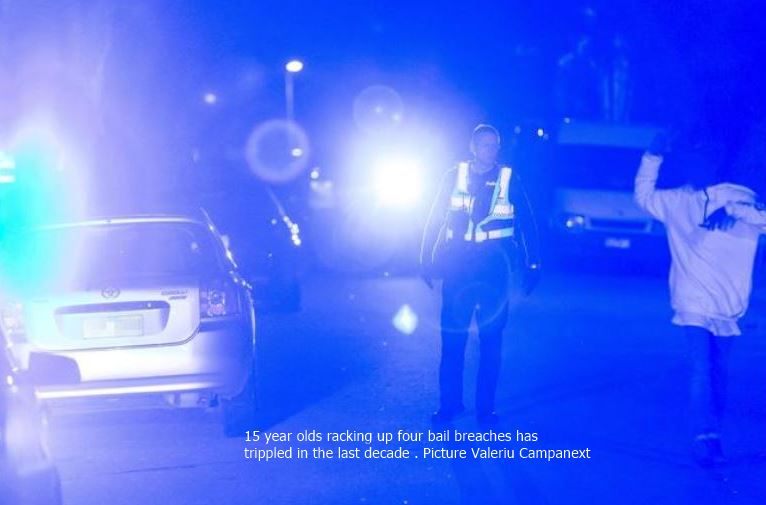
Contrary to Government agency claims, the program’s failure is spectacular by any measure, with 70% of participants reoffending within six months of joining the program.
This scheme, touted as “Labour’s flagship $40m youth crime ‘ fix ‘,” must be thoroughly investigated to ensure there was no criminality involved in the delivery side of the “fix”.
We have regularly seen where projects of Government initiatives have been routinely routed; ‘The Big Build’ and “NDIS” are just two high-profile examples, and inevitably the failure to manage projects is endemic to Governments, so it is not unreasonable to assume that the $40m Youth Fix would be any different because it has something very much in common with the two examples – a failure to deliver – just measured by a different matrix.
But above the sphere of incompetence or criminality is the impact on our youth and the community, more broadly, that these 70% of recidivists wreak.
What the Auditor General has exposed unwittingly is perhaps the answer to the conundrum that those of us interested in juvenile crime have been pondering for years: why has the crime rate among juveniles increased so dramatically?
We have long held the view that the Courts allowing young people to avoid sanctions for committing crime has been a major driver of the current problems. Still, now we find out that the Courts may well be complicit in the mismanagement of young perpetrators by referring them to the Government’s main Youth Crime Prevention Program with the very high prospect of failure and recidivism.
The failure of the Courts was not to ensure that a program touted as the Government’s main initiative was actually fit for purpose.
The ease with which courts seek diversion for young offenders is still a major problem; as the word suggests, they are routinely diverted from taking responsibility for their actions.
Not how Diversion is interpreted by the Courts, but instead, the reality of that approach.
But what to do to solve the problem?
There is no quick fix or magic bullet because the problem is so ingrained in society.
However, the first thing that must happen is that the government’s failed juvenile crime initiative must be cancelled and the funds diverted towards a solution.
Continuing on this failed path would be criminally irresponsible, and Misconduct in Public Office offences must be levelled at those responsible, not only for the project to date but also for anybody failing to cancel this failed initiative.
The Budget allocation for 2026-27 must be reallocated to fixing the problem, not perpetuating it.
To identify the solution, there are two parts: firstly, prevention to avoid young people getting into criminality, and secondly, if they do, then there are unpleasant consequences that will discourage further offending.
The whole management of juveniles must be a reward-and-penalty approach, so they quickly learn criminality has a serious downside.
That is not a ‘lock-em up’ and throw away the key approach but a targeted short-term penalty of incarceration where they can be exposed to a process of reward and punishment. Children do not need long sentences to change, as their world is likely to change a number of times in 12 months, so penalties of weeks in the first instance, with a graduated scale for recidivism, would be more effective.
If that approach needs a ‘root and branch’ review of the juvenile justice system, then that is what is needed, and needed urgently.The key to a review’s success is that it is conducted not by those within the system that needs reviewing; otherwise, the outcome will be predictable, and nothing will change.
Establishing an effective review panel will not be easy, and we will, in due course, address this part of the issue; however, the first and most pressing step is to cancel the current program and withhold any unallocated funds.
Apart from a direct assault on incompetence in this sector, it will send a message to all Government Departments that deficient management of initiatives will not be tolerated.That would release the $5 m budget allocation to go towards a solution.
This must be done as a direct consequence of the finding by the Auditor-General.
“The department (Department of Justice and Community Safety) described it as a ‘proven’ initiative, but its program evaluations have not used any targets or benchmarks to measure what success in reducing youth offending looks like, so it cannot show the program works as intended.”- Auditor-General.
Further, it was reported in the Herald Sun that,
‘The program targets offenders aged 10 to 24 with services such as mentoring, pro-social activities, and intensive case management, which over a dozen community organisations receiving state government grants to deliver.
But the report identified critical accountability gaps, including inconsistent participant eligibility and poor record-keeping by the community organisations receiving grants under the program.
It also criticised the Department of Justice and Community Safety for using skewed data to label the program a success, adding that the department’s success metrics excluded dropouts and custody returns from its reporting.’
The Auditor General should also follow the money trail to see how the funds were spent and ensure that individuals were not lining their pockets. As that would amount to criminality, something the program is supposed to address.
The public at large has had it with the lack of effective action by all authorities in this space, and this may turn out to be the defining issue on how the community intends to elect a Government.
The CAA applauds the Auditor General for his tenacity in exposing this disgraceful blight on the governance of Public money, and we would be pleased to offer any assistance towards a solution.
One tried-and-proven program is to reintroduce police into schools. This initiative was extremely effective in turning young people away from crime; police in schools can make a real difference, and its effectiveness can be easily measured.
We must prioritise prevention and use what is proven to work.

Co-founder and Deputy Chair/CEO of the CAA, a former Police Inspector with 32 years of service in Metro Uniform, Traffic Metro and Highway Patrol, Crime Cars, and CIB. Former Editor of Police Life and long-serving Public Relations Officer of VicPol. Founder and Life Member of the Blue Light Disco movement, Life Member of the Blue Light Federation, and completed his Police career as an Inspector after 6 years as a Patrol Officer. He then ran his own Business for 20 years until retirement. Ivan co-founded the CAA with former Victorian Chief Commissioner Kel Glare, and built the CAA into an influential voice for Victorians.