
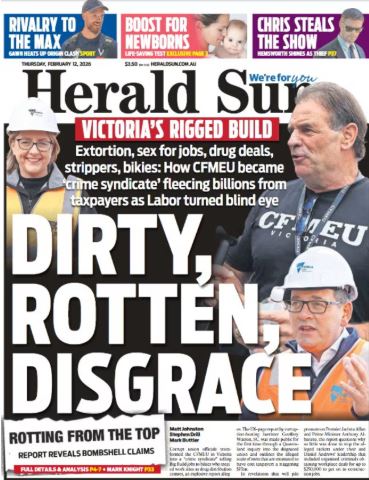
Picture Herald Sun.
It would be reasonable to transpose the issues, with a modern twist, that led to the permanent deregistration of the Builders Labourers Foundation (BLF) in 1986, including the jailing of their Secretary, Norm Gallagher.
The long-standing Secretary of the CFMEU, until recently, John Setka, although jailed in 1990, unlike Gallagher, has not been jailed for his CFMEU activities. That might all change, as he is due to face court in June 2026 on seven charges relating to threatening and abusive emails.
The alleged criminal behaviour of the CFMEU, as reported in the Herald Sun on 12 February 2026 and other publications, when compared to the behaviour of the BLF in the 80’s, makes the BLF seem tame.
As disgraceful and criminal as this alleged behaviour may be, there is a more serious consideration: the need for a “please explain” from the Victorian Government.
After all the reports of bad behaviour, how did this government not act?
All the rhetoric that the politicians may present cannot erase the hard fact that the Government has failed, because they have been ‘once bitten, twice shy’. How irresponsible is it to have this problem resurface?
It now means the Government must not only resolve the CFMEU’s current issues but also undertake the necessary work to ensure that such alleged criminality in the organised union workforce does not recur.
Unfortunately, the Union movement as a whole will have to accept restrictive practices imposed not only because of the CFMEU’s behaviour, but also because this is not the first time Unions have facilitated criminality.
Among the restrictions designed to promote and protect lawful union behaviour will be the need to change the industrial relations landscape across the board.
The Government must accept responsibility for managing Union activity and provide enforceable behavioural and activity-based standards, with breaches subject to swift prosecution, including jail time and fines.
The Fair Work Commission (the National Workplace Relations Tribunal) coordinates its activities through the Australian Council of Trade Unions (ACTU).
The failure of these bodies has clearly been the root cause of and the explosion of alleged criminality within the union movement.
Having the ACTU coordinating the regulations of the Fair Work Commission, along with their State branch affiliates like the Victorian Trades Hall Council (VTHC), not only is cumbersome and likely to be inefficient, but it could be argued that this is like ‘putting a fox in charge of the chook house’; nothing good can come from it.
As unpalatable as it might be politically, the Premier is caught between ‘a rock and a hard place’.
If she doesn’t call a Royal Commission, the Opposition will have a field day as the community will accept nothing less.
If she calls a Royal Commission, the evidence could be politically damaging if made public during the election lead-up. Again, the Opposition can make an issue of this.
There have been four Royal Commissions in Victoria over the last decade, and they are all well-justified and go to addressing serious anomalies; however, we would argue that the impact on Law and Order, the safety of our community, and the cost to the State (us) in the broader impact of the CFMEU issue, has far surpassed previous Commissions.
Key Victorian Royal Commissions (Approx. 2016–2026):
- Royal Commission into Family Violence (2015–2016): Led to major reforms in the state’s approach to domestic violence.
- Royal Commission into the Management of Police Informants (2019–2020): Investigated the use of lawyer Nicola Gobbo as a police informer.
- Royal Commission into Victoria’s Mental Health System (2019–2021): Investigated and made recommendations to overhaul the state’s mental health services.
- Royal Commission into the Casino Operator and Licence (2021): Investigated the suitability of Crown Resorts to hold the Melbourne casino licence.
A Royal Commission is essential to ensure no other entities have been turning a blind eye or otherwise compromised.
Our laws are the cornerstone of our democracy and the freedoms we enjoy, so, as with other serious matters, it is essential that the CFMEU and the broader Building/Construction industries, as well as Unionism more broadly in this State, be addressed.
What cannot be expressed strongly enough is that the alleged unlawful behaviours of the CFMEU and other players, not yet identified, constitute serious organised crime, and that the adverse impact on all of us, as crime stretches its tentacles, goes far beyond the Building Industry. The Industry is just the epicentre.
The solution is to equip IBAC, as our anti-corruption body, with the resources and expertise to be effective, something that they are now not.
The Community Advocacy Alliance (CAA) is funded by the members and the generous donations from the public. Please consider donating to help us continue to work for you. Simply click on the button below. Thank you - your generosity is very much appreciated.

Has any member, including Victorian Ministers, the courage to stand up and challenge the premier, or at least pose meaningful questions in the public domain?? No – They don’t want to risk their cabinet posting. Has her leadership been challenged by anyone?? Are the Cabinet members as rotten as she is?? Has any matter been referred to Police?? Apart from some hand wringing and occasional chest beating we have heard very little from the Victorian Opposition and nothing from the cabinet. I grew up in a democracy which, it seems has now been usurped by a dictatorship led by a Teflon coated Dictator. She seems to have a tight rein on her cabinet members (as any decent dictator would have)
I and most others, all know that this government, especially the premier, will put all sort of spin and blame on everyone except themselves and come election all will be forgotten and forgiven and they will somehow be back in power. I feel for my grandkids as they are the ones that will eventually wear the brunt of their incompetence and dare I say it, dishonesty.
I have read numerous rhetoric by the opposition concerning a Royal Commission into CFMEU corruption, if elected, and yet have not heard or read 1 single comment about holding the Labor regime to account for their involvement in this corruption. Noone is above the law but time and time again we see Politicians exempted from scrutiny, let alone punishment. This cancer in Victoria will never be addressed until politicians are held to account. The terms of reference for a Royal Commission must be clear, impactful and not restricted to one party of the conspiracy.