
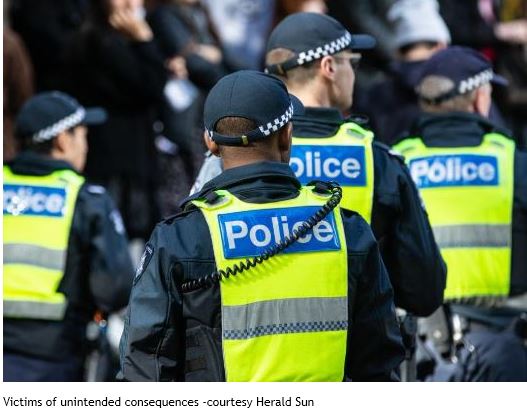
Industrial relations between the Force and its Police employees are currently facing a significant crisis, but an even greater problem is heading down the rails towards them.
When it arrives, it will have devastating consequences, particularly impacting the Victorian diaspora.
We are referring to,
- The concept of employees working from home being legislated.
- The significant number of Migrants, with many from countries where the rule of law either does not apply or is only marginal.
- The continuing erosion of the legislated Powers for Police to do their work, driven by ideology.
- The lack of support from the judiciary. This is particularly so in relation to Bail processes, and again, ideologically driven.
- and the Inefficiency of the Court System penalising both the police and the victims.
Coupled with the industrial landscape, the Force now finds itself on a collision course of these factors, and the consequences do not bear thinking about.
The mass exodus of 450 Police, accepting a sick leave payout deal, was reported in the Herald Sun on the 22nd of February 2026.
‘How a Victoria Police sick leave deal triggered a mass exodus from the force’. – HS Headline.
The deal that expired on the 31st of December 2025 is the key to aggravating an already dire staffing problem that is having a devastating impact on Force members.
As if what the police who are left are dealing with isn’t enough, gross negligence will only exacerbate the situation and lead to an increased rush out the door.
What we don’t know is who is responsible for creating this crisis.
- Is it the Government?
- The Police Association or
- The then Police administration negotiating the EBA?
An independent inquiry into this fiasco is urgently required to apportion blame and provide guidance on how the Force can address this staffing disaster.
Did they not see the unintended consequences of the impact this would have on the rest of the Force by this Enterprise Bargaining agreement?
Or was this some sleight of hand or skulduggery whereby the Government moved unrealised liabilities to another part of the ledger, so that paying out the Police members with the Sick Leave sugar hit, the Government achieved immediate savings on salaries?
The average pay grade for a Police member, including allowances, is over $100k per annum. When you consider other employment liabilities and costs, the 450 members who were attracted to the Sugar hit, in real numbers, translates into half a Billion Dollars off the government’s budget bottom line. We already know that it will take perhaps a decade to bring the numbers back up.
All the while, the Government wallows in the knowledge that they are saving a bomb for the entire forward estimates and paying homage to those who see defunding the Force as a legitimate cause.
Based on current estimates, it will take 6.25 years just to replace those lost due to the EBA. And that does not take into account any other adverse staffing hits incurred through to 2032 just to bring the Force back up to 2025 levels. The risk factors are insurmountable; in the current environment, it just won’t happen.
As Darryl Kerrigan would say, “ Tell ’em they’re dreaming”
Although the community inevitably suffers when the numbers in the Force drop to the point where one in 11 police vacancies are unfilled, what is not spoken about is the devastating impact on the remaining members trying to hold the Force up.
This latest double whammy has a two-pronged impact.
Firstly, it is undeniable that losing experienced Officers is counterproductive, but the pressure placed on the remaining staff will only lead to increased sick leave and resignations.
Police across the State already work a disproportionate number of after-hours shifts. Still, this latest blow will increase the frequency of Night Shift and other shifts that are less conducive to their lifestyle and family, putting greater negative pressure on them not to continue their careers.
We do not begrudge the members being paid out; the question is how, in such a difficult staffing climate, this payout was allowed to be so mismanaged, rather than a phased approach over a number of years and more closely managed.
Somebody has failed, and we need to know who the culprits are.
Then, to top things off, we have a more significant crisis heading our way that seems to be completely overlooked, and we see no strategies in place to deal with it.
Yes, the ubiquitous Working From Home (WFH) monster is heading for the Force (and all other emergency services) at breakneck speed, with legislation touted to be introduced before the Elections in November for a legislated two-day WFH right for State workers.
Yes, it does have some wishy-washy qualifier, an if, but how long that if will last is anybody’s guess, but in the norm for Industrial relations issues, the shoe is in the door.
There has been a lot of publicity about how employees who work from home can save money, but that is insulting to those who have the ‘if’ applied to them without compensation.
Police are already under huge stress due to the routing of the Force’s strength.
When the WFH train hits, problems will multiply, and the exodus will continue and accelerate alarmingly as members burn out more quickly, aggravating staffing shortfalls.
Why would anybody work godforsaken shifts to be spat on and cursed, be expected to deal day in and day out with the scum of our society, with a workload that is increasing exponentially while the workforce declines by the same matrix?
How fair is it that these people, who put their social lives in limbo, their safety on the line, and are increasingly being called on to deal with the worst that society has to offer, be any less deserving of the financial windfalls than other State employees who enjoy WFH?
The whole WFH debate lacks one imperative: productivity.
How is an employee’s productivity measured when they WFH?
There is no doubt that some WFH individuals are diligent, but many others may go through the motions without proper supervision.
Anecdotally, we are advised that traffic on Golf Courses has increased dramatically in recent times, as has dog walking, and that car parks at gyms are full during the traditional working week. You have also probably noticed a substantial increase in Lycra-clad treadlies on our scenic roads.
Productivity, accountability, and satisfactory levels of employee performance and effectiveness, compared to the salaries they attract, have not been included or even discussed. The example of individuals doing the big circuit for months at a time or answering their phone while on the beach will continue to rort the system.
Then think of the poor Police, who are again the brunt of this mismanagement, with the consequences seemingly evaded.
Our new Chief Commissioner has shown strong leadership, being clear-eyed about the issues. However, his role is being stymied by other pressures not of his making that will have far-reaching, deleterious impacts on the Force; impacts that even he may not be able to manage.
We definitely need a Royal Commission into this whole issue of police staffing and allied impacts so that proper planning to address the issues can be determined, as equally important as who or what entity is responsible for this mess and how they will be held to account.
It will be argued that a Royal Commission would be too expensive. Still, that expense pales into insignificance compared with the impact of the Government’s mismanagement of the Force in recent decades, which continues unabated.
But what can be done?
A review of the Force’s training would be one answer.
The media claim of 77 additional recruits per year is a drop in the bucket that will evaporate before having any impact, so radical approaches must be explored.
With the WFH edicts, the Government must have redundant buildings, as maintaining an exclusive workstation or office for WFH employees is nonsensical, so rationalisation is imperative.
This would free up additional resources to accommodate a vast quantitative expansion of training.
The resources for conducting the training can be drawn from members who need some reprieve from the frontline, a sabbatical, and/or members who can be encouraged to return to the Force in a training capacity.
Rather than the current approach to Police ongoing training needs, which currently favours online training of operational members, they can be trained at a new facility in a matter of weeks, rather than the months it takes for online training.
Shorter periods of focused classroom training will be more effective and have added benefits over the online model, which proponents argue is more efficient, but that is at the expense of effectiveness.
Classroom training advantages give the members a break from the frontline, exposing them to peers and enabling proactive assessment of their psychological status rather than waiting for the dreaded PTSI to strike, making them incapable of performing.
As far as recruits go, that number can be increased threefold by the first part of their training at the Academy, followed by the bulk of their training off campus at
another training facility, returning to the Academy for the last four weeks and graduation.
This approach will also avoid the need to reduce recruits’ training time to accommodate larger numbers, which may well be a false economy. Training is critical to the organisation’s effective capability and should attract greater focus.
It will be the Police administration’s ability to think outside the square to address staffing problems that makes a difference.
Many other initiatives will alleviate the issue; our Police members deserve something better.
The whole concept of encouraging retired police back to alleviate pressure on the existing force must be rethought so that the numbers returning are substantial, which may include removing the time barriers after leaving the force, as it is the quality and suitability of the returning applicant to perform the tasks on offer, not some arbitrary date, that should be the primary consideration.
The arbitrary date methodology is an antiquated approach from a bygone era. Matching the applicant to a task approach is more current in staff appreciation.
Is there a need for an inquiry? Yes.
The Community Advocacy Alliance (CAA) is funded by the members and the generous donations from the public. Please consider donating to help us continue to work for you. Simply click on the button below. Thank you - your generosity is very much appreciated.

APOLOGIES TO A. B. PATERSON
There is movement at the stations for the word has got around
that the politicians have reneged again.
Like their promise at election, no more members have been found
and no‑one will say if, or how, or when.
The Association members, all the general rank and file
are sick and tired of nothing being done
and the sound of one hand clapping just increased the member’s bile
when the gag was clamped up high by Number One.
There was bitterness, and protest by the members right across
the state at such a blatant cutting stroke,
but this is not surprising when you calculate the gross
results of Labour’s terms is just a joke.
There’s a feeling in the members of “Why is it still this way?”,
though the will is there to help and care and serve.
Still, the ancient Greek who wrote this must have meant it for today ‑
“You will end up with the Law which you deserve”.
Tallk about the issues outside, face discipline.. Issues bounce around an echo chamber of those that create it, who are so far removed, historically poor performers that know how to manipulate the promotion system.. they get there and want a trouble free wfh life. Good for me but not for thee.
A Royal Commission would take too long, cost too much, and likely be hobbled or largely ignored by the present Government. VicPol has many serious problems right now, and they do not have a quick fix. The powers and delays of a RC are not needed when so many VicPol members at all ranks, and many citizens, can readily point to areas that need to be fixed – and in most cases how that could be done. A small panel of multi-talented experts, not motivated by ideology, nor by undue greed, nor harnessed by nepotism, would be suitable to “quickly” produce a very usable report. To call for a RC is to play into the hands of the meddling Government and inept Bureaucracy that supervised achievement of the present disgrace. Ultimately, VicPol corporate design and position incumbents will need an overhaul. Similarly, Government will need to drop their pursuit of ideology to recognise reality and to sincerely review and recondition the Justice system to efficiently provide the community with certain security.