
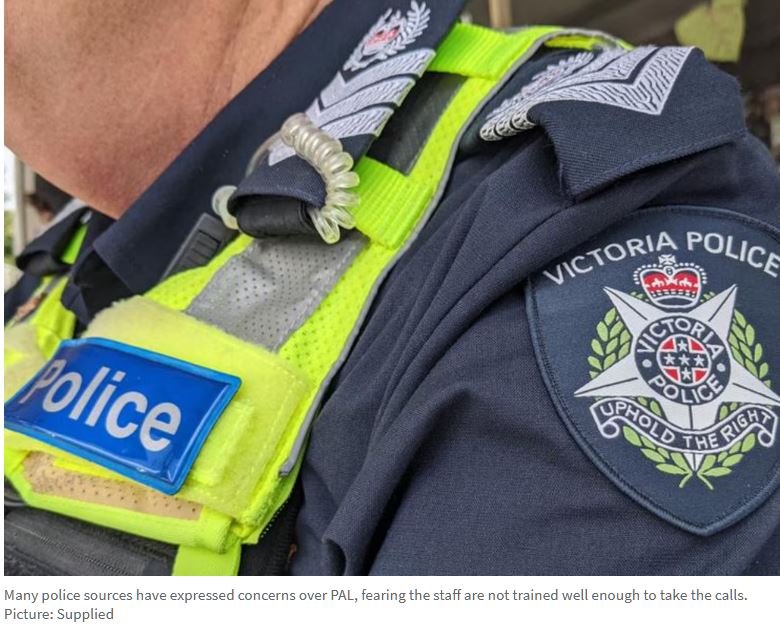
An article by journalist Justin Smith in The Herald Sun, 2nd of March 2026, exposes the failure of the Police Advice Line (PAL) and prompts memories of retired police involved at the management level in the introduction of 11444 in the 1980’s -1990’s.
It also exposes the inability, often referred to by the CAA in the Force, to understand Service Delivery or Service efficiency concepts accurately.
The CAA has been amazed at the lack of understanding of the concepts and their application by executive Police, let alone lower but still senior people.
This lack of understanding is embarrassing for the Force, where changes intended to improve Service Delivery are blatantly Service Efficiency masquerading as Service Delivery, as Smith has exposed in this instance.
The PAL does not do what it is purported to do; it is a failure. All the claims about saving Police time may be efficient if the Service is still delivered, but that is clearly not the case.
In the kindest interpretation, all the claims about why the public should use the PAL are blatantly misleading.
When you ring 131444, you will not get Police advice; you will be connected to a console operator who will refer you elsewhere. With all the good training and intent, they are not the Police and cannot, and should not, be touted as providing advice and taking crime reports, etc.
That is the role of sworn police, and, surprisingly, the Police Association is not more vocal in protecting the Police profession.
It is a classic example of service delivery and service efficiency failure when someone with good intent rings the number and a crime report is taken, or advice is given by a non-police operator.
Any wonder that the pride in policing is waning when, as a noble and specialist profession in society, it has been relegated to a job anybody can do.
The community is entitled to be aggrieved when they thought they were talking to a police member, and trust and confidentiality are blown away when they discover that they were not talking to a police person after all.
Taking the example of a theft being reported via 131444, firstly, the person taking the report has no policing skills or experience and can only tick boxes, so that when the file is forwarded to a Police Station for investigation, the member who is allocated the crime must start from scratch, making the report taken redundant.
The problems with this process are,
- That the attending member must start from scratch again makes the claims of efficiency false,
- The savings alleged in Police time are nonsense if work has to be repeated, just duplication at another place.
- Time-critical intelligence may not be obvious to call takers and may be lost to the investigator when the report makes it to the attending member from the 131444 operators.
- While there are delays in getting the report to the appropriate Police for attention, the crook may escape, or a crime scene may be decimated or compromised.
- Local knowledge of crime trends is not apparent to console operators, and what may seem an innocuous crime of itself may be critical to a wider investigation. This can only be identified by police with current local knowledge of crime trends.
So, for all the money expended on the PAL line, it is neither efficient nor provides even minimal service delivery, but does produce false efficiency figures, as Jason Smith’s report highlights.
Although it is claimed that the PAL was introduced in 2019, it was preceded by Police Advice Line 11444, which retired Police members of the CAA were involved in at the management level.
- The Courier (Ballarat)reported (Feb 14–15, 2019) that in the 1980s–1990s Victorians used 11 444 (Police), and that Telstra had decommissioned those numbers by 2002.
And why was 11444 selected as the PAL number? The telco at the time researched the most easily recalled numbers and found that 11444 was the most easily recalled number, and in particular, it was suitable for people using it in stressful situations because of the proximity of the numbers on a keypad.
The original 11444 was manned by sworn Police and seen at the time as essential for the effectiveness of the service.
It is interesting to understand the mindset of the creators of the launch of PAL (mark 2) in 2019; that the number change by the inclusion of a 3, meant that calls to the police were charged to the caller, not the police, as was the case with 11444. And then a large amount of money had to be spent promoting the alleged new service number; questionable economics writ large.
It does seem the changes wrought were an example of fixing something that was not broken.
Having said all that, and what has been written over the years about the PAL line, much of it now exposed by Smith as propaganda, a very exhaustive search of the Internet has failed to identify one critical aspect of this sorry tale.
Without reviewing, how can management understand whether a project is performing well?
Failure to measure the effectiveness of the service from the end users’ perspective (who it was designed to benefit) is or should have been designed /undertaken into the service before the new contracts were agreed to. An embarrassing ‘faux pas’.
The solution may be painful initially, but the only way to resolve the issue is to automate the exchange so that all incoming calls to 131444 are directed to the nearest open Police Station.
It would be up to the Station Commanders to ensure the service is delivered at the lowest possible levels, a philosophy in modern management and currently embraced by Force Command. Decisions closer to the function.
Supervision, accountability and training at that level will ensure the calls are answered and actioned promptly and properly.
To achieve the resources necessary to implement this initiative, broadening the recruitment of former members on a part-time basis would be an obvious solution.
Even some ex-members who have retired and are medically unfit for general duties should not be ignored, but, subject to medical assessment, may perform this duty and benefit from regaining a sense of purpose in life.
This is not a matter of apportioning blame for the failure of PAL, as that is pointless, but advancing a solution as to how the situation can be rectified.
And it all starts with proper evaluation of performance, not from an efficiency perspective alone, but for the function or service delivered to the community.
The introduction of effective Key Performance Indicators (KPI) give management at all levels the ability to ensure Police output achieves its purpose.
Footnote:
After completing this article and explaining it to my local Hot Bread girl, who was interested in knowing what I did in my retirement, she related a very disturbing story.
She had occasion to notice a car apparently dumped near her home, so she rang 131444 to report the vehicle. As she saw it her civic duty. The operator who took the call claimed the car wasn’t stolen, and nothing could be done. Later, she had the local police knocking on her door, telling her the car was stolen and asking if she had seen anything or any other person from the vehicle.
She was most distressed when she was told that the person who took the original call was most probably not a police officer.
As she said, “I could have told that non-police person anything, and God knows what they would have done with the information”.
“I have decided never to ring again, as they can’t even sort out whether a car is stolen or not”.
How many times has this happened?
The Community Advocacy Alliance (CAA) is funded by the members and the generous donations from the public. Please consider donating to help us continue to work for you. Simply click on the button below. Thank you - your generosity is very much appreciated.

The PAL and online reporting has so much possibility and opportunity to deliver efficient and reliable reporting methods for the public which frees up police from taking reports. The model running in QLD is the gold standard and should have been adopted by Vicpol, who actually did evaluations on this very model.
The QLD model has all calls to police stations running via their PAL equivalent and is manned by ex members and suitably trained VPS equivalent meaning the public gets appropriate and timely advice by a qualified person and reports are subtitled to a high quality.
However Vicpol cheaped out and PAL takes inadequate reports or just transfers the call to the local police station anyway meaning there is little to no time saving or efficiency for frontline police and as stated in this article, the assigned investigator needs to start from scratch when allocated a file for investigation.
A wholesale rebuild needs to occur in line with the organisational review to ensure PAL has full capabilities to provide the public with the appropriate advice and reporting abilities so that frontline members can focus on patrol and proactive policing rather than data collection and report creation.
Great article
Just more structured spin and BS from this corrupt government and their incompetent cronies.
Crime prevention detection and investigation is the role of our police…not some casual console operator.
It’s a pity Allen and co don’t spend as much resources on proper policing rather than avoiding proper service provision. Just look at what they’ve done to the CFA as well.
I assume all government buildings no longer have the king’s portrait?
Maybe they have portraits of mick Gatto?…given their funding loops and ms Allen’s connection domestically with the CFMEU.
My local member in Ballarat….michaelia settle.. signs all official corro with the Aboriginal flag and the Islander flag. No Australia flag or Victoria flag…yet she sits in the Vic parliament…sums them up. Just look at their resumes. All in via branch stacking.
The sooner these people are gone the better.
The sooner the police are properly staffed and the nonsense co agencies are gone and the courts are reformed..then we can start reducing crime again.
The state is bankrupt run down corrupted and chronically unsafe.
PUT LABOR LAST..no votes no preferences no seats!
Well said Terry!
I have totally given up calling Vicpol as the system in this state is beyond a joke. Vicpol needs to seriously start looking at how other states conduct business. Last time I called the PAL I was diverted to 000, so the I had to go through the passage of information again. Then I get a call from the police station with them sooking I used 000. Told the Vicpol member it was PAL who transferred me to 000.
Very cheaply organised system by the Vic Govt and they should be ashamed of themselves.