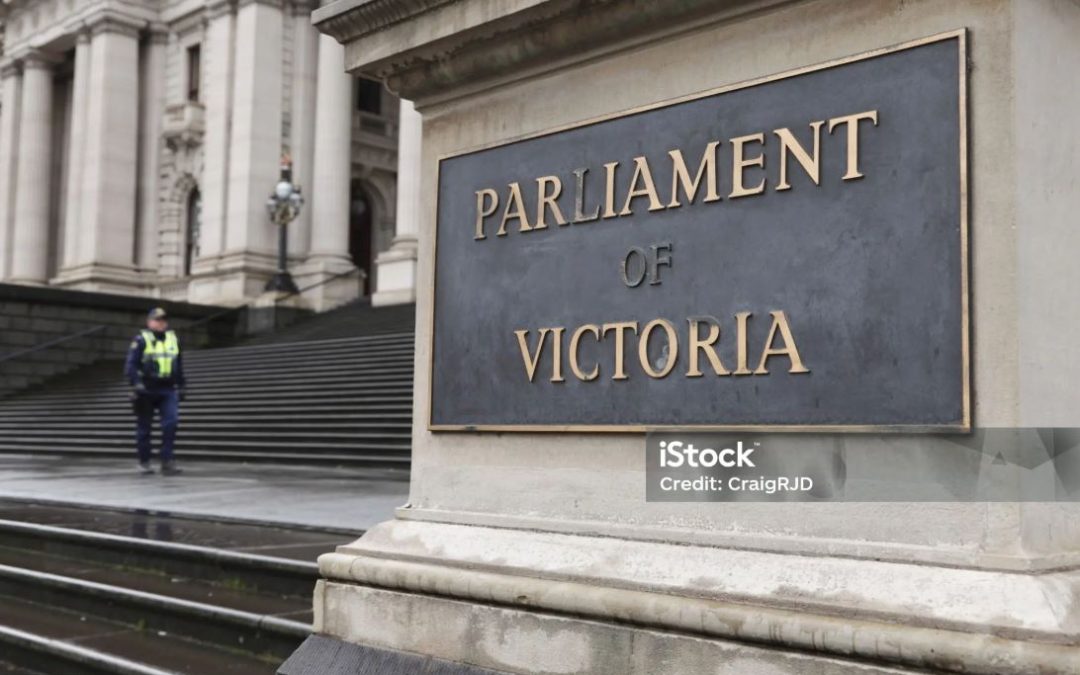
The Herald Sun 13/08/2026 carries an article headed, “PSOs TO PATROL SHOPS” and reports that the Premier directs that PSOs will blitz crime-ridden shopping centres.
The Police Act 2013 is specific relating to the deployment of Police and PSOs.
Under Division 2 – Relationship with government, Section 10, Ministerial directions:
(1) The Minister may from time to time, after consulting the Chief Commissioner, give written directions to the Chief Commissioner in relation to the policy and priorities to be pursued in the performance of the functions of Victoria Police.
(2) Subject to subsection (3), a direction under subsection (1) cannot be given in relation to any of the following matters—(f) the allocation or deployment of police officers or protective services officers to or at particular locations;
Clearly, the Premier has ignored the Police Act and usurped the prerogative of the Chief Commissioner (CCP) to allocate operational police and PSOs.
The Act, unfortunately, had unintended consequences when it requires the CCP to follow directions as to policy which is interpreted as permitting Governments to interfere with personnel allocations, despite the specific prohibition of this in Section 10.
None of the requirements of Sub-section 3 is applicable.
A classic example of the folly of such a power to order the deployment of police by Government is when the Andrews Government, during the COVID Pandemic, ordered a “Ring of Steel” be imposed to curb people’s ability to travel and required Police to enforce this edict when effectively it was a direction impossible to effectively implement.
The politicisation of the Victoria Police that has occurred over the past decades must be curtailed if we are to have a Force that acts without fear or favour.
The allocation of police resources must be at the sole discretion of the Chief Commissioner.
Authur Kelvin (Kel) Glare AO APM, on behalf of the CAA, is Co-founder and Chair, a former Chief Commissioner of Victoria Police with over 35 years of service in uniform, as a fingerprint technician and expert, as a Police Prosecutor, OIC and creator of the Pollice Prosecutions Division, Divisional Inspector, first Assistant Commissioner of the then Internal Investigations Department, Assistant and Deputy Commissioner, Operations and CCP from 1987 to 1992. Kel has an Honours Degree in Law from the University of Melbourne and was Admitted to Practise as a Barrister and Solicitor in 1977. On retirement, for seven years, Kel was Executive Director of a leading Security Company conducting both national and international investigations. Kel remains committed to helping others who need a voice.
The recent decision of the Victorian Court of Appeal to ignore imposing the mandatory term of imprisonment on two offenders who violently assaulted a Paramedic highlights the need for a higher level of accountability for judicial officers.
The counter argument that there can always be an appeal against sentences imposed, or not imposed, is disingenuous as many considerations kerb that course of action, including the cost of a further appeal.
The real issue is the lack of real accountability of the judiciary. Judicial officials must reflect the sentencing regime of a democratically elected Parliament that sets parameters for available sentences.
Murder, where a convicted offender may receive a life sentence, rarely with more than a lenient minimum term to be served, is the only occasion where a maximum sentence is sometimes imposed. We challenge anyone to identify any other case in the past twenty five years in Victoria that attracted the maximum sentence, despite the often long criminal history of the offender. Courts consistently and persistently thumb their collective noses at Parliament’s wishes. How many convictions must an offender have before a maximum sentence is imposed?
How can this wonton disregard of our elected Parliaments be tolerated? This continued behaviour is a systemic abuse of the separation of powers and is contempt of our Parliament.
The path to a solution must be to make judicial officials at all levels of courts accountable for their actions. This can be achieved through a Judicial Committee established on bipartisan lines that would inter alia require that those presiding in courts do more to meet community expectations. Those officiating who do not should be called to account.
A necessary corollary is that the appointment of judicial officials must be by contract so that those who act as a law unto themselves can have their services terminated at the end of a contract period.
In the United States many judges are elected officials. If community standards are not met they are most unlikely to be re-elected. We do not advocate this for Victoria but greater accountability must be achieved if the general populace is to continue to respect our courts.
Authur Kelvin (Kel) Glare AO APM, on behalf of the CAA, is Co-founder and Chair, a former Chief Commissioner of Victoria Police with over 35 years of service in uniform, as a fingerprint technician and expert, as a Police Prosecutor, OIC and creator of the Pollice Prosecutions Division, Divisional Inspector, first Assistant Commissioner of the then Internal Investigations Department, Assistant and Deputy Commissioner, Operations and CCP from 1987 to 1992. Kel has an Honours Degree in Law from the University of Melbourne and was Admitted to Practise as a Barrister and Solicitor in 1977. On retirement, for seven years, Kel was Executive Director of a leading Security Company conducting both national and international investigations. Kel remains committed to helping others who need a voice.
To provide the best experiences, we use technologies like cookies to store and/or access device information. Consenting to these technologies will allow us to process data such as browsing behavior or unique IDs on this site. Not consenting or withdrawing consent, may adversely affect certain features and functions.
Functional
Always active
The technical storage or access is strictly necessary for the legitimate purpose of enabling the use of a specific service explicitly requested by the subscriber or user, or for the sole purpose of carrying out the transmission of a communication over an electronic communications network.
Preferences
The technical storage or access is necessary for the legitimate purpose of storing preferences that are not requested by the subscriber or user.
Statistics
The technical storage or access that is used exclusively for statistical purposes.The technical storage or access that is used exclusively for anonymous statistical purposes. Without a subpoena, voluntary compliance on the part of your Internet Service Provider, or additional records from a third party, information stored or retrieved for this purpose alone cannot usually be used to identify you.
Marketing
The technical storage or access is required to create user profiles to send advertising, or to track the user on a website or across several websites for similar marketing purposes.