
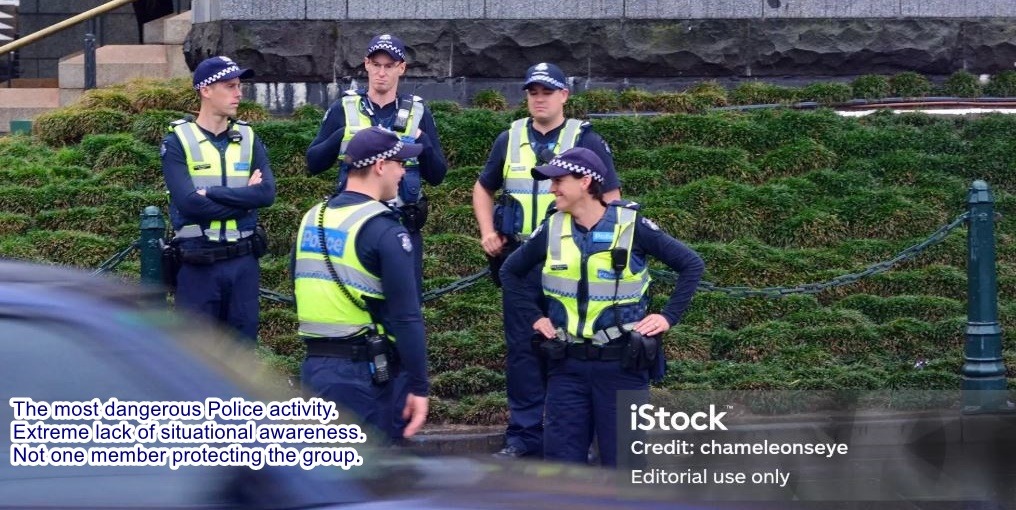
All Police work can be dangerous; every police member knows that, and denial would be inane. However, the risk must be considered in a historical context, and the murder of Police in Victoria is historically low. We categorically believe that any death of a Police member is one death too many, but we need to deal with the reality. Unfortunately, the Police Honour Roll is very short on detail, and we have to rely on estimates to determine the actual impact on Police members. What we can say for certain is that since 1853, there have only been 178 members who are recorded as losing their lives in the line of duty during those 173 years, and of those, there is a relatively small number who have died at the hands of a Felon. Best estimates have the number in the lower tens, rather than the hundreds. Motor vehicle crashes were the largest contributor to Police deaths. When it comes to Police on one-up patrols resulting in a member’s death, we could only identify 1 since 2000; therefore, most deaths have occurred when multiple members are involved in an incident. 17 Victoria Police members have been added to the Honour Roll for line-of-duty deaths from 2000 to 2025; of those, only 7 involved deliberate criminal acts. So that tells us where the danger lies, and it is not in one-up patrols. Having worked in traffic for a period during my career, I spent time in Metro Melbourne, predominantly two-up and occasionally one-up, without issue. I then spent time on the Hume Highway working out of Seymour, always one up. The closest police assistance was often 30 minutes or more away.
As an example, I was working the Goulbourn Valley Highway near Murchison East one-up when a call came through from Shepparton reporting two offenders leaving a scene with stolen property in two separate stolen cars, heading for Seymour along the Goulbourn Valley Highway.
I parked the Police car out of sight and waited.
Sure enough, the first car described went past, and the second car came past some five minutes later.
I advised Seymour by radio, took off, intercepted the second car, handcuffed the perpetrator without conversation to the steering wheel through the quarter vent, and took off after the first car.
I intercepted the first car quite a few kilometres down the road near Nagambie. I was able to convince him to comply while we waited for the Seymour Van, which took nearly 30 minutes to reach me.
With that crook secured, I retrieved the second one and my handcuffs.
It wasn’t until both crooks were safely in the Seymour Station that the crook in the first car admitted that, when I pulled him up, he had been waiting for the second car to arrive, hoping that the two of them would then effect an escape at my expense.
That I didn’t tell the crook in the first car I had already secured his mate saved my bacon; experience tells.
Later in my career, I worked one-up as a Patrol Officer in Melbourne, a circumstance I preferred, as working two-up always, in my view, increased the risk of getting distracted. The key to working safely as a Police member is not the number of colleagues you have around you, but your own survival skills, and that is predominantly ‘Situational Awareness.’ There used to be a strong emphasis on this skill at all levels of training, as it is an essential policing tool. Police graduates from training were assigned to Police Headquarters and were detailed for one-up foot patrols of the city. An invaluable learning experience for survival in a dangerous occupation. Unfortunately, many of the basic Policing skills seem to have been lost. Notably, we regularly see Police in the operational sphere in multiples, with their focus inward rather than on the environment they’re in, and that is dangerous, whether they are two-up or 10-up. The more Police that are grouped together, the bigger the target. It is clearly a lack of training and/or ineffective supervision that has been allowed to evolve in policing, making policing more dangerous. When you look at the hard numbers and compare them to the vast increases in the population and an apparent ‘laissez-faire’ approach as to who enters the country, police deaths are remarkably and thankfully rare. The voices opposing Chief Commissioner Mike Bush’s move to introduce one-up patrols are from the usual suspects trying to usurp the Chief Commissioner, as is the trend among naysayers and knockers. None of their criticism is based on empirical data. Their bleating is more about trying to exercise power over him than about looking seriously at the issues in a pragmatic way, something they are highly unlikely to succeed in, as they continue to underestimate the man. They are aggrieved that we have a Chief Commissioner who is a leader, not a head bobber. The decision is neither brash nor reckless, and what a Coroner may have determined many years ago. According to available research, the coroner was scathing of the Police Command about leaving in service a faulty holster, susceptible to gun grab, when they were aware of the issue. The problem with the police-issued holster was its gun retention ability. However, we were unable to find any reference in the public domain to the issue of one-up patrols in the Coroner’s findings. The CAA encourages the Chief Commissioner to continue with this pilot scheme and acknowledges that not all Police members would be comfortable working alone, with nobody to talk to, let alone any safety aspect. The opt-in of the one-up proposal recognises this and will allay any fears members may have. With this opt-in rider, the Police Association doesn’t have a role to play in this matter; it is up to each member. We encourage the Force to review its training and ensure that ‘Situational Awareness’ and other survival skills receive priority not only for frontline members but also in evaluating members for promotion to supervisory ranks, thereby saving police lives.

Of the 33years I was in Vicpol, 11,was in the TOG/TMU, metro and country. Shifts were predominantly one up, unless it was NS or an afternoon shift in the metro region.
In the country, even afternoon shifts were often one up.
I was always careful, picking when and where I could safely interact with traffic offenders. Safety was always on my mind but it never stopped me doing my job effectively.
What I found particularly dangerous was being sent to a domestic whilst riding the solo, with no back up whatsoever. A solo doesn’t afford you the ability of any form of protection and the bike is not an easy vehicle to escape from a dangerous situation upon. There is no car to take shelter in. You are absolutely exposed. But what can you do, you have to attend the job regardless.
Girls are different now and I believe the members on the road face far more serious threats. Community attitudes towards our members has shifted. I personally would not like to be performing one up patrols in this day and age.
I do believe one up work is appropriate in some policing situations. Sheriff’s officers worked one up for years unarmed as did warrants and file police calls.
However…. Mental awareness and physical abilities are crucial.
It is undoubtedly a more violent Victoria than we have ever seen..more edged weapons ..more disregard for law and the police. Misuse of police during covid hasn’t helped. My nephew is a member at Shepparton. I wonder how comfortable I feel with him working one up…but I’ve known him all his life…he’s sensible ..switched on and respects his limitations. With recruitment policies …how many members actually are capable of working one up??
I think this may be a classic case of both sides being right….but some one up policing should occur in the right environments and areas of policing.
Mr Bush is trying hard. He’s earning respect….he’s earned mine …. He may be the best commissioner we’ve had since comry…who followed other great ones.
I think the naysayers should raise their concerns..work though them and trial his ideas in appropriate areas.
I worry more about violence in Victoria now than I ever have in my life. Thanks to Labor…. I worry about our police..the risks they face and the interruption to public support caused by their politicisation.
But…they are our coppers..and they have always been the thin blue line protecting us.
Way back on 29th June 1988 I was involved in a fatal traffic stop with an offender who was enroute to rob his 6th bank in country Victoria. He became known as the “Country Bandit’ I was armed with just my ’38 revolver, which he removed from my person, and the small rubberised baton that we carried. Nothing else. I won the day due to my high level of physical firness. He was shot dead by me. With the weaponary available to police members today I would go back to one up patrols in a heartbeat
I worked one up traffic patrols all over most of Victoria for 30 plus years and had very few problems. One up tends to make you more aware of your surroundings and I always advised the appropriate D24 of the intercept with location and vehicle details. I found that when I did work two up that there were more violent incidents as I think the tendency was to be more hands on or forceful where as I have been known to walk away from vehicle interceptions when on my own if the situation looked like getting out of control. Many members in my my units preferred one up and those who didn’t were accommodated.
One-up policing was and is inherently dangerous. Vehicle intercepts, domestics, armed and multiple offenders should never be attended one-up. I can think of several occasions where the only reason I lived was due to decades of martial arts experience. Twenty-six years of my thirty-one-year career were spent in remote country areas. There is not a single military unit that operates one-up and police should not either.
As a current serving officer of 30 years who has spent 90% of his career in the West and worked 1 up shifts as 251 and others, it is a shame that retired Insp Ray has concentrated his article in a very narrow perspective. Although I agree current training is poor, ret Insp Ray fails to grasp the inherent increases in danger to police members in the current period. With no consequences in punishment to offenders and no deterrences attitudes have changed. Why not take on a cop, nothing will happen. But it isn’t just a risk of death as this article points out, risk of permanent or serious injury should also be a consideration, remember we are now not deemed employees by our own government so excluded from compensation. Let’s also remember, arsons, serious knife crime and shooting at buildings didn’t happen every night in Victoria but do now. Not to mention the rise and rise of Sovereign Citizens either. Unfortunately when you step out of an organisation it is hard to stay current, just because things were a certain way when you retire doesn’t mean they are the same now.
Jason, thank you for your service and input. I. Could not cope with what we expect of Police today. We are going through a period of no consequences for action. This comes from the family unit where a parent can no longer smack a child or inflict punishment. No consequences at home so why should it be any different at home. Reaching the age of 20 I was kicked unconscious twice. I hated working alone although I did so often 5 yrs in MTS and TOG and as a Supervising Sergeant. In my experience with MTS and TOG members who wanted to work alone often had an ulterior motive engaging in extra curricular activities outside of Policing.
100% correct. Rose coloured glasses were used for the writing of this article
I do not understand that initially or police force admitted their number was dangerously low. No matter how much they advertised they couldn’t fill vacancies. Then they have attempted to recall retired members and retained police. There is in my mind an admission in these acts that they are understaffed and this shift to one up patrols is a last ditch attempt and filling the cracks. It’s not acceptable to send police officers out one up. Police officers have only their video evidence from their body cam to back them up. A single camera and multiple offenders leaves them open to allegations when much of what’s going on around the scene is not recorded. A criminal is much more likely to have a go if the officer ifs one up especially if he is substance affected or has mental health problems. Another aspect is that a police officer will find it more difficult to de escalate having only one option available at a time. At present one officer in a critical situation might have a taser whilst the other has a gun drawn. I would think that you will find a slower more appropriate de escalation well be compromised one up. I have heard that field interviews are being held more often and alarmingly for indictable offences. This really does smack of keeping cops out of the station even when they need to be back doing the interviews in a safe environment. Im afraid this its a management ploy to solve inadequate staffing levels and its been created to fool the public and it will place our officers in danger. It will inevitably end up forcing more experienced officers out the door when the casualties mount. The thing about statistics are they are a record of what has been recorded whilst there was respect in the community. With the onset of drugs and the increase of family violence attendance and mental health overflow we face a different forecasted figure. I was on the can for 18 years and I have done some one up duties. Do not let your police officers down by agreeing to let them go one up, it’s like taking someone on with one hand tied behind your back. A one person take down is a lot more difficult and dangerous than a two man take down.