
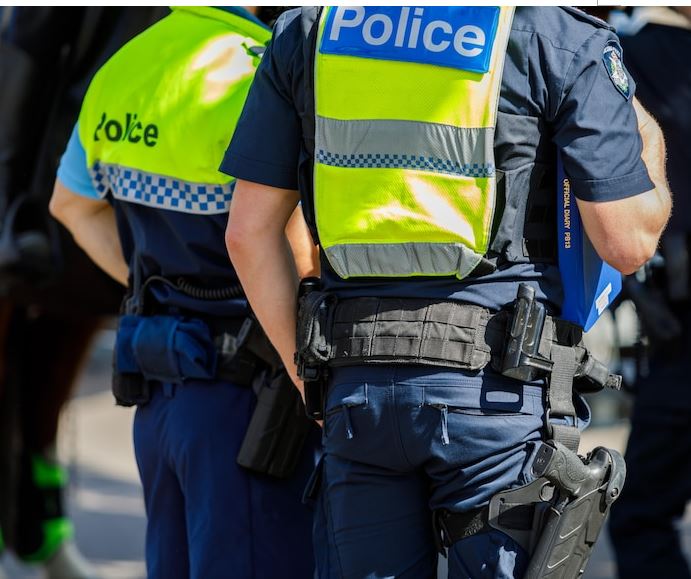
“My gravest fear is that with the utility belt and all the Police paraphernalia hanging from it, it will cause members to push the belt through the door to solve a problem instead of using their brains”.
Although the current issue predominantly refers to Highway Patrol, the broader application exists where the approach to Patrol duties needs review.-
- Foot patrols- it is inherently unsafe for members patrolling two up to walk side by side conducting their patrol.
They are often too easily engaged with their partner rather than the public, and their ‘situational awareness’ is severely compromised.
Two up or any multiple of Police on the beat should be spread out on either side of the street where practicable or at reasonable intervals.
This not only projects a wider Police presence but also preserves members’ safety and the effectiveness of their patrol.
-
- Local Mobile Patrols – It is common for Stations that field a Divisional Van on the 24-hr rotation to be two-up, and that is sound; however, the additional resources that a Station can apply to their community can be substantially multiplied by general duty patrols being one-up.
How that can work safely is that each member of a local mobile patrol has their own vehicle. The Supervising Sergeant works one up, and the normal Supervisor’s driver could man yet another car, putting four cars patrolling and one supervising, 5, instead of just 3, increasing the visible Police presence substantially.
That means when a job is allocated, the capacity of 5 cars can attend. It adds substantial weight to the Police presence, reducing the likelihood of violence towards the police or the community.
It is not a matter of members attending dangerous situations on their own, but they are backed up by multiple members and units.
Moreover, the Supervisor can detail one of the single-member patrols to deal with reports at the scene when any danger has passed, and relieve the other vehicles, improving the capacity of the Force to respond to demand.
To make this work, the supervisor’s role and capacity to manage resources are paramount.
A new protocol needs to be explored in which jobs are assigned to the Sergeant for distribution to their units. Decision-making at the lowest operational level possible.
If this approach were extrapolated across every station, that would translate into literally hundreds more police cars projecting the deterrent effect of a highly visible police presence on crime and other anti-social behaviour. Car manufacturers would jump with glee at the prospect of providing VicPol with hundreds more vehicles. On a pragmatic note, providing two to three additional vehicles to a Station would be cheaper than recruiting additional police and more effective. Cars generally don’t take sickies, come late to work or get bogged down with paperwork. The issue of Patrol efficacy has not been addressed for some time and follows a pattern that has changed little over 50 years. A review and update are well overdue, if for no other reason than to improve members’ safety.

First off, I’m a 36 year frontline vet / supervisor. I find your article on One-Up policing extremely ‘utopian’ in in its concept and view! I have lived, worked and operated in a ‘One-Up’ Patrol environment and let me say this, one particular incident nearly took my life! Now that was despite other units being available, but a few things you didn’t account for were distance, other units being tied up and just how quickly situations escalate. 5 vehicles you say? Where are police getting those from? Places I served at, we had our Div Van, Station Sedan, Supervisors Vehicle and maybe, a Files Vehicle. Possibly 5 vehicles turning up in support? Not sure how you can suggest that as a benifit for your article! Most days, when I was performing 1-up Supervisor Duties, I had very few units available to cover large areas, due to a number of factors, main one being domestic violence jobs. Once a unit was allocated a DV job, they were off the road for at least 2 hours, sometimes more. Of course, that placed more stress and responsibilities on remaining patrol units, which then lead 251 units, like myself, to attend jobs 1-up, in an effort to fill the patrol duties. Sorry, I can not support your article in any form, or your hollistic, utopian view on this matter.
There are many ongoing complaints from the public and even members about the lack of visible policing especially on our roads. When the one up ban came in it effectively cut Highway Patrol presence on the roads by more than half. Now if a member has urgent corro or is required at court his rostered partner cannot go out on the roads by which is one less patrol car again. I give an example of a Highway Patrol member at Echuca being rostered on a solo, had to ride to Bendigo to pick up another solo member so they could work together. Strict instructions were given not to intercept motorists whilst riding on their own on the way to join the other member. Hours lost out of the shift.