
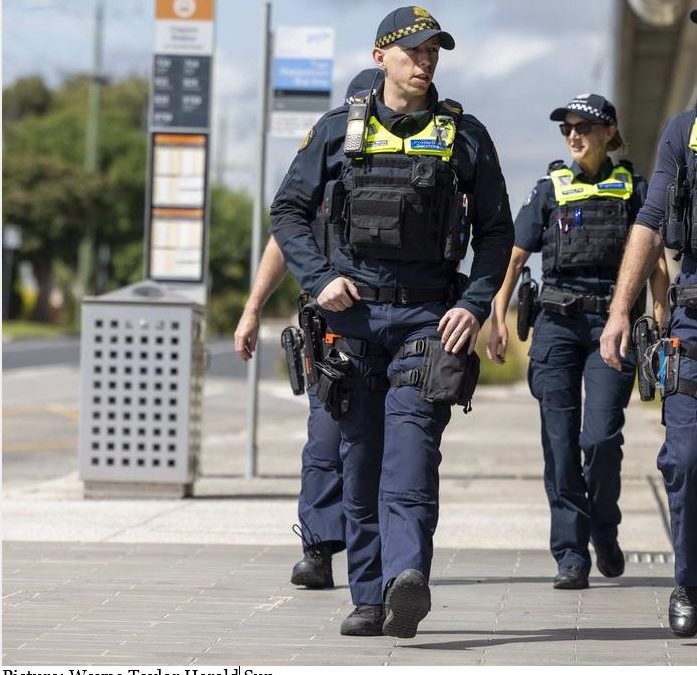
The announcement in the Herald Sun, 12th of April 2026, ‘Victoria is haemorrhaging police officers’, by the Leader of the Opposition, Jess Wilson, to increase the Police numbers by 3000, is very welcome news indeed. Long-suffering Victorians can at least have hope that, with a change in government, the issue of law and order, particularly the Police capacity, in this once fine State would be seriously addressed. At last, our safety is a priority.
What concerns us most is the methodology the Opposition proposes to achieve its targets.
Establishing overseas recruiting centres and the associated marketing to attract recruits could be a very expensive option, especially if no suitable ‘sunset’ clause for this process is included.
It also has the potential of the Force, believing the problem is fixed and fails to address the problems within, the root cause of the current issues.
It is worrying that no real effort has ever been made to recruit Victorians.
It is true that well-trained personnel from the countries listed and interstate will help, but it is not the solution; rather, it is a welcome stopgap.
The problem, as we understand it, is that there are plenty of Police applicants; it is the training and processing that is the bottleneck.
The CAA has raised this issue before and proposed a solution.
The first step before we head overseas is to examine and review the selection process of Recruits to ensure they’re fit for purpose from selection to retirement.
Failing to do that adequately is kicking the can down the road.
Poor recruitment selection today creates the problems of tomorrow.
The epidemic of resignations as Police exit in alarming numbers is more than likely to be, in large part at least, the manifestation of poor selections in the past as much as poor management today. Perhaps focusing on a quantitative rather than a qualitative outcome is the problem.
It is critical that applicants are screened more effectively to minimise the risk of non-physical injuries during their service, and investment in this area would be money well spent, provided the outcomes are monitored.
It would also be a good investment to properly examine the exit avalanche to identify causes and address those. Failing to do that will only mean the causes are still there, and the problem will reignite at some point in the future.
One of the major failures is that VicPol has outsourced recruitment application training, so the potential recruits are not being evaluated on their merits but on a taught response from independent contractors.
That is a major recruiting flaw, regardless of how dedicated the applicant trainers may be.
Outsourcing this process is the result of the Force seeking greater efficiency, rather than understanding that effectiveness should never be compromised for efficiency.
We are advised that a potential recruit may need to pay up to $2,000 to complete the application process and training before assessment. That has to be a major disincentive for many suitable people considering a career with Victoria Police.
Victoria Police must take back control of this process and be responsible for all aspects of it. It seems disingenuous to ask people to join and pay for the privilege of being considered.
The Force must also review management accountability, not only for staff functional performance in the field but also for their ability to deal with the non-physical stress that the police service exposes them to.
In summary, there is a need for overseas recruiting, but recruiting in Victoria should be the first priority, as it will be substantially cheaper, enabling world-class training to be developed and implemented across the Force to improve the organisation’s overall performance and the conditions in which personnel are forced to work.
We have seen in recent years vast improvements in the employment conditions of Police in this state, but this has been overshadowed by the large numbers leaving the organisation. So simply improving tangible benefits of themselves is not the answer without the non-tangible benefits being developed.
Although we do not begrudge any improvements, given the conditions that police work under, the provision of new buildings, better equipment, and improved conditions can be counterproductive to the organisation’s efficacy.
Tangible rewards do not replace effective management; however, rewards used judiciously may solve the current problems.
Rather than spend millions overseas, why not invest in the current staff to slow the retention exodus?
Retention bonuses will go a long way to stem that tide and encourage others to join. It would also attract interstate serving Police seeking a reward for service.
Additionally, this scheme, which can be spread over many budgets, would be easier to maintain.
A bonus system starting with Graduation, then two years of service, five years, then ten-year increments would overtly reward service and discourage those considering an exit plan from Policing.
Investing in the current members, showing appreciation for their work, can be a cost-effective strategy as the scheme has many attractions, particularly if the bonus is linked to performance.
It would be disheartening for hardworking members to see lazy, incompetent members rewarded simply for turning up for work.
Senior Police and political leaders should have a look at the Hawthorne experiment undertaken by Elton Mayo, although it was many years ago; it is as relevant today as it was then and relates to Policing, as is currently evident throughout the Force.
The Hawthorne experiments at Western Electric’s Hawthorne Works plant demonstrated that worker productivity increased not only because of physical conditions (such as salary, leave and other conditions) but also because workers felt valued when observed and given special attention, a phenomenon known as the Hawthorne effect. Led by Elton Mayo, the studies highlighted the importance of social relations, employee morale, and management attention over strict physical working conditions.
By all means, we encourage overseas and interstate recruiting of serving Police officers as a short-term fix, but what is desperately needed is a serious effort to recruit locally and retain existing staff.
We would like to be assured that if the Opposition wins government, they can walk and chew gum simultaneously.
The Community Advocacy Alliance (CAA) is funded by the members and the generous donations from the public. Please consider donating to help us continue to work for you. Simply click on the button below. Thank you – your generosity is very much appreciated.

Why is it necessary for potential recruits to part with $2000 to be considered for selection. Can I assume that money is for some online training costs, or something else? Do we still use experienced sworn police members in a training role? (And not contractors)
It is my view that Victorian police members are very well paid, have excellent leave and recreation arrangements. It’s a tough job at times, but so are many other professions. Given the pay and conditions, and the expansive variety of workplaces and roles on offer, the retention it seems, can only be attributed to force management. Perhaps we should get rid of some of them in the first instance.
There are many unanswered questions as far as recruitment and retention is concerned. Has anyone done any research on the exit interviews which I assume have been conducted. with each departing member? I suggest that would be a good place to start.
The actual costs I think involve doctor , psychologist visits etc, test booklets to practice, as well as a range of other things, before they are recruited. I know of one person who paid for laser eye surgery to beat the eyesight requirements, which are very archaic. I believe the whole “Will I get in or wont I” mentality is part of the reason people are not applying to be recruited. It takes way too long and then it takes a longtime to to find out if you are actually going to the Academy, and then you still need to pass at the Academy.
Just maybe older civilians with life experience could be used in stations for enquiries, admin etc to allow Police to spend more time out and about.
Could it be that the state’s obsession with diversity leads the Force to focus on the wrong candidates for recruitment?
This was my view I posted on Facebook the 12th April 2026 on police recruitment. Excuse the way it’s written but I tell it how it is.
“Crime is up. Police numbers are down. Good on Libs and Nats trying to fix the problem with importing police officers.
But it’s not the solution. How about dealing with the real problem first and hit it head on. You have to ask, “Why are coppers leaving the job in droves? Why aren’t people signing up for recruitment?”
You need answers to find the right solution. If you import coppers into a broken force, they’ll just resign.
Start by listening and asking those still in the job and those who resigned/retired. Only then can the problem be fixed. Then you can have a functional police force. Then you’ll have numbers to reduce the crime.
I’ll start. Get rid of labour and the corrupt cronies. The Chief Commissioner can’t be a “yes” man.
Let police do their job without bowing down to public scrutiny. Fix the judicial system, bail and remand laws.
But most of all. Look after the police members and their welfare. Then maybe they can protect society.
I’ve been there”
Very valuable advice [free of cost] by S McLarty:
If you import coppers into a broken force, they’ll just resign.
Start by listening and asking those still in the job and those who resigned/retired. Only then can the problem be fixed.
Exit interviews may not be sufficient.
However, such a survey needs to be quite sophisticated [not superficial] to ensure that it reaches beyond the fear of retribution.
Something the author missed – How will the public react to being policed by foreigners?
Serious question, policing is essentially done with the consent of the public, importing thousands from who knows where would likely cause even more antagonism to police.
I’ve worked for the prison service, the fire brigade and Vicpol, I enjoyed being a member the most, it was the most rewarding of all however compared to the other two jobs, Vic police are the most overworked and underpaid job I know of. We’re three generation police family and my sone who was a SC has left to drive trains, he’s paid over a third more with paid overtime and strict shifts, he misses the job but wants to buy a house.