
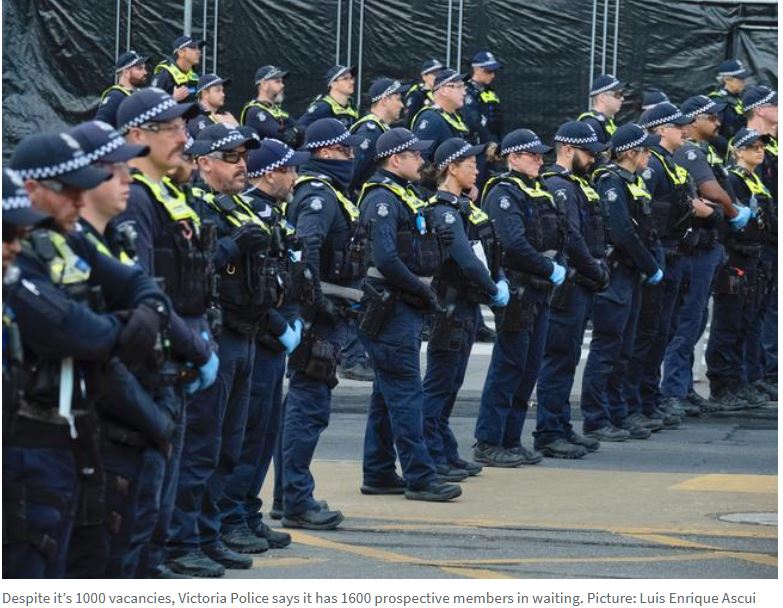
Victorian Police were known colloquially in the 1980s as the ‘People’s Force ‘, ironically the title of the book by VicPol Police Inspector, Dr Robert Haldane, chronicling the History of the Force.
It is sad that some 40 years on, the title and its function have been lost and, even worse, the positives that created the ’ People’s Force’ are seen as irrelevant to today’s Policing and ridiculed by many within the Force.
The cost to the community has been high, having to deal with reduced public safety and the consequence of an out-of-control crime rate. Apart from the social cost, the fiscal cost must run into Billions.
A comparison of VicPol performance to NSW, a comparable State, is a good place to start.
NSW, for example, maintains some of the lowest violent and property victimisation rates across all Australian States and Territories.
Comparing police per capita ratios between Vic and NSW is relevant to measuring the overall Police Force’s performance relative to each State’s crime rates.
The risk of anarchy rises and falls in direct proportion to the crime rate.
This graph is an eye-opener for all Victorians, and Police administrators in particular.
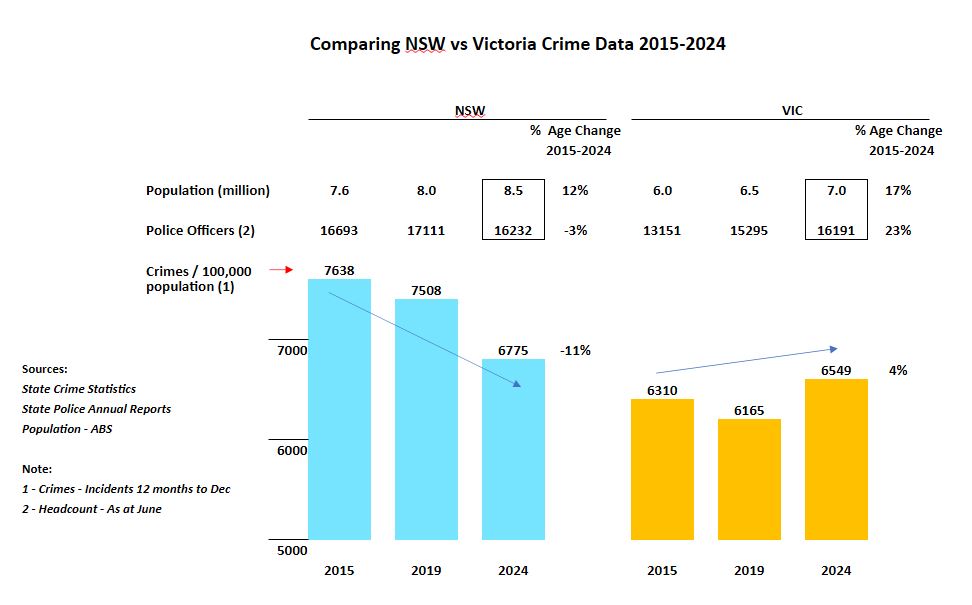
This comparison must be assessed in light of the geographical difference between the two states. NSW is roughly 3.5 times the size of Victoria, and the tyranny of distance places greater demand on Police resources and Police operational planning, making the differences highlighted in the graph substantially more impactful.
From 2000, there was a decline in both States’ crime rates, but around 2013 the wheels really fell off in Victoria; the impact of 2000 Administration moves kicked in. A rapid increase in crime remains unchecked, and you will note that since about 2015 there has been a substantial increase in Force numbers where NSW numbers have remained relatively static, which highlights the concern that throwing 1500 more Police members at the problem is very unlikely to achieve any meaningful impact on the crime issue.
There is a real likelihood that they will be thrown into inefficient Task Force Operations so high-profile arrests can give the illusion of effectiveness. High-profile arrests have little or no impact on crime figures.
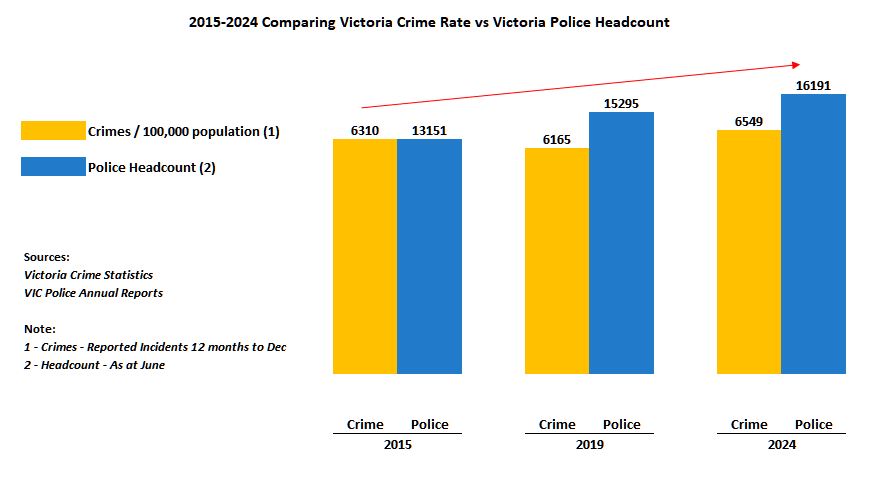
Graph prepared by Adrian King of AXS Partners.
More dollars out of our pockets for no meaningful return.
As a priority, the poor management of crime and social disorder in Victoria is a critical factor that negatively affects all of our lives; this didn’t happen this year or last, but it is a culmination of poor executive appointments incapable of running a Police Force since about 2000, excluding the current incumbent who has been handed a poisoned chalice.
A failure in this critical area of Government can and does break our society.
As our political system relies heavily on Law and Order to function properly, irrespective of a Government’s political persuasion, all politicians have a vested interest in ensuring Law and Order is maintained, as the adverse impact of failure is profoundly deleterious to all Government and societal functions.
We are now questioning the politically favoured solution promoted in Victoria of ‘more police numbers’ as the panacea for this issue.
We accept there are numbers of police at any given time who are on sick leave or vacancies that have not been filled. But there is no reason to suspect that NSW doesn’t face the same issues.
We are also cognisant of other pressures that affect effective policing, such as poor legislation, the abysmal performance of the Courts, and natural or manufactured disasters.
Probably one of the most significant issues is corruption within the Government and the private sector. Clearly, legislation is way behind in arming police with the capacity to do much about it.
Even with these headwinds, it is time to accept our Force is not up to par and needs a major overhaul, particularly to its culture.
Making excuses for failure no longer washes.
There is no guarantee that providing Victoria with 2000 more police or the 1500 announced will result in a comparable reduction in crime and social disorder, or, more importantly, a return of a feeling of safety to the community.
The question is what happens if we are in the same place ,crime-wise, in three years; very likely on current trends, it will be a place far worse than where we are today.
There is nothing in the public space about VicPol forward planning and, critically, how these plans will be implemented, but even more importantly, how they will be empirically measured to give us confidence somebody knows what they are doing.
The community is entitled to demand that information; we pay the Force’s bills including the Police salaries.
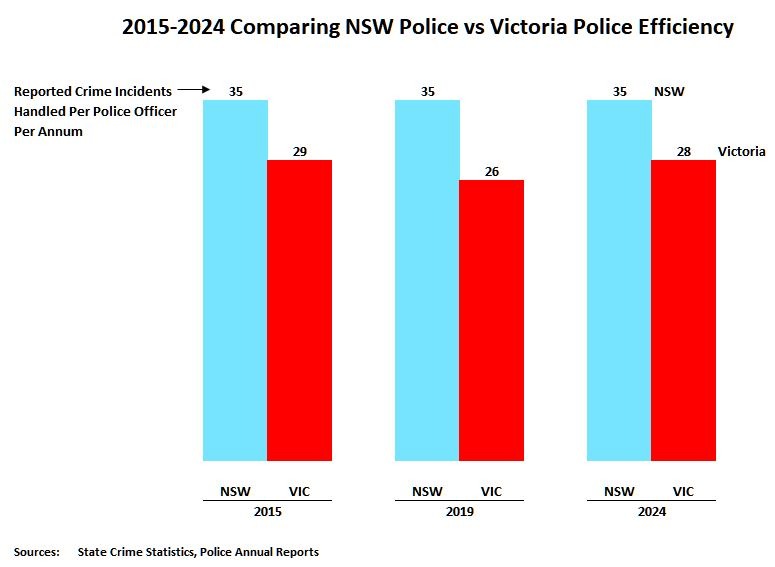
Graph prepared by Adrian King of AXS Partners.
Although this graph focuses on the individual members, the Graph is a macro look at the organisation, and as an organisation Victoria falls well short of our neighbours north of the Murray River.
Even with the VicPol’s focus on Reactive Policing, this does not translate into less crime.
It has long been recognised in policing and criminal-justice circles that “you can’t arrest your way out of a crime problem”—a maxim often used to stress that arrests are only one part of crime reduction, alongside prevention and community engagement,
Our take on the statistical data is that VicPol has substantially failed to deliver its services, and a direct comparison with NSW suggests that VicPol management needs urgent and frank discussions with its NSW counterparts to determine how they have succeeded, even with the additional challenges of a much larger geographical area 3.5 times larger than Victoria.
Most revealing are the graphs showing a huge rise in criminality we can reasonably attribute to COVID-19, but NSW has achieved laudable results given its ratio per capita. Victoria urgently needs to discover their secret.
Victoria is leading the charge on out-of-control crime and doesn’t look capable of reining it in. We garner this is also the view of the community more generally, translating into a growing lack of confidence in the Force.
Since 2000, we have seen a dramatic decline in proactive policing, which involved working with the community rather than being isolated from it. The focus has now shifted much further toward the Reactive function, and the numbers prove it.
VicPol has lost sight in recent years that the effectiveness of policing correlates directly with its relationship with the community it is supposed to serve.
Central to this police-community disconnect has been the strategy of isolationism by successive police administrations.
Recognising that Police serve the community rather than the other way round is a cultural shift the Force must implement.
Implementing that shift will be hard; however, the additional byproduct will be that Police will be working in a more conducive environment, lowering pressure on them and reducing the likelihood of stress-related injuries among members.
Moreover, the need to adjust the pendulum, which has moved too far towards the Reactive function, back to an equilibrium with the Proactive functions is a critical, long-overdue change, and the reason we are rapidly falling into an unchecked spiral towards anarchy.
The task of turning around VicPol’s failures is daunting, as the problems have been allowed to fester under years of poor administration.
To redress the failures, there needs to be a properly resourced Inquiry that can provide the Chief Commissioner with the guidance, advice, and tools to improve the Force’s performance for the benefit of all Victorians.
Simply throwing money at the Force without addressing the problems won’t work.
It must include input from NSW Police command-level officers, and VicPol must, if necessary, eat humble pie, as NSW have shown how it is done.
This graph of the comparable budgets for the three Eastern seaboard states is an important indicator on this issue.
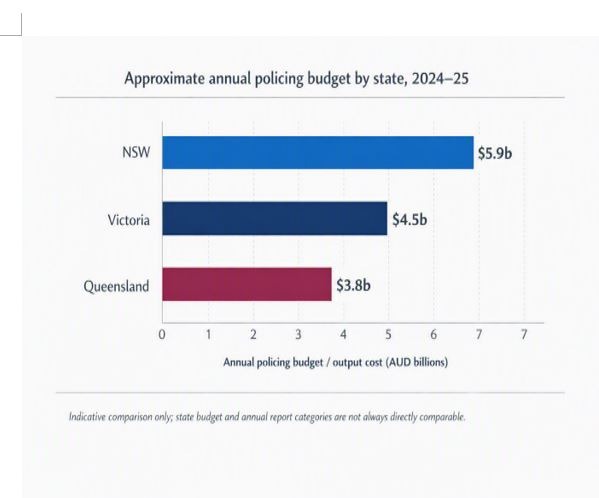
The budgets, with NSW having a $1B+ break on Vic., suggest NSW has invested in advanced technology and other resources rather than blind member-number solutions. Which have proven in Victoria not to work and are unlikely to in the future.
The CAA stands ready to assist in achieving the required transformation; we have 400 years of policing experience across various levels and eras, supported by a wide cross-section of non-Police Victorians, all of whom combine to form a formidable body of experts.
We can speak with authority from a policing and community perspective.
We must rebuild the People’s Force.


Co-founder and Deputy Chair/CEO of the CAA, a former Police Inspector with 32 years of service in Metro Uniform, Traffic Metro and Highway Patrol, Crime Cars, and CIB. Former Editor of Police Life and long-serving Public Relations Officer of VicPol. Founder and Life Member of the Blue Light Disco movement, Life Member of the Blue Light Federation, and completed his Police career as an Inspector after 6 years as a Patrol Officer. He then ran his own Business for 20 years until retirement. Ivan co-founded the CAA with former Victorian Chief Commissioner Kel Glare, and built the CAA into an influential voice for Victorians.
There’s a significant difference in the paperwork and processes between VicPol and NSWPol, even though VicPol is getting more efficient, there are still administrative processes increasing members time off the road.
More vehicles at police stations would be great. 24hr/all hour Stations in western region have 2 x OIC 7 X SGT 40+ ORs with only 3 x vehicles. 1 X divvi van, 1 X SGT vehicle 1 X OIC vehicle. With multiple MGT requests over many years to obtain further vehicles knocked back.
At the end of the day the CCP has to achieve VicPol performance as expected by the Victorian population – which includes the media, the government via Statute Law, and perhaps other commentators. Problem number one is to identify and specify the many levels of acceptable performance. Problem number two is to establish a corporate structure and culture capable of delivering that performance. Patently those two challenges have not been met for years. Isolated interventions [“band-aids”] and even truckloads of money will NOT remedy the malaise.
Current organisation structure and culture will continue to thwart efforts – they might have a limited, short-term effect, and that will be at a high financial and community welfare cost.
Given that a malaise has spread broadly across VicPol over the last few years in particular, it can be expected that it will take a focused effort and considerable energy to apply a successful antidote. It will not be an overnight simple fix. “Band-aid” treatments will not work on the root cause. The existing Judicial system and culture, unfortunately contributes to the problem and will inhibit a recovery – so to, might the actions/inactions and attitudes of TPAV.
The most effective, efficient and durable remedy to the current ills of VicPol is a major overhaul of “Personnel” practices, which will almost certainly require external expertise. It should begin with an Organisation-wide redesign of the hierarchy, resulting in revised Position Descriptions which must include measurable performance standards to enable accountability. Position incumbents who may fail to reach the standard specified, should be allowed to apply for positions that are suitable to their abilities. Some staffing losses can be expected, nonetheless retention and recruitment rates will soon improve, and some significant financial savings and morale benefits will accrue. The community will reap the benefits of a happier, healthier, more professional and efficient VicPol.
Sociologists have long argued that the high youth crime rates is a social rather than a crime problem; we all heard the saying that it takes a village to raise a child. When children from particularly African countries are removed from the natural discipline inherent in their societies, youth crime skyrockets. But of course, it is not PC to say so.
The difference between NSW and Victoria? NSW didn’t have Daniel Andrews and Jacinta Allan at the helm for almost 12 years!
A timely article and to the point. Rebuilding a “People’s Force” is a challenging objective, but one that must be pursued, both to reverse the growing crime rate, and to give serving officers the job satisfaction that comes with knowing they are trusted and appreciated by the community they serve.
We cannot move forward toward this objective if we don’t acknowledge the damage that was done by Andrews/Patton to the relationship between VicPol and the community. VicPol’s resources were abused by Andrews & Patton, especially during Covid, to bully, intimidate and coerce the community through state-directed violence. The long-term outcome is that community trust in VicPol took a dive, while a significant number of experienced and conscientious officers have elected to leave the Force post-Covid.
The objective of rebuilding a People’s Force needs to be embraced and demonstrated at the top levels of VicPol, and supported by government (including proper resourcing). This objective needs to be injected into the recruiting process, to improve the quality of the cadets at the Academy. A People’s Force can only be forged if we identify and remove sociopaths at the recruitment/basic training stage.
This is a very informative article that says so much.
Suffice to say that the issues facing Victoria Police reflects many examples of ineffective and incompetent leadership for around 25 – 30 years, in the private and public sectors and in politics.
This does not mean those people in leadership positions over the years are not decent people, but rather there have been “square pegs in round holes” and such mistakes end up causing major problems as outlined in this article with Victoria Police.
For example, the decisions and actions that led to the Lawyer X Royal Commission were a disgrace and should never had occured, and had there been competent leadership could not have occurred, and worse, those responsible have not been held to account.
It will be very interesting to see what happens with the upcoming Royal Commission into the building industry in Victoria?
With Victoria Police, the focus should be on those things that matter and not on the things that do not matter.