
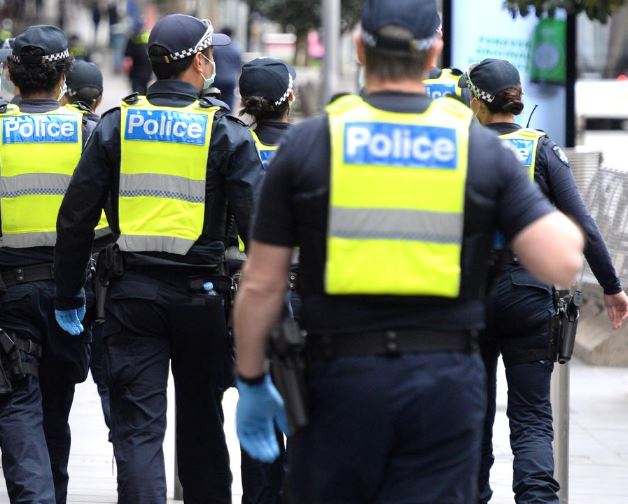
One Policing art that has been disappearing over the last decade has now reached a point where it poses a real and ever-present danger to Police on the beat, extending to Police mobile patrol units and is reflected in the crime statistics that show clearly that the proactive function of police patrols is ineffective.
The Art of the Police foot patrol has all but disappeared, replaced by a quantitative approach that is endangering the lives of the police involved.
Central to this new, increased danger is the loss of the skill of Situational Awareness.
Today, you are more likely to see a gaggle of police walking along a city street than police members on patrol. Still, the gaggle is in response to a perceived need by management, mistakenly believing that numbers create a deterrent rather than an individual well-trained police member properly performing Patrol with well-tuned situational awareness and community engagement skills.
To increase the deterrent impact, if there are four or five members detailed for patrol, they must be spread out to cover greater areas, and that is effective deterrent Policing, metaphorically a police presence on every corner.
An effect achieved by properly trained supervisors.
It is surprising that the Police Association (TPAV) is not very vocal on this issue; in fact, their silence is deafening. The skill of patrolling directly relates to Police members’ safety, an issue we presume is of critical interest to the TPAV.
What we don’t know is whether these patrol skill deficits are a lack of training of members and or supervisors, or just the easy way out for supervisors.
We would hope this is not Force policy; we credit the Police administration as being smarter than that.
What you will see with these skill deficits is police engaged with each other, perhaps talking about babies, station gossip, or football, who knows, but what we do know is that this practice is very dangerous. These groups, inwardly focused, are a bigger target for terrorists or organised crime gangs, or rogue individuals, and these risks should not be discounted.
The gaggle phenomenon should be known as the ‘non-patrol ’.
The members in conversation have no Situational Awareness, so they will not see danger coming.
You can’t dodge a bullet (metaphorically) if you don’t see when it is coming.
In this era of heightened risk of terrorism, the Police groups make easy targets all bunched together out in the open, walking at a leisurely pace, not concentrating on their function, is a recipe for disaster in lost Police lives.
One of the most dangerous activities reported to us has been groups of members convening a meeting, perhaps by a supervisor, in public places with their backs to where any threat may eventuate.
Sitting Ducks is an appropriate analogy.
Probably the misguided two-up policy of years ago has never been fully corrected.
Policy Introduced in 2015:
Near-total ban on solo public policing.
Now:
Two-up is strongly enforced for high-risk and Highway Patrol duties. Multiple exemptions based on risk assessment, location, urgency, and staffing realities—functionally a risk-managed policy, not a universal rule.
The problem is that members have become entrenched in the need for the company rather than ensuring operational effectiveness.
And while on members’ safety, supervisors must intervene to manage gawkers at incident scenes.
Far too often, we see in media footage at incident scenes, gawkers standing around, apparently enjoying the event, and we are not talking about the public, but other police.
Gawking, not keeping an eye on the background to protect themselves and the members directly involved, must be addressed before any real harm occurs, apart from being unprofessional.
It will take strong leadership to turn this around. Something we are confident Chief Commissioner Bush could provide.
It does not seem logical that a well-trained police officer cannot undertake foot patrol or mobile patrols one-up.
If there are two members available, one should patrol either side of the street, multiplying the visible Police presence.
This allows for community engagement, the most potent proactive Police function. And when it comes to mobile patrols, the same logic should apply.
When a supervisor is tasking their shift, vehicle availability is a critical consideration.
It seems illogical to have one or two vehicles two up when the Station has other vehicles idle.
Three or four vehicles, one up, are far more effective than the apparent holy grail that Police vehicles must be two-up.
The concept of an observer in a Police vehicle in practise means the passenger has eyes down on a phone or other electronic device, making the role of observer moot.
The role of the supervisor is to manage all vehicle crews, so the allocation of resources to a public call may require two or three, or more, one-up vehicles to respond.
Often, as the case may be, once the matter is under physical control, resources can be peeled off, making patrol more efficient in any geographical area, reducing initial response times and increasing patrol visibility, thereby reducing crime. On many occasions, leaving just one member to complete the administration.
The two-up policy, even though it has been diluted since its inception, must be rescinded so lame-duck excuses cannot be used to maintain the status quo.
Although introduced as a safety issue, the risk to members has not diminished since its introduction but has increased.
More members have paid the ultimate sacrifice during the two-up period than at any other time, including multiple deaths not seen since the Kelly ambush of 1878 at Stringy Bark Creek near Mansfield.
The most effective safety strategy to reduce fatalities and injuries to Police in the Patrol environment is Situational Awareness, but what is it, and why is it so critical for Police?
Simply put, it is the art of looking at the bush and seeing the trees.
Ask anybody to look at the traffic and explain what they see. Usually, the answer is a lot of Cars.
Ask a trained Police member what they see, and they will report the types of vehicles and any obvious anomalies, such as passenger-side windows wound down when all other vehicles have them closed, erratic driving, avoiding being blocked in, a very young driver with similarly aged occupants in a high-end car.
And the real giveaway is that all occupants are paying attention to the police vehicle.
All these things, and more, justify checking out the vehicle.
A trained member on patrol will engage with the public, but, more importantly, will focus on the faces of every individual they pass. They are looking for body language that may indicate unlawful intent.
These are just a small part of the many aspects of Situational Awareness.
None of this happens when a gaggle of Police, or even just two, stroll around, talking amongst themselves.
We are confident that the Chief Commissioner is across this issue, and we hope, for the benefit of members, that the Police Association becomes proactive in this approach, given the benefits to members.
The Community Advocacy Alliance (CAA) is funded by the members and the generous donations from the public. Please consider donating to help us continue to work for you. Simply click on the button below. Thank you – your generosity is very much appreciated.

So true, seeing a “two up or three up or four up at a shopping centre” on their phones, none are seen to enter shops and talk to staff none are seen talking to the public, none are scene conversing with random young people, or recognising young children (remember my friend the policeman) remember the Public Relations Branch, remember the lecture squad, remember neighbourhood watch. Sir Robert Peel “The Police are the Public and the Public are the Police”
If we happen to stop and talk to police on “patrol” they seem almost aghast that some wants to chat. Just a look at me presence armed to the hilt with side arms strapped to their legs like someone from GUN SMOKE..
Then then there is the “HONEY POT SYNDROME” when something happens there are a mob of police, the “clip board brigade”. At each incident the number of police cars resembles a flashing light used car lot.
Excellent article. I am inclined to think there is a failure to train supervisors. I know I got no formal training and it was years before I found a relieving OIC who knew how to get the best from his supervisors
Very good analysis. Police patrols are totally invisible.
I can notice police officers only when they go to buy lunch in the local shopping centre.
Apart from that I still see in my memory, a group of police officers surrounding and assaulting two old women sitting on the bench in the park, in that infamous Covid era.
They became a storm troopers for the government and the party with majority in parliament.
I’m 80 years old and I’ve seen ,much better times when police was public orientated and was judged as working for people and with people. Now they are clerks enjoying computers in the offices (easy spent time) and forgetting what their main role suppose to be.
Police Force needs deep and meaningful change.
Another thought provoking missive from the wise counsel at the CAA, which prompts me to make a couple of personal comments. I just drove the Hume Freeway from Melbourne to Albury and back over Easter and did not see one police patrol, either local or HWP! My second point is regarding the nature of policing and what makes a good police person! Police are representative of the community from where they originate from, yes, training does attempt to equip a police person with the skills and abilities to do what is a very complex and difficult job, BUT, at the end of the day, the effectiveness of our police is inherently linked to the culture and ethos that the individuals recruited to be police, bring to their role. Look around at the youth of today and compare it to the youth of “our era”. Chalk and cheese! One is about self and the other is about service! Thankfully, there are exceptions that are committed to our community safety! But, not many.
Police on foot patrol are almost useless unless they meaningfully communicate with members of the public. Obviously police have to trained how to effectively interact in a positive way with the community. To be able to communicate across languages and cultures in our culturally, linguistically and religiously diverse community. Yes, occasionally one can see members on foot patrol but rarely do they involve themselves with the shopkeepers, mums and their kids, old people, young people and others. As the article suggests, they just talk amongst themselves. And that is not good enough.
Recently, a friend of mine commented that the police force has lost a generation of expertise.
He was referring to exactly what this article has mentioned.
By way of example, during the 1970’s Assistant Commission, Operations, Mr. S.I. Miller (later Chief Commissioner) introduced “Crime Beat” that involved a member in uniform on foot patrol, one up, in shopping strips in metropolitan and country areas during the daytime.
“Crime Beat” was a great success with the general public and business owners praisworthy of seeing the visible police presence and furthermore, during the time of the foot patrols there were no reports of serious crime.
Regarding the Melbourne CBD, when City Traffic was in operation, there was a combined patrol function and a function to direct traffic at major intersections, and when that was disbanded the visible police presence in the Melbourne CBD was not replaced.
There is no substitute for a visible police presence and for reasons unknown, that concept seems to have disappeared and this is something to think about.