

A well-hackneyed proverb sums up the current approach to reducing crime: insanity.
“The definition of insanity is doing the same thing over and over again and expecting different results.”
What makes this even worse is that this is the same strategy used and built upon over more than two decades, and Police and political leadership have never, it appears, been prepared to question it, albeit the impact on crime is negligible; the statistics prove it.
We are not claiming that Task Forces do not have an important role to play in managing crime; however, their overuse and use as a political tool needs to be substantially reigned in.
They have been used to replace many of the former Crime Squads, looking at a specific crime rather than a specific area within that crime category. The loss of specific knowledge and skill built up in a Squad approach is therefore lost over time.
This impacts the effectiveness of Detectives who can only specialise in a very narrow sphere.
The overarching reality is that as you build Task Forces or other like groups, both regionally and Force-wide, unchecked, the pendulum shifts even further from preventing crime to an overreliance on catching crooks to reduce crime – a spurious assertion.
It is morally wrong to wait for a crime to occur and another victim to be created when there are other options. There needs to be a balance struck.
Were all the resources put into getting a conviction against Tony Mockbel worth the effort, given those same resources could have prevented untold crime? A crime tsar, we were told, who now attends the races, seems to live a good life and deems not to have to work.
Another example is the Taskforce Hawke/CFMEU; where after two years there appears to be no convictions of ringleaders achieved.
The Task Force hierarchy was reported in The Age as bemoaning a lack of cooperation from victims, hindering the investigation. A recurring issue highlighted in reporting around the operation has been that many potential victims and witnesses have been unwilling to formally cooperate with police.
This reluctance is commonly linked to fears of intimidation, repercussions within the industry, and the influence of organised crime figures. Without victim statements and witness cooperation, investigators face difficulties gathering admissible evidence and laying charges
There was once a criminal offence of Misprision of Felony – knowing a felony had been committed and by whom and not reporting this to police. A modern version aimed at serious indictable offences may make some recalcitrant witnesses come forward.
Overriding these concerns would be a lack of trust in police, promoted by the criminal elements involved in the Big Build, but the Task Force has not applied resources to remedy this problem. Simply throwing more detectives at the problem will not change anything.
Traditional policing methods are the answer.
A sustained uniform presence in and around building sites like Big Build will give the Police a chance to build relationships with individuals and enhance the opportunities for victims to have a ‘quiet word’ with a Police member who has built trust. The same strategy should be used in all uniform Police work in the community. The Task Force is finding out you can’t Police without the community; only in this case, rather than the broader community, the construction/contractor cohort.
Making Building sites safer for workers would generate better results for the Task Force.
These resources need not be pulled from the Stations; a professional relationship between Task Force Commanders and Station Commanders should enable a team approach in which Stations can support the Task Force’s objectives.
Many Police involved in Task Forces develop an elitist attitude and would find it difficult engaging with a local station commander – this must change.
Furthermore, it is imperative that Police support other agencies with roles in the Building Industry so they can do their job, and they know it.
There are reports that Task Force Hawke has charged five individuals with blackmail, three with extortion and five with corruption. But how these successes help the safety of Victorians is questionable because, to use this mechanism, they would have to charge hundreds to have an impact on crime. What are the objectives and targets (KPI’s) set for the Task Force, and how do you know when it succeeds?
The current inflexible Task Force approach reminds us of the old joke,
“How many people does it take to change a light globe? “None. They just promise the old one is working.”
And that raises the question of how that Task Force has made the State safer; the Force has trouble enough delivering, or trying to deliver, its service to all citizens, but is ensnared in following perhaps political imperatives rather than its real role to the State.
Something is terribly wrong with our system when additional Detectives (number unknown) can be assigned to a Taskforce that serves the Government’s political needs and can’t keep Police Stations open for the rest of us.
That proposition has taken a downward curve with the announcement of four inner suburban Police Stations being permanently closed. The rationale is obscure, but a cynic might suggest this is a power struggle between the Force and the government – give us more or we will close more stations?
Crime is escalating both in quantum and severity, so arguably strategies have failed all of us, police and the public alike; crime is not diminishing but increasing as the fiscal and psychological cost in police resources is growing astronomically.
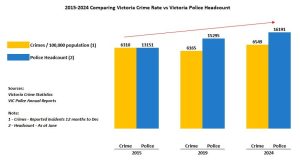
Task Forces have an important place in policing, and organised crime figures must be pursued and charged where possible, but a continued careful evaluation of resources allocated to each target must be ongoing to prevent Task Forces from forever gobbling up resources with no measurable improvement in obtaining results.
The Task-Force phenomenon has gripped the policing and political psyche as the panacea to the crime epidemic.
Task Forces appeal to Police administrations and Government as an easy way to appear to be doing something, even as crime rates climb rather than decline.
The alternative is creative and effective policing strategies and management aimed at the heart of criminal activity, and that can be found in every local Police area command.
The effectiveness of the Task Force strategy is never disclosed, but the crime statistics paint a picture of failure.
Moving police from street-level policing into a Task Force or similar is not only an inefficient use of resources but also of questionable value, since the Task Force outcomes are never made public, and we are never told at what stage the cost-benefit of these groups ceases to be worthwhile; or are they just allowed to wally along in the hope they get a result?
It is a political nicety for the police and politicians to announce another Task Force; all that means is the problem has been given only a political fix. Whether it solves the community issues is moot.
Every time we see another reference to a Task Force, Special Duties, or other such group (Police management have become very adroit in describing these functions to mask the number of Groups set up ) of police to tackle a specific crime or social issue into a unit, they all rapidly dress up like American Special Forces, ditching their uniforms for some unidentifiable rationale, raising an aporetic question.
Parading around in public in mufti while fully armed and decked out with Police accoutrements, sometimes including a ballistic vest with Police emblazoned across it, seems very odd indeed. Perhaps they think they are undercover? Doh!
Former Chief Commissioner Patton, addressing the CAA at an AGM, said that the Force had a huge problem with new members breaking their necks to get into a Police uniform and then, within three or so years, breaking their necks to get out of it.
Avoiding shift work might be part of the answer; as might a uniform not fit for purpose; however, more important is the matter of culture within the Force. If the leadership places such weight on the Task Force phenomenon, then that’s where the action is and where, for my career, I need to be. Diluting the importance of the uniformed frontline 24/7 policing role may be to blame.
It reminds us of a previous Chief Commissioner who changed the Force uniforms to black (Salute Blue) and allegedly claimed the reason was to make the Force look tougher, ‘or similar words’; an inane reason by any measure.
Moreover, where does everybody think the police come from to fill this plethora of units?
The only source of police is from the police stations, which has the effect of reducing policing at the local level, from where all crime, serious or otherwise, emanates.
Taking resources from Police Stations defies logic, aggravated by a general trend to take the best and brightest. You can imagine what that does to those not selected. A blatant demotivational strategy that management seems to embrace, and we wonder why some of our Police are less than enthusiastic about attending to our needs.
The move to a centralised hierarchical management model where the district Commander, usually a Chief Superintendent, had power that the higher echelons were jealous of has caused serious damage to Police effectiveness and efficiency. The regionalisation dismantled this localised command structure, which had previously been willing to challenge executive decisions when their actions adversely affected the communities they served.
But there can be nothing more frustrating for a member than looking at a new station roster where their shifts for the coming period are constantly weighted by afternoon shifts, quick changeovers and more frequent night shifts and weekend work. Moreover, the number of shifts allocated to catching up on the ever-present paperwork shrinks, which means more pressure from the bosses.
And while that is happening, more and more members from their station are seconded to a Task Force or other special duty group, and the numbers on the Station shrink further; the outlook for a member pursuing their new roster period, the first casualty is their culture, takes a huge hit – is it all worthwhile?
If crime and social disorder are adequately and effectively managed at a local level, focusing on preventing crime at its source, where it all starts, may not make headlines and make politicians and Police leaders stop puffing their collective chests, but it will reduce the crime that the community has to deal and live with daily.
The CAA has long advocated for the reintroduction of the Police Inspectorate that can oversee and evaluate, amongst other things, Task Forces to ensure their efficacy. Independently within the organisation, reporting directly to the Chief Commissioner, at the very least should ensure the Chief is getting the right advice, not advice from other senior officers serving their own purpose. The Putin phenomenon.
The CAA has been a staunch supporter of Chief Commissioner Mike Bush, but we are starting to have doubts about whether that confidence and respect was best placed.
Watch this space.

Here is an idea, why not train up those of us who in our 50s and 60’s are very fit with ample life experience only unable to apply because of the archaic eyesight standards preventing recruitment ?
We are sensible, don’t have young families meaning late night ,split shifts sit differently.We have lived experience , patience , understanding and would be more than happy to work .
As for the task forces, I am happy there was and still is one regarding the individual who murdered two and attempted to murder two more Police , one being my sister. The fact that person was finally found is thanks to the groundwork done. They have their place.
I share your concerns Carmen. However the strength of a once mighty organisation has been diminished by stupidity.
The idea of recruiting Reservists was a good one, but stupidity has put that to rest. I expressed an interest of joining the Reservist ranks and was told by a coordinator ensconced somewhere in the castle, that I could not seek a Reservist position in a prosecutors office, but would need to be at the front counter. That is despite my advice to him that my experience as a prosecutor for 7 years, 9 years in legal practice, and another long period as a Team Leader with WorkSafe, and a prosecutor with Community Corrections. I lost interest quite rapidly and will not apply to rejoin.
I imagine I am not the only one who in reality wants to help with the current burden, is hamstrung by idiocy. I shall remain retired. So be it.
Many years ago, the then Chief Commission, S.I. (Mick) Miller, commented that there are three levels of policing:
Proactive policing,
Reactive policing, and
Task Force Investigative policing.
Nothing has changed with this basic concept.
Proactive policing means a focus on crime prevention in the broadest sense such as mentioned in this article.
Reactive policing is mainly to investigate a crime after the occurrence either by a uniformed member of the Force or a local detective or a detective/s from one of the dedicated specialists squads – armed robbery squad, arson squad, fraud squad, homicide squad, breaking squad, stolen motor vehicle squad etc.
Task Force policing is confined to the more complex and protracted investigations that usually comprised of a task force group of multi disciplined and multi jurisdictional people.
It would seem to me that the way the Force is now organised has changed the function of the specialist squads and replaced their function with the proliferation of the task force approach – if so, this is a huge mistake?
To develop expertise, and to appropriately manage crime, all crime related functions should be centrally managed, to include all detectives, squads, and allied support functions, contained within a Crime Department headed up by an Assistant Commissioner, Crime.
This worked well in the past and no doubt will work well if adopted again.
Similarly traffic related policing, specialist support and generalist policing, should be centrally managed.
A departmental organisation structure ensures unity of command and consistency.
The matrix structure that currently exists is a failed experiment with the losers being the community of Victoria.
Policing is not necessarily complex, it’s only been made that way.