by CAA | Jan 3, 2018 | Library, Uncategorized
3rd January 2018
The troll we exposed, Victoria Police head of Professional Standards Command, could face charges as could his colleague.
The Federal offence of,’ Using a carriage service to menace, harass or cause offence’ carries a penalty of three years imprisonment.
It would seem that there is a primia facie case that the two Commissioners acting in concert have breached this Section 474.17 of the Commonwealth Crimes Act. However, as there has been a refusal to investigate the matter there remains a doubt, albeit that the allegations have never been denied by VicPol or either of the Commissioners.
That makes this whole saga very embarrassing for IBAC and the Chief Commissioner who both failed to investigate a complaint of a serious crime.
It is also very embarrassing for the State Government.
The two Assistant Commissioners involved in this issue will be waiting for the inevitable tap on the shoulder either from their more ethical colleagues or one of their ethical bosses.
To retain any remnants of credibility the two Commissioners have left, they should do the honourable thing and resign to save further embarrassment to the Force and in particular the Force Command who are currently under fire for the perilous state of crime in this State and can ill afford a further erosion of public confidence..
A bigger problem remains for the Premier, Daniel Andrews who has steadfastly supported the Chief Commissioner.
Does he now support the Chief Commissioner refusing to investigate complaints of criminal activity by Victoria Police Command like his Minister who announced today (2/01/2018) her complete confidence in Police Command?
By the Chief Commissioner not doing what the Police Act requires him to do he has put himself in a tenuous position bordering on complicity. Not ensuring that Victoria Police is distanced from the scurrilous remarks by Assistant Commissioner Fryer by ensuring they are retracted and the Trolling activity by Assistant Commissioner Guerin ceases, drags the Government into the fray because the refusal to investigate means that the activities of the Commissioners are endorsed by Victoria Police.
This whole sorry saga needs to be sorted and unfortunately falls to the feet of the Acting Chief Commissioner in what may be a true test of his credentials given that Chief Commissioner Ashton has already announced he will not be extending his tenure with no guarantee he will fulfil his contract, given his poor health.
Mr Premier there is a wildfire moving out of control and it will consume many if it is not controlled.
The integrity of Victoria Police Command is at stake.
Maybe you need to do some shoulder tapping.
by CAA | Jan 3, 2018 | Library, Uncategorized
3th January 2018
The Community Advocacy Alliance recently had cause to expose underhanded Victoria Police tactics by a senior officer, acting under a false name in what can most charitably be described as an unbecoming manner. The Chief Commissioner of Police has refused to take any action and has thereby supported that poor conduct.
Unfortunately this is just part of a pattern indicative of deep malaise within that organisation, and particularly within the “Professional Standards” section of it.
The Chief Commissioner has also refused to take any action in a case where detectives knowingly charged a citizen on the basis of documents they knew were not just unreliable but were also completely inadmissible in court – yet they put those unreliable documents forward in court.
This gross abuse of power was ruled fully acceptable by police Professional Standards!
The same detectives produced to the citizen another document which fully disproved their allegations against him – but that document was NOT put before the court and has never been seen again. Professional Standards approved that too!
The Chief Commissioner has been told about the detectives inserting in a witness statement material they knew was false – just as Andrew Rule exposed in the Herald Sun (November 26, 2017). And yet the Chief Commissioner has done nothing but refuse to act.
CAA has other correspondence from a head of the police Professional Standards command which incorporates not merely dishonesty but abuse of the very law the police are supposed to enforce.
Nothing has been done despite complaints having been lodged, just as CAA has reported the most recent abuse.
None of this is new. Andrew Rule also reported (Herald Sun October 3, 2015) how Professional Standards covered up a straight out theft by a detective who has since “progressed smoothly up the promotional ladder.”
Something stinks at police headquarters, and it is not the drains.
by CAA | Jan 2, 2018 | Library, Uncategorized
2 January 2018
Possibly the last suspect on your list, it was on ours.
A personal attack on the Chairman and more generally on the Community Advocacy Alliance (CAA) by Victoria Police was aimed at trying to discredit and bully the organisation as thirty years out of touch and therefore irrelevant to the modern demands on Policing.
The attack was delivered on behalf of Victoria Police by an acting Deputy Commissioner Fryer.
The attack apart from being generally churlish was factually incorrect and exaggerated. It is true that some of our members of the executive of the alliance have retired from executive positions in Victoria Police and elsewhere some time ago. But the CAA Executive also has civilian members who influence the CAA from a community perspective and like the Policing component represent historical and current victims. The executive also has members who finished their police careers recently.
What may not be particularly palatable to Victoria Police is that serving police support the CAA and much of the material produced and policies recommended are influenced by these members.
The attack was of a personal nature and an attempt to bully the CAA but most disturbing was the avoidance by Victoria Police of actions to address the thing that has spawned the CAA and community concern – the Crime tsunami currently being experienced in Victoria.
This core issue was completely ignored.
The CAA acknowledged that things like sexual harassment and discrimination are important and should form part of management responsibilities but to elevate these internal management responsibilities above the roll of the police organisation and responsibility to the community it serves is to really question priorities.
Part two of this attack was a post on the CAA Facebook page by a Vernon Demerest which generally followed the same line as the Fryer attack. This Demerest attack was in response to a defence of the Victoria Police allegations by one of the CAA executive who was personally offended.
In his attack Demerest bemoans that the Plan 100 produced by CAA as, “A list of easy gets, which appeal to populist politicians who aren’t really interested in doing the heavy lifting by investing in the things which will really make a long-term difference to the social problems we currently endure. Early intervention in childhood development and education, for example.”
This is an enlightening insight to the author who criticises the Plan 100 obviously without reading it. A key strategy of the Plan 100 is to re-engage with Youth and in particular to reintroduce Police to Schools in a structured Police In Schools Program. Be interesting to know what all this heavy lifting is and how that helps Victorians currently living in fear. Having cheap shots at politicians will not do the authors career any good.
A bit about Demerest.
Vernon Demerest is a fictional character played by Dean Martin in the movie Airport, ironically thirty years ago. Yes the Facebook page is a fake as is Demerest fictional.
Demerest became a troll on the CAA Facebook page lodging a number of posts attacking some of the genuine people who made rational coments.
Demerest was invited to expose his real identity but as with all trolls he continued to hide.
One would have thought that the troll who is a serving member of the Victoria Police would have realised that trying to outsmart a coterie of ex police who coincidently are all trained investigators would not be the smartest thing to do..
It did take us forty eight hours to identify the Troll’s alter ego, who is ironically in charge of the Victoria Police Professional Standards Command. He has now taken down the fake Facebook page deleted all of his posts and even deleted his own Facebook page. All a bit late the material was retained by the CAA and for security distributed and filed elsewhere.
The problem for the CAA is, what to do now.
We know who the troll is but to expose the troll would be very embarrassing for Victoria Police given the positon the Troll has in the organisation but the public has a right to know as they are paying this troll’s salary.
Because of the lack of response to our correspondence from Victoria Police we lodged a formal complaint against Assistant Commissioner Fryer for his outburst and Assistant Commissioner Guerin, AKA Vernon Demerest the troll.
As the Police Act requires any complaints against any Commissioners must be referred to IBAC, who after consideration, not investigation, returned the file to the Chief Commissioner and we have no difficulty with that process thus far.
The Chief Commissioner has however decided that he will not investigate or take further action.
We can only conclude from that that the Chief Commissioner endorses the libellous remarks by Assistant Commissioner Fryer and effectively adopted the remarks as those of Victoria Police. The Chief Commissioner obviously has no problem with Assistant Commissioner Guerin, the head of Victoria Police Professional Standards Command, creating a false identity on social media with the sole intention of pursuing a personal attack on the CAA and its Chairman.
I would have thought that this behaviour is not very ethical and wonder how a members of a lower rank doing the same would be treated by the Professional Standards Command.
We ask again for the Chief Commissioner to investigate this matter properly and if the evidence is there commence disciplinary proceedings or otherwise sanction the two Commissioners and step Victoria Police away from endorsing this type of behaviour.
by CAA | Dec 31, 2017 | Library, Uncategorized
31st december 2017
A personal attack on the Chairman and more generally on the Community Advocacy Alliance (CAA) by Victoria Police was aimed at trying to discredit and bully the organisation as thirty years out of touch and therefore irrelevant to the modern demands on Policing.
The attack was delivered on behalf of Victoria Police by an acting Deputy Commissioner Fryer.
The attack apart from being generally churlish was factually incorrect and exaggerated. It is true that some of our members of the executive of the alliance have retired from executive positions in Victoria Police and elsewhere some time ago. But the CAA Executive also has civilian members who influence the CAA from a community perspective and like the Policing component represent historical and current victims. The executive also has members who finished their police careers recently.
What may not be particularly palatable to Victoria Police is that serving police support the CAA and much of the material produced and policies recommended are influenced by these members.
What stood out about this attack and what was obviously the personal nature and an attempt to bully the CAA but most disturbing was the avoidance by Victoria Police to address the thing that has spawned the CAA and community concern – the Crime tsunami currently being experienced in Victoria. This core issue completely ignored.
The CAA acknowledged that things like sexual harassment and discrimination are important and should form part of management responsibilities but to elevate these internal management responsibilities above the roll of the police organisation and responsibility to the community it serves is to really question priorities.
Part two of this attack was a post on the CAA Facebook page by a Vernon Demerest which generally followed the same line as the Fryer attack. This Demerest attack was in response to a defence of the Victoria Police allegations by one of the executive who was personally offended.
In this attack Demerest bemoans that the Plan 100 produced by CAA is, “A list of easy gets, which appeal to populist politicians who aren’t really interested in doing the heavy lifting by investing in the things which will really make a long-term difference to the social problems we currently endure. Early intervention in childhood development and education, for example.”
This is an enlightening insight to the author who criticises the Plan 100 obviously without reading it. A key strategy of the Plan 100 is to reengage with Youth and in particular reintroduce Police to Schools in a structured Police In Schools Program. Be interesting to know what all this heavy lifting is and how that helps Victorians currently living in fear. Having cheap shots at politicians will not do the authors career any good.
A bit about the Demerest.
Vernon Demerest is a fictional character played by Dean Martin in the movie Airport, ironically thirty years ago. Yes the Facebook page is a fake as is Demerest fictional.
Demerest became a troll on the CAA Facebook page lodging a number of posts attacking some of the genuine people who made rational coments.
Demerest was invited to expose his real identity but as with all trolls he continued to hide.
One would have thought that the troll who is a serving member of the Victoria Police would have realised that trying to outsmart a coterie of ex police who coincidently are all trained investigators would not be the smartest thing to do..
It did take us forty eight hours to identify the Troll’s alter ego who has now taken down the fake Facebook page deleted all of his posts and even deleted his own Facebook page. All a bit late the material was retained by the CAA and for security distributed and filed elsewhere.
The problem for the CAA is, what to do now.
We know who the troll is but to expose the troll would be very embarrassing for Victoria Police given the positon the Troll has in the organisation but the public has a right to know as they are paying this troll’s salary.
by CAA | Dec 29, 2017 | Library, Uncategorized
29th December 2019
The cost of criminal activity in this State is skyrocketing and whether the impost is on our taxes or our insurance premiums we all pay, many times twice, but the criminals responsible, do not.
It is time to raise again that much maligned concept of restitution.
It is argued that most criminals, particularly younger ones, have no capacity to pay, so restitution is a waste of time. The capacity to pay should not influence the liability. The ability to pay and the liability are not mutually exclusive.
It may be some years before a criminal has the capacity to pay restitution but the debt should not be expunged by serving a sentence or other court sanction of any type, a bit like HECS fees. The victim or their Insurers do not have the capacity to wipe their cost, so why should the criminal who gained from the crime, avoid responsibility. There is something perverse about crime paying.
• The issue of reasonable restitution to victims should be determined by the Judiciary at a point in proceedings where the case is proved (Guilt is determined) and before the matter of sentence is addressed.
• The costs associated with the crime should form part of the Police Brief so the material is available to the court, the prosecution (to prosecute for appropriate restitution) and the defence (the defendant).
• Offenders under 18 can have the restitution liability linked to their parent/s. Once this becomes known, watch the improved supervision of minors by parents.
• Recovery of the restitution from perpetrators after they are released or have some other Court imposed sanction, should be managed by the Tax Office not the Courts on a set minimum rate of 25% of their income, irrespective of how that income is derived.
• At any time the Convicted person can expunge the debt by settling with the Tax Office.
• Social Service income should not be excluded and the restitution payments are not quarantined by minimum taxable incomes or other thresholds.
• The effect of any court order in relation to restitution liabilities must be retrospective to the date of the offence so that criminals who try to hive off assets (when caught) will have them seized to service the liability.
The implementation of this concept would be a major crime prevention initiative with criminals knowing that the liability for their behaviour will be there until the debt is settled, similar to Taxation liabilities.
The benefit to victims will be generally more symbolic, as some criminals will never make good on their debt, but many victims may benefit over time as the adage of, crime does not pay, becomes a reality for criminals.
White collar crime is an area where the greed of the offender (usually money) in effect becomes their penalty. It seems odd that the system incarcerates fraudsters and they can walk away unencumbered at the end of any sentence. The restitution liability would in many cases negate the need for incarceration and the criminal will be punished substantially by the thing that caused the offending, money. There is a pleasant irony that the motivator for their offending is the penalty they need to endure.
The bonus to all of us is that we do not have to pay for the incarceration.
Recidivist offenders would see their liability climb. That escalating debt may also act as a deterrent from further criminal activity knowing that at any time the tax office can seize any assets they accrue until the liability is expunged.
Using restitution as part of the legal consequences of offending will enable the Courts to substantially reduce the numbers of offenders in jail as the nonviolent that pose no physical threat to the community can make way in the prison system for more deserving cases.
At least if the matter is managed by the tax Office we can be assured of fiduciary competence as that office is equipped to manage the long game that this may end up being with career criminals.
That the restitution issue impacts on sentencing is problematic but the broader community would find it much easier to accept an apparent lenient court imposed sentence in the knowledge that the offender has a reasonable restitution liability to help the victim.

by CAA | Dec 28, 2017 | Library, Uncategorized
28th December 2017
If a criminal makes a victim of one person (perhaps by stealing, or perhaps by killing) then the law and its appointed officials are supposed to ensure that justice is done for that victim – right? And that does sometimes happen. But too often it does not happen, and sometimes the law actually prevents that happening.
Sometimes the evidence against the offender is not allowed to be presented by laws made, not by Parliament, but by lawyers.
Here we will mention just one aspect of this absurdity. Under the Common Law which founded our rules of evidence which are relevant to a case (whether to the prosecution or the defence of an accused) could, and should, be put before the court. In more serious cases that means put before a jury. And it should make no difference as to how that evidence was obtained.
This led to certain injustices, particularly where some form of duress was used to obtain a “confession”. We can all agree that could not stand – if for no other reason than the very strong likelihood that any admission elicited by force would not be actually true, but merely given to stop the force continuing. Simple enough.
But then the lawyers took us down the path of the dreadful “Miranda” decisions born in the USA. Yes, that haven of technicalities and complexities was brought to Australia just like movies and coca-cola. Movies, literature and news media are replete with examples of the absurdities that followed in the US, and we shake our heads at how that was allowed to happen; how did our cousins get it so wrong?
Well, we did too. We followed them. More specifically, criminal lawyers persuaded our Courts to follow them. Judges make laws sometimes, when our Parliaments are – or remain – silent.
So now in Victoria, if evidence has been obtained improperly it will probably not be allowed to be put before a jury or court. If it was obtained illegally, as opposed to merely improperly, you can bet on it being disallowed. And all this applies to material that flows from an improper or illegal act (the “fruit of the poisonous tree” principle).
All very noble, you might think, but the consequences are often grossly ignoble. In one case the police obtained a warrant to install a listening device in an office and thereby obtained evidence of “businessmen” bribing taxation officials. The problem was – according to these judge-made laws – they got into the office by a subterfuge; that was reckoned to be improper. So the tape recordings of the offenders’ conversations was not allowed to be put forward.
(Do not bother to ask just how a listening device, or “bug” could otherwise have been installed the office – that is not the point here.)
Should the police have carte blanche to go anywhere to search for evidence? No, or course not. But is it right that when they – or any other witnesses for that matter – come across relevant evidence by accident, or while looking for something else without proper authority, or perhaps in ignorance of the laws, should be compelled to keep that relevant evidence from a jury/
For example, if an employee of a firm suspects criminal misconduct by the employers and takes a copy of the firm’s records that show this, should that be enough to let the criminals off? Many an honest employee is prepared to “blow the whistle” but the present laws seem to work against this.
If a constable comes across some people in a car and requires them to open the car boot (perhaps for no real reason other than a general feeling of suspicion or unease) and finds a dead body (or stolen property, if you like) shouldn’t he or she be allowed to tell a court about that?
If a burglar finds a murder victim in a house, while pursuing his own illegal trade, or even hears the murder being committed, would you not want a court to know about that when the murderer is being tried?
We do not suggest that anybody who acts illegally should get off scot free just because they happen to obtain evidence of a crime by a perpetrator, but it is not logical to allow the perpetrator to go scot free just because somebody else did something wrong. The present rules often let perpetrators go free to continue their depredations – to make further victims of us all.
The law should seek to protect us from offenders, and to protect any accused person against false evidence – and should doubtless protect any us against seriously abusive conduct committed against us (and that goes for those accused of crimes, too) but the approach of throwing the baby out with the bathwater, as our courts now do, ultimately works against society.
It is certainly possible to frame laws that strike a balance between the seriousness, or wilfulness, of an action, and the seriousness and relevance of evidence that flows from it.
Proponents of the present absurdity will argue that it is necessary to prevent some people (probably police officers, but not necessarily) wilfully trespassing against the rights of others in order to gain evidence. Those proponents are commonly in the camp of criminal lawyers who themselves have much to gain from that argument, or Human Rights Lawyers who object purely because they can ,but put that aside for the moment.
It cannot be denied that there have been occasions when precisely such trespasses occurred – when suspects were mistreated in some way, quite deliberately, and quite outrageously. But note that we argue that such behaviour should not go unpunished – that usual deterrents should apply. We merely argue that another offender, or accused person, should not go unpunished merely because of misconduct by somebody else.
Are we really so incapable of distinguishing between the baby and the bath water? Do we really have to let crooks go free because of the sins of others? Do we really need to slavishly adopt the flawed lawyer-and-offender-friendly rules from another jurisdiction where it is routinely abused?
Why do we allow society, ourselves, to be victimised twice – once when an offender commits a crime and again when he/she escapes punishment because of some error by somebody else?
In this current environment the Government must now be heard on the Miranda debacle and clearly articulate how they propose to Legislate change.

by CAA | Dec 27, 2017 | Library, Uncategorized
27th December 2017
Each hour of Community Service work given to Ahmed El Lababidi of Glenroy for bashing a policewomen is another reason for the judiciary to be placed on performance based contracts.
The Judiciary again has found a way to out manoeuvrer the Government (and the people) and circumvent the Law. The Magistrate runs the Court so the buck stops with him no excuses or blame shifting.
The contempt shown toward the Government (and us) in this case is beyond belief and is only exceeded by the contempt shown the victim.
So it goes to prove that the Judicial system can choose to ignore the Law.
You can bet that the Magistrate didn’t even award damages to pay for the dental work or the six weeks she was off work or the loss of confidence that the police member now suffers and may affect her ability to pursue her career in a manner she would have liked to.
With all that, the Office of Public Prosecutions is now considering an appeal that would not be necessary had the Magistrate done his job in the first place.
Might be a top idea to reinstate the charge of Assaulting an Emergency Worker and the other dropped charges and present the defendant to another Magistrate and not waste time on an appeal.
As it was reported that the other charges were dropped, not proceeded with, Victoria Police could reinstate and present the defendant on those matters to another Court and show some ticker and support for their member. They could also seek a Court Order for the damages and hit the offenders’ hip pocket.
He can then contemplate the way he intends to find the money while serving the mandatory six months for assaulting the Emergency Service Worker.
Be interesting to find out if this was a manoeuvre by the Courts which would avoid deportation if El Lababidi was at any risk of that sanction.

by barlet | Dec 18, 2017 | Library, Uncategorized
18th December 2017
The recent decision of the Victorian Court of Appeal to ignore imposing the mandatory term of imprisonment on two offenders who violently assaulted a Paramedic highlights the need for a higher level of accountability for judicial officers.
The counter argument that there can always be an appeal against sentences imposed, or not imposed, is disingenuous as many considerations kerb that course of action, including the cost of a further appeal.
The real issue is the lack of real accountability of the judiciary. Judicial officials must reflect the sentencing regime of a democratically elected Parliament that sets parameters for available sentences.
Murder, where a convicted offender may receive a life sentence, rarely with more than a lenient minimum term to be served, is the only occasion where a maximum sentence is sometimes imposed. We challenge anyone to identify any other case in the past twenty five years in Victoria that attracted the maximum sentence, despite the often long criminal history of the offender. Courts consistently and persistently thumb their collective noses at Parliament’s wishes. How many convictions must an offender have before a maximum sentence is imposed?
How can this wonton disregard of our elected Parliaments be tolerated? This continued behaviour is a systemic abuse of the separation of powers and is contempt of our Parliament.
The path to a solution must be to make judicial officials at all levels of courts accountable for their actions. This can be achieved through a Judicial Committee established on bipartisan lines that would inter alia require that those presiding in courts do more to meet community expectations. Those officiating who do not should be called to account.
A necessary corollary is that the appointment of judicial officials must be by contract so that those who act as a law unto themselves can have their services terminated at the end of a contract period.
In the United States many judges are elected officials. If community standards are not met they are most unlikely to be re-elected. We do not advocate this for Victoria but greater accountability must be achieved if the general populace is to continue to respect our courts.
by CAA | Dec 1, 2017 | Library, Uncategorized
1st of December 2017
The opening question asked by radio host Neil Mitchell when interviewing Assistant Commissioner Brett Guerin in response to his exposure as a serial troll by the CAA was, “Are you guilty?”.
Guerin’s response was, “Yes.”
Guerin’s trolling was not restricted to the CAA but had been occurring for a number of years under the alter ego of Guerin, Vernon Demerest.
With that announcement the future career of Guerin was sealed it would be untenable for him to command again and remain part of the Victoria Police executive.
His interview with Mitchell descended into a series of justifications liberally sprinkled with pleas that he was not trying to excuse his behaviour. Apologising to his family was fine. He ought to have thought to apologise to his victims and withdraw the disparaging remarks he made.
The only reason that Guerin was pleading his case is that he had been caught out and was making a ham-fisted attempt to minimise his culpability. Being stood down by the Chief Commissioner is not a ringing endorsement for this strategy.
It is a sad indictment on Police Command that one of their brethren just, doesn’t get it. The community has a reasonable expectation, as do rank and file members of the Police force, that the Commissioners voluntarily hold themselves to a higher standard. A philosophy that Guerin did not ascribe to, as was evident in his interview playing down the seriousness of his misbehaviour.
We question whether other senior police in the close knit senior ranks were aware of his trolling as it had been going on for years.
Those, if any, who knew but took no action are also culpable and it will only be a matter of time before exposure. Self- reporting may be their best option.
Like in all these things it has opened Pandora’s Box. People with allegations of misconduct in relation to the Police Executive and some senior Officers may be emboldened to come forward.
Repercussions of Guerin’s activity and ‘Guilty Plea’, will reverberate through the upper echelons of Victoria Police for some time to come yet.
The CAA is proud to have provided this service to Victoria by revealing this matter.
To all of our supporters including many serving and former police who have encouraged and congratulated the CAA on its work, thank you.
Ivan W Ray
Secretary
Community Advocacy Alliance.

by CAA | Nov 29, 2017 | Library, Uncategorized
29th December 2017
Plea Bargaining is the trading down of offences committed by a perpetrator in return for a guilty plea. Guilty criminals reduce their sentence by having offences they committed whitewashed and, as an added bonus, because they were never convicted of these offences, should they reoffend not having those crimes ever used against them again. It is a system that benefits our worst and most violent criminals, the very ones we want removed from our community.
Allegedly these Plea bargaining deals are done in consultation with the Informant (the police member who charged the offender) and the victim, but in practice this process managed by Prosecutors and Defence Counsel operates perilously close to coercion in obtaining (if they do) any acquiesce from parties.
This process is very attractive to criminals that have been caught dead to rites; not only do their crimes get watered down and offences whitewashed but they get the bonus of the Court not hearing the magnitude of their offending, the anguish and suffering of the victim and attract an ‘early guilty plea’ sentence reduction as well.
A criminal who steals a car, burgles a house, sexually assaults one victim and shoots another the wounds nearly fatal, steals all the family valuables while high on an illicit drug is a prime candidate for a generous plea bargain. That the Police caught the offender in possession of the firearm in the stolen car with the family’s property and additionally a quantity of the drugs, you would think it would be a clear cut open and shut case that the perpetrator would be held to account for all these offences.
But this perpetrator can bargain for the majority of the offences being dropped, including the most serious, in return for a guilty plea to one or two lesser charges. Other offences not proceeded with are effectively expunged. There is something criminal about that.
This type of Plea bargain is argued as efficient jurisprudence as proceeding to trial with all the matters would not achieve a better result. What does ‘better result’ mean and for whom, the community may have a very different opinion to jurists.
While one of the objectives of our legal system is to rehabilitate offenders, we all know that in the majority of cases where offenders commit multiple offences rehabilitation is realistically a pipe dream, but the plea bargaining process paradoxically rewards bad behaviour of our worst and often most brutal criminals, how sensible is that?
It is the reoffending that highlights the absurdity of plea bargaining, which by the way is not legislated but a process introduced by lawyers, not our elected government, raising the question as to who is the main beneficiary of this process. I am tipping it is not the victims.
After fulfilling the penalty imposed in the scenario above the perpetrator re offends, as too often is the case, the offences that were whitewashed (not presented so no conviction)from the earlier trial cannot be presented to the court as a prior conviction. That means in a new trial for drug offences the perpetrators previous history of drug abuse and consequential behaviour cannot be put before the Court. The Court would reasonably treat the subsequent drug offence by this criminal differently had the Court known this was an habitual and brutal offender, whose previous offending involved drugs.
Another matter of substantial influence on Plea bargaining is a reluctance of prosecutors to run cases where there is a risk that costs may be awarded against the Crown or Police. Cost are never awarded against the defendant in criminal matters irrespective what costs are borne by the Crown by shenanigans of the defendants or their legal counsel.
There is no argument with costs being awarded against the Crown or Police if the prosecution is malicious in any way but to regularly, as a matter of course, award costs against the Crown or Police simply for a case to fail is a relatively new nuance in the history of jurisprudence and must be addressed by legislators as a matter of urgency.
Unwilling to proceed with cases based on the risk of costs, is yet another win for the career criminal and makes nobbling of witnesses by the criminals and or associates an advantageous endeavour.
If the main justification for this plea bargaining outbreak is cost, then the old adage of,’ Justice on the cheap is justice denied’, has certain resonance jurists should note.
The ridiculous growth of the practice of plea bargaining is now permeating in to how crime is recorded. In the first report from the Community Safety Trustee there was a proposal that the Government is seeking to change the recording of crime statistics to measure incidents rather than the current method which measures all the individual offences irrespective whether they are carried out by the same offender at the same time.
This new idea could mean that all offences that occurred in the Bourke Street Massacre, the multiple offences committed in a particularly egregious aggravated home invasion or the slaughter committed by Julian Knight would all be recorded as just three events or crimes.
Claims in the media by Police that the number of young offenders are decreasing but offenders were committing multiple offences, suggesting somehow this distorts the real figure and the impact of their offending. This hypothesis would be fine was it not for the inconvenience of there being victims, they can’t whitewash or plea bargain their suffering.
A cynic may conclude this new methodology is nothing more than a bit of goal post shifting because of the poor score in their present position. This cannot be allowed to happen.
Overlooked completely by the justice system in their efforts to rein in costs is the impact plea bargaining has on crooks. If they are involved in an ‘incident’ then committing more offences in the commission of that crime doesn’t matter and the deterrent effect of risking a harsher penalty evaporates because they know most of what they do will be plea bargained away, so what the hell.
The lack of prosecution and the soft option of Plea bargaining for offenders aggravated by the knock on effect for recidivists having their crimes purged for the future is a major contributor to the breakdown of Law and Order. Offenders getting free passes and multiple rewards from the legal system for bad conduct, (including their legal fees covered) is bizarre, so it is not surprising that criminality prospers at the expense of us all.
The huge costs of dispensing justice might be reined in if criminals were held to account discouraging them from their lawless ways rather than rewarding them for their bad behaviour.
The scales of justice need to be reset.

by CAA | Sep 10, 2017 | Library, Uncategorized
10th September 2017
The laws removing a person’s right to drive are designed to improve compliance and reduce death and injury on our roads. This is a laudable and noble endeavour; however, when that noble cause also creates undesirable consequences, it should be reviewed.
There is no doubt that the strong penalties imposed on drivers who break road laws have a deterrent effect, particularly on young drivers, but the current sentencing (some mandatory) needs to be discussed and reviewed. Sentencing or penalties should be about correcting behaviour not about destroying lives and making things worse for our community.
The total removal of the right to drive can be a terrible penalty with many unintended consequences that do not always achieve the desired effect. If a penalty also means losing employment, this is very severe for a first offence and is counterproductive to the greater community good.
There will be an argument that the transgressors deserve what they get and they made bad choices and put others at risk – perhaps there is merit in that view, but when considering the overall impact of these penalties that they can be disproportionately unfair, particularly for first or young offenders. There needs to be a pragmatic review of the system. Destroying lives is not good Justice.
We are not talking about dangerous, serial or rogue recidivists. They do not deserve compassion.
There is a bias in imposing penalties against those who are employed in the non-professional sphere. Licence Suspensions and Disqualification coupled with fines (often and routinely higher than for property crime and crimes of violence) may utterly destroy those who need a driver’s licence for their job.
Taking away a person’s livelihood for relatively minor offences is cruel and unjust.
The first thing that happens to most trade-orientated defendants is their job is lost and hope of employment in their trade unlikely. Apprenticeships can be lost forever. Some professional people and workers in retail, health and hospitality can access their work by public transport but frequently a trade worker must be able to drive, not just to access their workplaces but to undertake their work. Mechanics who cannot test drive a car, or plumbers and carpenters who cannot carry their tools to work, are just some of a myriad of jobs that require a licence. We may, of course, add any employment where a driving licence is an employment condition.
Workers who lose their licences and their jobs lose the capacity to pay fines. Defaulting on penalties can lead to imprisonment. The loss of income also means that any loans un-serviced can result in foreclosure and the probable repossession of the goods, usually their car. This inevitably leads to the downgrading or loss of any form of credit rating. The multiplication effect of penalties does not take into account that the offender still has to live and the penalty is further magnified if the driver is on the lower end of the socio-economic scale. Insolvency and bankruptcy are sometimes inevitable.
In summary, penalties for low range traffic offences and first offenders are destroying lives.
It is incongruous that penalties regularly reported in the media for crimes of violence, drug and property offences (and even some high-range driving offences) seem to be proportionally and sometimes lighter than those imposed on drivers who are first-time offenders for low-range offences.
Poorly applied sentencing penalties will not lead to a reduction in offending, but an escalation as perpetrators convert to victims of the system. They can feel trapped and can see only the option of repeat offending, or resorting to habitual welfare, joining the unemployable.
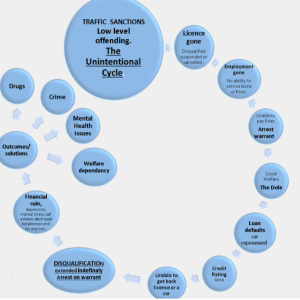
A feeling of hopelessness and being trapped in the” Unintentional Cycle” pushes many to criminal activity and or drug abuse as an escape or an ill-advised path to a solution. The untold mental damage and perhaps self-destruction is bad enough for the individual but the impact on the community is underrated.
Low-level traffic offenders can go from net contributors to a net liability for the community through welfare.
Drivers need to be accountable for their non-compliance, but we need to review the removal of drivers’ licences to allow the courts to use diversions, conditional Suspensions and Disqualifications.
It seems odd that diversion is the preferred option for the courts in criminal matters, but they do not apply the same standards to traffic matters. The rationale should be identical.
To remove a licence conditionally by limiting hours of driving so that the defendant can continue to work, would seem to be a fairer outcome and the impact on their social life not unreasonable – though even that may be excessive for a first offender.
Why should we not offer Good Behaviour Bonds in traffic cases as is done in some other State jurisdictions?
Under the current system, we still have many recidivist traffic offenders. The current regime does not promote compliance to any higher degree than the alternative approach we recommend.
How many of the current crop of recidivist drivers lost their licence for their first offence and ended up in the “Unintentional Cycle”?
We call on the Government to bring about necessary changes to legislation to provide greater flexibility in sentencing for traffic offences in Victoria, making them at least comparative to the criminal sentencing practices.
Ivan W.Ray Hon. Secretary Community Advocacy Alliance.
by CAA | Aug 6, 2017 | Library, Police Veterans in Schools, Uncategorized
6th August 2017
“The Hub”, is a designated building designed to house several Police related Not for Profit organisations and critically to provide a purpose-built base for the operation of the Retired Police Peer Support Program.
The Retired Police Association (RPA) Peer Support Program (PSP) has only been operating for less than two years and has cobbled together sufficient funds to train up 41 Retired (PSP) staff who operate purely on a voluntary basis throughout Victoria and also cover their own and clients out of pocket expenses.
In this very short time frame, the group are looking after 400 ex-police varying in need from the company to serious mental health issues including depression, PTSD and addictions to gambling, drugs and alcohol.
The group are finding the same experience as the Department of Veterans Affairs where issues, particularly of PTSD, are manifesting later in life.
The CAA has recruited the recently Retired Deputy Commissioner of Veterans Affairs Mike O’Meara who has extensive experience in administering the Psych services of Defence to advise the CAA on the administration of these initiatives and to assist the RPA.
Based on world practises, we can assume that fifteen per cent of ex-members will need some assistance with mental health issues after they cease employment with VicPol.
This probably is replicated with other emergency services, particularly the Ambulance Service. To say that the RPA has seen but the tip of the iceberg is a statement made in fact. It is not unreasonable to warn the Government of a tsunami of mental health issues for ex-police that is not far away and the early intervention of a Peer Support Program may lessen the impact and cost when it arrives.
Funding is a pressing necessity with the program only having sufficient funds to see them through to mid-2017. Apart from the meagre funds of the RPA, the group have received funding from the Police Association to assist with training however the financial viability of the program for the long term must be addressed relatively urgently to allow the practitioners to get on with the job rather than worrying about funding. I am at a loss as to how PSP has been so successful to date given that they have achieved their success on such a minuscule budget and what they have achieved and is testament to the dedication and ingenuity of the Retired members running the program.
Of a much more pressing necessity is the establishment of ”The Hub” facility which ideally will provide suitable accommodation for the PSP operatives and their administrative support but also house Clinicians to back up the program and act as a referral for some of the more dire cases handled by the PSP.
One of the problems is the stigma either real or perceived that people suffering mental health issues experience.
To that end, we propose to establish a commercial coffee shop as the front door of the services. A space people needing help can attend without fear of stigma. I am important that the Coffee shop is a commercial venture catering for the public to assist with the anonymity of people to access the resources.
The PSP has identified the security of the PSP operatives as a major concern as they are not permitted to attend private dwellings and currently their only option is to meet at local coffee shops. This is proving unsatisfactory by not offering the clients some confidentiality but also by the lack of security should a client have an episode.
We have identified a surplus Government building on the corner of Coventry and StKilda Road, South Bank, adjacent to Victoria Barracks. The building has been vacant for many years and originally housed the Department of Veterans Affairs Outpatients Psych Service.
We understand that the building has either been or is in the process of being transferred from the Commonwealth to the State ownership and we understand that part of the ownership process is a condition that the Veterans Art created as part of the rehabilitation within DVA has a permanent display gallery.
We have not inspected the building, but it is highly probable that the needs of the “The Hub” could co-exist with the Gallery. Until we have access to the building, we will not know the suitability.
The concept of “The Hub” requires the ability to develop a commercial coffee shop so location is important, good public transport and car access is essential and sufficient room to provide administration for RPA PSP, Blue Light Vic., CAA, Blue Ribbon, Police Legacy, Operation New Start, Police in Schools, Police Games Administration and clinical services to support RPA PSP.
We would be interested in accessing any alternate surplus Government Buildings preferably reasonably close to but not necessarily in the City.
Bringing all of these organisations together will have the bonus of improving their capacity to perform their various NFP functions and also add to the anonymity of ex-members going to the facility to seek help or undergo treatment.
It will also allow for easier access to these organisations by VicPol and the Government.
We would be pleased to discuss any options in relation to this initiative.
by CAA | Aug 6, 2017 | Library, PTSD, Uncategorized
6th August 2017
“The Hub”, is a designated building designed to house several Police related Not for Profit organisations and critically to provide a purpose-built base for the operation of the Retired Police Peer Support Program.
The Retired Police Association (RPA) Peer Support Program (PSP) has only been operating for less than two years and has cobbled together sufficient funds to train up 41 Retired (PSP) staff who operate purely on a voluntary basis throughout Victoria and also cover their own and clients out of pocket expenses.
In this very short time frame, the group are looking after 400 ex-police varying in need from the company to serious mental health issues including depression, PTSD and addictions to gambling, drugs and alcohol.
The group are finding the same experience as the Department of Veterans Affairs where issues, particularly of PTSD, are manifesting later in life.
The CAA has recruited the recently Retired Deputy Commissioner of Veterans Affairs Mike O’Meara who has extensive experience in administering the Psych services of Defence to advise the CAA on the administration of these initiatives and to assist the RPA.
Based on world practises, we can assume that fifteen per cent of ex-members will need some assistance with mental health issues after they cease employment with VicPol.
This probably is replicated with other emergency services, particularly the Ambulance Service. To say that the RPA has seen but the tip of the iceberg is a statement made in fact. It is not unreasonable to warn the Government of a tsunami of mental health issues for ex-police that is not far away and the early intervention of a Peer Support Program may lessen the impact and cost when it arrives.
Funding is a pressing necessity with the program only having sufficient funds to see them through to mid-2017. Apart from the meagre funds of the RPA, the group have received funding from the Police Association to assist with training however the financial viability of the program for the long term must be addressed relatively urgently to allow the practitioners to get on with the job rather than worrying about funding. I am at a loss as to how PSP has been so successful to date given that they have achieved their success on such a minuscule budget and what they have achieved and is a testament to the dedication and ingenuity of the Retired members running the program.
Of a much more pressing necessity is the establishment of ”The Hub” facility which ideally will provide suitable accommodation for the PSP operatives and their administrative support but also house Clinicians to back up the program and act as a referral for some of the more dire cases handled by the PSP.
One of the problems is the stigma either real or perceived that people suffering mental health issues experience.
To that end, we propose to establish a commercial coffee shop as the front door of the services. A space people needing help can attend without fear of stigma. I am important that the Coffee shop is a commercial venture catering for the public to assist with the anonymity of people to access the resources.
The PSP has identified the security of the PSP operatives as a major concern as they are not permitted to attend private dwellings and currently their only option is to meet at local coffee shops. This is proving unsatisfactory by not offering the clients some confidentiality but also by the lack of security should a client have an episode.
We have identified a surplus Government building on the corner of Coventry and StKilda Road, South Bank, adjacent to Victoria Barracks. The building has been vacant for many years and originally housed the Department of Veterans Affairs Outpatients Psych Service.
We understand that the building has either been or is in the process of being transferred from the Commonwealth to the State ownership and we understand that part of the ownership process is a condition that the Veterans Art created as part of the rehabilitation within DVA has a permanent display gallery.
We have not inspected the building, but it is highly probable that the needs of the “The Hub” could co-exist with the Gallery. Until we have access to the building we will not know the suitability.
The concept of “The Hub” requires the ability to develop a commercial coffee shop so location is important, good public transport and car access is essential and sufficient room to provide administration for RPA PSP, Blue Light Vic., CAA, Blue Ribbon, Police Legacy, Operation New Start, Police in Schools, Police Games Administration and clinical services to support RPA PSP.
We would be interested in accessing any alternate surplus Government Buildings preferably reasonably close to but not necessarily in the City.
Bringing all of these organisations together will have the bonus of improving their capacity to perform their various NFP functions and also add to the anonymity of ex-members going to the facility to seek help or undergo treatment.
It will also allow for easier access to these organisations by VicPol and the Government.
We would be pleased to discuss any options in relation to this initiative.

by CAA | Jul 5, 2017 | Library, Uncategorized
5th July 2017
‘THE FRUIT OF THE POISONOUS TREE.’
If a criminal makes a victim of one person (perhaps by stealing or killing) then the law and its appointed officials are supposed to ensure that justice is done for that victim – right? And that does sometimes happen. But too often it does not happen, and sometimes the law actually prevents that happening.
Sometimes the evidence against the offender is not allowed to be presented by laws made, not even by Parliament, but by lawyers.
Here is just one aspect of this absurdity; under the Common Law of England, which we inherited, evidence which was relevant to a case (whether to the prosecution or the defence of an accused) could, and should, be put before the court. In more serious cases that means put before a jury. And it made no difference how that evidence was obtained.
This led to certain injustices, particularly where some form of duress was used to obtain a “confession”. We can all agree that could not stand – if for no other reason than the very strong likelihood that any admission elicited by force may not be actually true, but merely given to stop the force continuing. Simple enough.
But then the lawyers took us down the path of the dreadful “fruit of the poisonous tree” decisions born in the USA. Yes, that haven of technicalities and complexities was brought to Australia just like movies and Coca-Cola.
Movies, literature and news media are replete with examples of the absurdities that followed in the US, and we shake our heads at how that was allowed to happen; how did our cousins get it so wrong?
Well, we did too. We followed them! More specifically, criminal lawyers persuaded our Courts to follow them. Judges make laws sometimes, when our Parliaments are – or remain – silent.
So now in Victoria, if evidence has been obtained improperly it will probably not be allowed to be put before a jury or court. If it was obtained illegally, as opposed to merely improperly, you can bet on it being disallowed. And all this applies to material that flows from an improper or illegal act (the “fruit of the poisonous tree” principle).
All very noble, you might think, but the consequences are often grossly ignoble. In one case police obtained a warrant to install a listening device in an office and thereby obtained evidence of “businessmen” bribing taxation officials. The problem – according to these judge-made laws – was that they got into the office by a subterfuge; that was reckoned to be improper. So the tape recordings of the offenders’ conversations was not allowed to be put forward.
(Do not bother to ask just how a listening device, or “bug” could otherwise have been installed in the office – that is not the point here.)
Should the police have carte blanche to go anywhere to search for evidence? No, or course not. But is it right that when they – or any other witnesses for that matter – come across relevant evidence by accident, or while looking for something else without proper authority, or perhaps in ignorance of the laws, should be compelled to keep that relevant evidence from a jury?
For example, if an employee of a firm suspects criminal misconduct by the employers and takes (steals) a copy of the firm’s records that show this, should that be enough to let the criminals off? Many an honest employee is prepared to “blow the whistle” but the present laws seem to work against this.
If a constable comes across some people in a car and requires them to open the car boot (perhaps for no real reason other than a general feeling of suspicion or unease) and finds a child’s dead body (or stolen property, if you like) shouldn’t he or she be allowed to tell a court about that?
If a burglar finds a murder victim in a house, while pursuing his own illegal trade, or even hears the murder being committed, would you not want a court to know about that when the murderer is being tried?
We do not suggest that anybody who acts illegally should get off scot free just because they happen to obtain evidence of a crime by a perpetrator, but it is not logical to allow the perpetrator to go scot free just because somebody else did something wrong. The present rules often let perpetrators go free to continue their depredations – to make further victims of us all.
The law should seek to protect us from offenders, and to protect any accused person against false evidence – and should doubtless protect any us from seriously abusive conduct committed against us (and to some extent that goes for those accused of crimes, too) but the approach of throwing the baby out with the bathwater, as our courts now do, ultimately works against society.
It is certainly possible to frame laws that strike a balance between the seriousness, or wilfulness, of an action, and the seriousness and relevance of evidence that flows from it.
Proponents of the present absurdity will argue that it is necessary to prevent some people (probably police officers, but not necessarily) wilfully trespassing against the rights of others in order to gain evidence. Those proponents are commonly in the camp of criminal lawyers who themselves have much to personally gain from that argument, but put that aside for the moment.
And strangely, they do not argue that evidence unlawfully obtained that assists the defence should be excluded, but put that aside, too.
It cannot be denied that there have been occasions when precisely such trespasses occurred – when suspects were mistreated in some way, quite deliberately, and quite outrageously. But note that we argue that such behaviour should not go unpunished – that the usual deterrents should apply. We merely argue that another offender, or accused person, should not go unpunished merely because of misconduct by somebody else.
Are we really so incapable of distinguishing between the baby and the bath water? Do we really have to let crooks go free because of the sins of others? Do we really need to slavishly adopt the flawed lawyer-and-offender-friendly rules from another jurisdiction where it is routinely abused? Why is our Parliament silent when the same abuses are occurring here under laws made outside Parliament?
Why do we require society, ourselves, to be victimised twice – once when an offender commits a crime and again when he/she escapes punishment because of some error by somebody else?
Noel Newman APM NPSM
Retired Commissioner Queensland Police Retied Deputy Commissioner Victoria Police
Hon. Treasurer Community Advocacy Alliance.

by CAA | Jun 19, 2017 | Library, Uncategorized
19th June 2017
There is no doubt additional education of students on the negative aspects and risks of drugs is important, as are support services for those effected but if ever there was an argument for the allocation of Police Resources to schools to work to prevent the problem then this is it.
In other States Police are embedded in Secondary Schools as part of a structured Police In Schools Program but that does not seem to be a worthy allocation of resources in this State. Paradoxically in other States with structured Police In Schools Programs Crime rates are falling.
Assistant Commissioner Nugent is correct in highlighting how the drug issue in schools feeds into the ever increasing crime rate.
We cannot expect teachers to deal with the criminal aspect of the Drug problem in Schools. Not their role.
We would hope Mr Nugent uses his influence on Police Command to reverse its stubborn rejection of allocating Police to Schools and provide police to work with other professionals to deal with the problem as well as implement prevention strategies.
A properly structured Police in Schools Program, not ad hoc visits, where potential problems are dealt with throughout a child’s education has a proven track record of reducing crime that benefits the community. Children and youths can be diverted from involvement in Drugs and other anti-social behaviours (not limited to but including Domestic Violence, Bullying and Ideological Radicalisation) taking the load off the professional services including Operational Police and the Courts.
Better to prevent than wait for them to offend and then deal with the consequences as now is the strategy – our children are surely worth that much.
Ivan W Ray

by CAA | Jun 17, 2017 | Library, PTSD, Uncategorized
17th June 2017
“The Hub”, is a designated building designed to accommodate a number of Police related Not for Profit organizations and critically to provide a purpose built base for the operation of the Victoria Police Retired Police Association Peer Support Program (PSP) and support VicPol peer support activities.
The Retired Police Association (RPA) PSP has only been operating for less than two years and has cobbled together sufficient funds to train up 41 Retired Police PSP Councillors who operate purely on a voluntary basis throughout Victoria and also cover their own and clients out of pocket expenses.
In this very short time frame the group are looking after 400 ex police varying in need from social company to serious mental health issues including depression, PTSD and addictions to gambling, drugs and alcohol.
A parallel program is operated by Victoria Police and that program could be accommodated in part by “The Hub” in its operations.
The PSP group is having similar experience to the Department of Veterans Affairs where issues, particularly of PTSD attributable to service, are manifesting later in life.
The CAA was advised by the recently Retired Deputy Commissioner of Veterans Affairs Mike O’Meara who has extensive experience in administering the Psych services in Veterans Affairs, on the development of these initiatives.
Based on world experience we can assume that fifteen percent of ex- members will need some assistance with mental health issues after they cease employment with VicPol.
This would no doubt be replicated with other emergency services particularly the Ambulance Service. To say that the PSP, has seen but the tip of the iceberg, is a statement of fact. It is not unreasonable to warn the Government of a tsunami of mental health issues for ex- police that is not far away and the early intervention of the PSP may lessen the impact and cost when it arrives.
Funding is a pressing necessity with the PSP program that only has sufficient funds to see them through to mid-2018. Apart from the meagre funds of the PSP the group have received funding from the Police Association to assist with training however the financial viability of the program for the long term must be addressed relatively urgently to allow the practitioners to get on with the job rather than worrying about funding.
We are at a loss as to how PSP has been so successful to date given that they have achieved their success on such a minuscule budget. What they have achieved is testament to the dedication and ingenuity of the Retired members running the program.
Of a much more pressing necessity is the establishment of ”The Hub” facility which ideally will provide suitable accommodation for the PSP operatives and their administrative support but also house Clinicians to back up the program and act as referral for some of the more dire cases handled by the PSP.
One of the problems is the stigma either real or perceived that people suffering mental health issues and their families’ experience.
To that end our proposal is to establish a commercial coffee shop as the, “Front door”, of the services. A space people needing help can attend without fear of stigma. It is important that the Coffee shop is a commercial venture catering for the public to assist with the anonymity of people to access the resource and contribute to the operating costs of the PSP.
The PSP has identified the security of the PSP operatives as a major concern. They are not permitted to attend private dwellings and currently their only option is to meet at local coffee shops. This is proving unsatisfactory by not offering the clients appropriate confidentiality and a level of security should a client have an episode.
The concept of “The Hub” requires the ability to develop a commercial coffee shop so location is important, good public transport and car access is essential and sufficient room to provide administration for RPA PSP, other NFP Police related organisations and clinical services to support PSP.
Another aspect of, “The Hub” is to include a Police and Citizens Youth Club (PCYC) in the building. Apart from the obvious advantages in the Youth space, a PCYC Gymnasium could also help fund the operation of “The Hub”.
Allegedly many Gyms, now extremely popular with younger adults, are operated by Bikie Gangs (OMG’s). The operations of PCYC in the youth field are not compromised by the operation of the facility as a commercial Gymnasium, additionally many Police and other Emergency Service members would be more comfortable using a PCYC Gym than some of the alternative venues. Not having a member of an OMG working out beside you would be an attraction to many.
The proximity of the Gym to the PSP services will also provide the capacity for some clients to combine their gymnasium programs for the health of their body with the work on their mental health.
Bringing these organizations together will have the bonus of improving their capacity to perform their various NFP functions and also add to the anonymity of current and ex- members going to the facility to seek help or undergo treatment.
The facility has also the capacity to provide opportunities for Volunteer work which may assist some of the PSP Clients.
It will also allow for easier access to these organizations by VicPol and the Government.
The recommendation is to establish a Pilot facility so that operational mattes can be addressed and sorted. It is recommended that a Board of Directors be established to manage the facility that initially includes Police and Government representatives together with a Chair and others drawn from the broader community with commercial experience.
The whole operation would need seed funding and the application of some resources however once established the “The Hub” would be self-funding.
As the development of this concept achieves identified targets, so the program can be replicated across the State with the critical proviso of the establishment of a Community Board to operate each Hub independently. There is an important role for Local Government in the program to also provide resource support.
The initial Board would assume responsible for the overall coordination, development of the program and manage Operational standards and fiscal responsibility, coordinating all establishments and facilities operating under the banner of “The Hub”.
Ivan W.Ray Hon Secretary
Community Advocacy Alliance
by CAA | Jun 13, 2017 | Library, Uncategorized
13th June 2017
The announcement by Victoria’s Chief Commissioner of Police Graham Ashton AM APM, of his intention not to extend his present appointment throws into sharp relief the serious challenges facing policing in Victoria.
The Community Advocacy Alliance (CAA) recognizes that the performance of Victoria Police is not only the responsibility of the Chief Commissioner but is a responsibility shared across those senior personnel commanding key line functions. It is for this reason the CAA has advocated the need for a Commission of Review which will address Police Command per se, its personnel, its protocols, its priorities, response times, service delivery, the allocation of resources and all other pertinent issues including underlying philosophies.
A Review is critical to ensure that the best benefits are achieved for all Victorians from the increased allocation of Police for duty in this state which all Victorians are paying for.
A Commission of Review is the only mechanism capable of making Victorians feel and be safe again.
Such a review will ensure that any new appointee as Chief Commissioner will take over an organization that is indeed fit for purpose. Simply appointing another “skipper” to command a ship seriously in need of overhaul and in imminent danger of sinking does not deliver to Victoria or its citizens a police force which will meet the increasingly testing environment of today and tomorrow.
At the same time there is need for reform of the judiciary and the appallingly inadequate sentencing regime. Bail and parole processes are also in need of urgent review and change to reflect the reasonable expectations of the community.
Justice must not only be done – but be seen to be done.
These issues are the focus of much genuine community concern.
The CAA calls upon the Government to immediately implement a Commission of Review as these major issues need to be urgently addressed in this State.
Kelvin Glare AO APM Ivan W. Ray
Chairman CAA Secretary CAA”

by CAA | Jun 1, 2017 | Library, Uncategorized
1st June 2017
If a criminal makes a victim of one person (perhaps by stealing, or perhaps by killing) then the law and its appointed officials are supposed to ensure that justice is done for that victim – right? And that does sometimes happen. But too often it does not happen, and sometimes the law actually prevents that happening.
Sometimes the evidence against the offender is not allowed to be presented by laws made, not by Parliament, but by lawyers.
Here we will mention just one aspect of this absurdity. Under the Common Law which founded our rules of evidence which are relevant to a case (whether to the prosecution or the defence of an accused) could, and should, be put before the court. In more serious cases that means put before a jury. And it should make no difference as to how that evidence was obtained.
This led to certain injustices, particularly where some form of duress was used to obtain a “confession”. We can all agree that could not stand – if for no other reason than the very strong likelihood that any admission elicited by force would not be actually true, but merely given to stop the force continuing. Simple enough.
But then the lawyers took us down the path of the dreadful “Miranda” decisions born in the USA. Yes, that haven of technicalities and complexities was brought to Australia just like movies and coca-cola. Movies, literature and news media are replete with examples of the absurdities that followed in the US, and we shake our heads at how that was allowed to happen; how did our cousins get it so wrong?
Well, we did too. We followed them. More specifically, criminal lawyers persuaded our Courts to follow them. Judges make laws sometimes, when our Parliaments are – or remain – silent.
So now in Victoria, if evidence has been obtained improperly it will probably not be allowed to be put before a jury or court. If it was obtained illegally, as opposed to merely improperly, you can bet on it being disallowed. And all this applies to material that flows from an improper or illegal act (the “fruit of the poisonous tree” principle).
All very noble, you might think, but the consequences are often grossly ignoble. In one case the police obtained a warrant to install a listening device in an office and thereby obtained evidence of “businessmen” bribing taxation officials. The problem was – according to these judge-made laws – they got into the office by a subterfuge; that was reckoned to be improper. So the tape recordings of the offenders’ conversations was not allowed to be put forward.
(Do not bother to ask just how a listening device, or “bug” could otherwise have been installed the office – that is not the point here.)
Should the police have carte blanche to go anywhere to search for evidence? No, or course not. But is it right that when they – or any other witnesses for that matter – come across relevant evidence by accident, or while looking for something else without proper authority, or perhaps in ignorance of the laws, should be compelled to keep that relevant evidence from a jury/
For example, if an employee of a firm suspects criminal misconduct by the employers and takes a copy of the firm’s records that show this, should that be enough to let the criminals off? Many an honest employee is prepared to “blow the whistle” but the present laws seem to work against this.
If a constable comes across some people in a car and requires them to open the car boot (perhaps for no real reason other than a general feeling of suspicion or unease) and finds a dead body (or stolen property, if you like) shouldn’t he or she be allowed to tell a court about that?
If a burglar finds a murder victim in a house, while pursuing his own illegal trade, or even hears the murder being committed, would you not want a court to know about that when the murderer is being tried?
We do not suggest that anybody who acts illegally should get off scot free just because they happen to obtain evidence of a crime by a perpetrator, but it is not logical to allow the perpetrator to go scot free just because somebody else did something wrong. The present rules often let perpetrators go free to continue their depredations – to make further victims of us all.
The law should seek to protect us from offenders, and to protect any accused person against false evidence – and should doubtless protect any us against seriously abusive conduct committed against us (and that goes for those accused of crimes, too) but the approach of throwing the baby out with the bathwater, as our courts now do, ultimately works against society.
It is certainly possible to frame laws that strike a balance between the seriousness, or wilfulness, of an action, and the seriousness and relevance of evidence that flows from it.
Proponents of the present absurdity will argue that it is necessary to prevent some people (probably police officers, but not necessarily) wilfully trespassing against the rights of others in order to gain evidence. Those proponents are commonly in the camp of criminal lawyers who themselves have much to gain from that argument, or Human Rights Lawyers who object purely because they can ,but put that aside for the moment.
It cannot be denied that there have been occasions when precisely such trespasses occurred – when suspects were mistreated in some way, quite deliberately, and quite outrageously. But note that we argue that such behaviour should not go unpunished – that usual deterrents should apply. We merely argue that another offender, or accused person, should not go unpunished merely because of misconduct by somebody else.
Are we really so incapable of distinguishing between the baby and the bath water? Do we really have to let crooks go free because of the sins of others? Do we really need to slavishly adopt the flawed lawyer-and-offender-friendly rules from another jurisdiction where it is routinely abused?
Why do we allow society, ourselves, to be victimised twice – once when an offender commits a crime and again when he/she escapes punishment because of some error by somebody else?
In this current environment the Government must now be heard on the Miranda debacle and clearly articulate how they propose to Legislate change.

by CAA | May 4, 2017 | Library, Uncategorized
PLAN 100……..
“Addressing Law and Order for all Victorians”
Prepared by K. Glare and I. Ray
For the
Community Advocacy Alliance.
The Community Advocacy Alliance (CAA) has previously identified the magnitude of the “Crime Tsunami” facing this State and has also commented on some of the most obvious causes.
This document is designed to provide a basis for building a workable strategy to redress the trends. This document has been prepared with the information available in the public domain and through consultation with serving and retired Police and the broader community, including victims.
The document covers broader Law and Order issues beyond Policing, and Policing can be broken into three general categories: effectiveness, efficiency, and morale.
These three important facets of Policing are the key areas that must be addressed for policing to serve the community as effectively as possible.
The argument of “policing is different” just does not wash anymore, and service delivery needs to be a priority, and the Police performance needs to be held accountable back to the community through the Annual Report and quarterly reporting, coupled with the Crime statistics.
If Service delivery falls below par, the Chief Commissioner needs to explain why and how he proposes to rectify the matter.
The other argument that there are “different pressures” on modern policing also does not wash. Sir Robert Peel, when designing the principles of modern policing over 100 years ago, which have stood the test of time, did not envisage the motorcar, technology, the impact of drugs, or a raft of other new issues arising since the principles were designed.
It is inconceivable that Victoria Police will continue on the current strategies that got us where we are now, in a ‘crime tsunami’yuryu`, particularly when neighbouring States with comparable community demographics (that operate more in line with Peel’s Philosophy) are reducing their crime rates with fewer police per head of population. We accept that trends can be fickle, but a consistently rising crime rate in Victoria has evolved that has not been seen in other States. To reverse this trend, there does not seem to be a plan, feasible or not, just a few isolated, incidental adjustments. It needs somebody to stand up and take responsibility.
Implementing the contents of this document is the fastest and best way to reverse current Crime trends, which have evolved over nearly twenty years, but will still take time to resolve.
The community is demanding change of a systemic and profound nature immediately. The demands are becoming more strident and show no sign of diminishing, but the reverse.
To make a difference and start the recovery process:-
- REFORMING AND MODERNISING THE POLICING FUNCTION:
Service Delivery: Policing is no different to any other service provided to the community by the government or the private sector. It is totally reasonable that the community can expect a certain level of delivery of that service set against benchmarks, so that management and the community can have confidence in the organisation.
We now live in a fast-moving digital world where things happen now, not when the service provider feels like it, so archaic approaches to service delivery must be modified.
One of the most disturbing things that the Community has fed to us is the alarming number of times that police do not respond to calls for assistance, and when they do attend, it is alarming that people are often told, “Nothing can be done,” or “it is not worth chasing up as nothing will happen”. Although anecdotal, there is sufficient consistency to accept that there is a major problem.
Additionally, the lack of feedback after contacting the police, either as a victim or witness, is also alarming. Examples of victims of violent crime living in fear, not knowing whether perpetrators have been arrested, are common, and a response time to an aggravated burglary of forty minutes without explanation, and examples of Police not responding at all to serious incidents are common and a disgrace. These matters are serious to the victims and the community, but they would appear not serious to the police.
If Policing is to be effective, it needs the support of the community. Current strategies border on treating the community with disdain, and that must be addressed.
- The failure of Service delivery: This can be traced to a problem of accountability and a lack of clear standards in the allocation of tasks. Tasks are currently and traditionally allocated to crews by vehicle call signs rather than to individual members. Allocating a task to an individual member will allow management to properly supervise the process. This simple procedural adjustment to give members ownership and responsibility will dramatically improve service delivery. The ability to identify how individuals are performing is a management bonus.
- Response time benchmarks: An urgent need exists to establish benchmarks for standard response times to jobs allocated by a priority hierarchy. Despatch times need to be measured against call received times and the time the allocated resource arrived at the call (Code 1) – not just the time the call was dispatched, because there is then no way of determining whether or how long the resource took to attend the job. Allocating tasks to an individual member will allow management to monitor the response difficulties more accurately.
- Activity returns: Setting out the action taken and, critically, the callback by the responsible member to the originator of the call or the victim is a critical part of the process, and no job should be marked as completed until this is done. The supply of Mobile phones to all police, as recommended elsewhere, will assist in this task, as members engaged in any static duty would be able to follow up complainants without the necessity to be in the Station.
- Additional intelligence: Intelligence derived by further contact with complainants is an immeasurably effective Policing tool.
- The Police Advice Line: The activation of the Police Advice line 11444 ( – the number originally chosen for the high recall value) should be reactivated as a matter of urgency. The Community is being told not to use 000 for non-life-threatening cases for ambulances, and this should also apply to the Police. When you talk to the community, as we do, there is confusion about where to ring for what service. Local Police stations are often unmanned or switch to a convoluted and confusing message, particularly if the caller is under stress. It should not be the community that has to sort out who they should talk to for which service. The process must be simplified. For emergencies, ring 000; for all other Police matters, ring 11444. A protocol for these calls to route the caller to the appropriate place, which may be the local Police Station or somewhere else in the organisation, will streamline the telephone service delivery at least. Replace existing switchboards with one.
- Role of Local Area Commanders and Station Commanders: Extending the role of Area and Station Commanders to achieve a pre-determined number of random calls to complainants and or Victims is required to assess the performance of individual Police under their command. That is the only way that proper evaluation of their performance can be assessed.
- Victim information protocol: A protocol to keep victims informed in relation to investigations needs to be established and managed. Assigning benchmarks and a mechanism to monitor standards has to be developed.
- Phone Protocol: Phone contact with any organisation is usually the first avenue of contact, and it is therefore essential that a protocol be put in place and managed for dealing with phone contacts. It is not acceptable that calls to Police Stations, in particular, are answered by naming the Station – the person answering the phone should have the good manners and professionalism to identify themselves and be accountable for the conversation
- Business cards for members: Essential and efficient individual business cards that can be handed to victims and or witnesses are necessary and feed into the image and service delivery of the organisation. The use of generic cards with handwritten details should be abolished for no other reason than being very unprofessional.
- Computer Aided Despatch: Releasing CAD data to the public through the Victorian Crime Statistics Agency will hold Victoria Police to Public Account for issues, for example, instances of erratic or dangerous driving calls to 000 and action taken.
- Maintaining Service Delivery Standards: At a sub-district level, a public meeting to discuss Law and Order issues as they impact the local community must be undertaken quarterly in line with the release of Crime Statistics and Community satisfaction survey levels. An organisation without feedback lives in a vacuum, which will always be detrimental to its good operations.
Commission of Review: Every organisation benefits from periodical reviews, and when an organisation is struggling to achieve best practice, an independent review is essential for the health of the organisation. To address fundamental philosophical attitudes that must be altered will be challenging. A competent Commission of Review can achieve this.
Modifying entrenched values, however difficult, must be achieved rapidly. A properly structured Commission of Review will not only provide guidance for the Government and the Chief Commissioner but also give confidence to the community that their concerns are being addressed.
- Undertake a Commission of Review: Establishing a Commission of review of policing in this State and other issues that the Commission identifies should be implemented, which could include Judicial practices, Corrections procedures or principles and activities of other Government Departments as they relate to the Law and Order issue.
- The independence of the Chair: The effectiveness and credibility of the Commission to the Police and the public will require great care in the selection of the Commission Chair. Examples of competent independent persons include recently retired New South Wales Commissioner Scipione or a suitably experienced former senior police officer. The independence, politically and from the current command, is essential.
- c) Timing of the Commission: The Commission needs to commence as soon as possible, reporting back to the Government and the Chief Commissioner progressively.
- The process: The process of the Commission will be as important as the outcomes for altering entrenched values and the current mindset of the organisation, and needs to be coordinated with the Coghlan Inquiry.
- Adopt a Proactive Policing Philosophy: Adopting this philosophy is not contrary to but an essential part of the Victoria Police Mission Statement.
- Modify current strategy: Importantly, there is a need to modify, not dispose of, the “Sophisticated Management Index” tasking experiment. As its current application is counterproductive to effective policing.
- Broken Windows Philosophy: Introduce the ‘Broken Windows Policing Philosophy’ as the guiding principle of Policing in this State.
https://www.manhattan-institute.org/pdf/_atlantic_monthly-broken_windows.pdf.
- Structural Review: Review the management structure of the Force to ensure that there is no accountability splitting and there is a direct line of accountability from the Chief Commissioner to the most junior Constable. Every manager needs to be accountable for the operation of the command with which they are entrusted without exception.
- Performance-based management: Implement Performance-based management at all ranks across the Force, measured by KPIs, with the Chief Commissioner having the ability to move or sanction non-performers.
- Benchmarking: Establish Benchmarks and KPIs to measure targets in Crime, Traffic, Public Order and Personnel Management for each Manager/Unit and hold them to performance account.
The emergence of new technology, almost on a daily basis, provides exciting opportunities for improving the efficiency of Policing. With the technology comes risk, and without stifling progression, sensible efforts to protect police and the organisation must be applied. Equally, the technology must only ever be an aid and, at all costs, avoid the error that allowed statistics to become the management.
- The G-Tag: Pursue with vigour the Community Advocacy Alliance G-Tag proposal as a major Road Safety, Crime prevention and Community Safety initiative. Coordination with Federal initiatives, if necessary, of GPS tracking.
- GPS: The prolific applications of Global Positioning Systems (GPS) technology both commercially and privately will ultimately attract crime, and although not currently evident, it is sure to occur, and that could be catastrophic. It is absolutely critical that the Government and Police take a leadership role in managing and, in part, controlling its use rather than it being left to develop in an ad hoc fashion as it is rapidly doing now. Leadership now will avoid catch-up strategies in the future, which may prove too difficult to effectively implement.
- Mobile technology: Immediately issue all Police members with an appropriate Mobile Phone with the normal smartphone capabilities and the ability for audio, video and still photography to be automatically encrypted and uploaded to a centralised safe repository where the material can be secured and retained for future reference.
- Emergency APP: Phones to be fitted with an emergency ‘App’ to protect members on and off duty and location facilities permanently enabled, but with a modified geolocation feature.
- E-Training: Expand and develop sophisticated training for Police in the use of Social Media platforms and how to prevent and investigate Cyber Crime.
- Broader Crime Command E-Training: Members of the Crime Command must be exposed to detailed training in this area, favouring broader training and cyber policing responsibility rather than specialised tasking.
- E-Crime specialists: An e-crime specialist unit for advanced technical advice would still be required, but this unit could be primarily unsworn staff.
- Personal E-Security Training: A component of all training must include personal use and the risks to members and their families in the use of Social media. Police email addresses and other interactions by Police with other social media platforms must be subject to training and a realistic policy.
REALIGNMENT OF POLICING PHILOSOPHIES
Operational realignments – Moving operational decision-making closer to the coal face with accountabilities and performance-based management.
- Backfill Police Stations: As a priority, backfill all Police stations to their authorised personnel strength as of 1st of June 2016. Cancel all secondments, temporary duty or other off-station functions and commence a review of staffing levels at all stations.
- Downgrade statistical influence: Immediately downgrade the influence of statistic gathering and tasking by statistics and leave tasking to Station and Unit Commanders (retaining access to statistics as a management tool), whose performance is measured against the applicable benchmarks and Key Performance Indicators (KPIs). Review the Station cluster concept.
- Management by KPIs: Have Station and Unit Commanders provide weekly progress reports towards achieving their KPI targets.
- Task group re-evaluation: Re-evaluate all special task groups, task forces or other similar functions and apply a cost-benefit analysis, overlaying other considerations for their existence, that analysis to be biased towards outcomes over financial cost.
- Review non-operational sworn Police functions: Immediately review all non-operational positions currently filled by sworn members with a target of a twenty five percent reduction in sworn police fulfilling non-operational roles.
- Using sworn Police in non-operational roles: For specific resource requirements of a temporary nature, require that sworn police in non-operational support roles be first call over Stations for planned major and unanticipated events.
- A Force reserve Unit: Establish a Reserve Unit for Victoria Police where those who have not met performance targets (of any rank) can be transferred to allow them to adjust to the organisation’s requirements and provide opportunities for more skilled individuals to fill the vacated positions.
- One-up patrols: Investigate the feasibility of one-up response units for stations equipped with additional vehicles to allow for members of a Shift Section to each have a vehicle to respond to routine calls for assistance under the direction of a Supervisor. This will allow for a substantial increase in the flexibility of resources to deal with operational demands. Not to be interpreted as reducing Police numbers, as the proposal is numbers neutral, but each member has a vehicle. The impact of two members arriving at an incident is magnified if there are two Police cars. The Los Angeles Police Department has adopted this strategy.
- Foot Patrol priority: Where possible, introduce foot patrols to major shopping precincts or other appropriate places.
- Managing members on restricted duty: Quarantine a limited number of positions for members who want to work part-time or for other non-health-related restricted duty personnel, so the integrity of the Station Roster is not compromised, which puts undue stress on other members. Backfilling part-time positions to ensure the integrity of the unit or station’s service delivery is essential.
- Impact on Prisoners on remand: Establish the impact of Police procedures on the length of time that prisoners are held on remand. Ensure that Victoria Police are not the cause of excessive delays in bringing perpetrators to justice, to enable Victoria Police to be vocal on this issue.
IMPROVING MANAGEMENT
Introduce performance-based management:
To move the Force to a performance-based management model, a good place to start is with the selection process for entry to and promotion from within.
- Selection Boards: Immediately reintroduce or restructure Selection Boards for Applicants to join the Force, chaired by an Officer of a minimum rank of Inspector. Ensure those conducting internal Selection Boards and Panels are of Officer Rank and, where possible, at least two substantive ranks above the rank of the applicants.
- Performance of Board Members: Board performance to be monitored so that results may be a consideration in the future promotion of Board members themselves. Consideration for Promotion must be weighted to the performance of the applicant’s current/last or previous Commands, measured against KPIs, with personal attributes of lesser weight.
The most reliable measure of future performance is past performance.
- Review Promotions criteria: Immediately review the promotional criteria to ensure that it aligns with the proactive and accountability paradigm of Policing.
- Performance Review Panel: Establish a Performance Review Panel to advise the Chief Commissioner on the performance and suitability for retention of all Sections, Operations and Branches of Victoria Police. This review should be ongoing and provide alternatives, advice and recommendations based on the core principles of Policing and the ability of Victoria Police to meet its KPIs. The former Police Inspectorate performed this function in the past and was extremely effective.
- Promotion based on past performance: The establishment of appropriate KPIs and a culture of performance-based promotion relying on the past performance of applicants. Commands to evaluate suitability for promotion will rapidly aid the germination of a culture around this principle.
- Consequences for non-performers: As important as it is to change culture for it to be truly effective, there must be consequences for non-performers and those who work actively or passively against the principle. The concept of a Force Reserve dealt with elsewhere will address this issue.
DISCIPLINE
Discipline is essential to a police organisation, and that area needs adjustment to improve the coerciveness of the police, particularly in high-stress environments.
- Victoria Police, by its nature, is a disciplined organisation, and therefore it is essential to reintroduce Drill to the training of Recruits. Once trained in the concept of Drill, it stays forever and is a major contributor to discipline and the ability to work as a team, often in a hostile environment. If additional time needs to be added to the training, it would be well justified and improve the overall ability of the organisation, for which discipline is essential. Discipline is important not only for the cohesive performance of the organisation but also for the safety of Police members.
Self-discipline grows from being subject to external discipline.
- Random Drug Testing: Introduce more rigorous random illicit drug testing for the police. Enforce zero tolerance for Police who test positive to illicit drugs. The initial response should be one of providing support and treatment for any drug issues. If the Police member fails to take advantage of the services offered, they should be (subject to the clinician’s advice) immediately moved from sick leave to suspension. Suspension without pay and referral to the Victoria Police disciplinary procedure, with the onus on the employee to show cause why their services should not be terminated on the basis of a positive test.
The standards of the police must exceed those of the community.
7) YOUTH STRATEGY
Youth strategy – the Police role in the youth space has greatly diminished over recent years with the current “Risk Averse” philosophy causing a strategy to develop where Police overtly move all responsibility for Youth to others. It is essential that VicPol assumes a leadership role and reconnects with youth as part of a major modernisation of the current regressive strategies toward youth, and that VicPol accepts its responsibilities in this area. A comparison with other State Police shows there is a correlation between Police connecting with Youth and Crime rates.
- Youth Command: Introduce a Youth Command and dispense with other Commands that perform functions that can and should be the responsibility of other Police Units and Sections that should deal with the issues adequately if given appropriate KPIs.
- Youth Officers: Introduce dedicated Youth Commanders to the regions responsible for coordinating youth issues at a local level of the rank of Inspector reporting to a Superintendent responsible for the region’s overall Youth Strategy.
- Police in Schools: Reintroduce a Police in Schools program with all Stations required to implement the program across Victoria, coordinated, resourced and trained by the Youth Command. This is a key element for a long-term impact on Crime and community safety; however, there were many examples of short-term improvements.
Significantly, the Police involved in the PISP will be the frontline in addressing Family Violence issues through their ease of contact with school families. Early intervention by PISP Officers who are well-resourced will significantly reduce risks to family violence victims.
- Blue Light: Provide support and resources for Blue Light Victoria (BLV) from the Youth Command to expand BLV’s core function coordinating with the PIS Program by developing an upgraded Memorandum of Understanding (MOU) designed to grow the resource.
- Youth Camps: Building on the highly successful Blue Light Camp at Maldon, explore the feasibility of extending the concept to work towards establishing additional camps throughout Victoria, which is critical to building on the work of both Blue Light, Police in Schools and other Police Youth programs as they can all be interrelated.
- PCYC: Explore the feasibility of establishing Police Citizens Youth Clubs based on the model used in other States. These clubs would fit well with, The Hub, concept discussed elsewhere as well as Police in Schools, Blue Light and the Youth camps initiatives.
- Operation New Start: A program designed to keep young people at school. This program dovetails well with other recommended Police Youth initiatives. Require the Youth Command to support and resource Operation New Start and develop an MOU.
- Life Ed: A very worthwhile existing program that should be integrated with the Police in Schools program, and a liaison Officer appointed, as was once the case.
- Ropes Program: Require the Youth Command to work with the Justice Department in the development and integration of the Ropes Program into the Police Cautioning Program.
- Training Senior Youth Officers: The Youth Command to manage and train Senior Officers at a Divisional level dedicated to Youth and the operation of Youth Liaison Groups, coordinating activities of all groups working in the Youth Space in managing recidivist youths.
- Realignment of the definition of a child: Immediately prepare a submission for the Government to realign the definition of a ‘Child ‘within the meaning of all Acts and all other Government functions in line with CAA recommendations and community expectations. [Noting that one can vote and join the Armed Services to kill or be killed at age eighteen.]
- Regional Youth Commissioners: Immediately prepare a submission to the Government for the establishment of Regional Youth Commissions responsible for the overall management of Youths who commit crimes and management of Youth Liaison Groups at a Divisional level, with the authority to direct actions of other Government Departments or agencies operating in the Youth field.
- Chief Commissioner’s authority to release children’s images: Immediately prepare legislation to make the Chief Commissioner the responsible authority in determining what information and or images of the identity of children is released to the media or elsewhere, whether they are a victim, suspect or a convicted person and the discretion exercised by the Chief Commissioner to be absolute.
- Police Cautioning Program: Undertake a detailed review of the Police Cautioning program to extend its function and capability to deliver greater impact on young people, performing its critical diversionary outcomes. Additional resources from other Government and not-for-profit (NFP) organisations should be coordinated and directed by the Cautioning Program to ensure a concerted effort is applied to individual young people to prevent them from re-entering the Criminal System. The Police Cautioning Program should become the pre-eminent diversionary vehicle. If offenders are diverted at this stage, it will save many millions of dollars and improve community safety substantially.
8) POLICE FLEET/DRIVING
Police fleet and driving- upskilling and equipping the police fleet designs to meet Force objectives.
- Marking Fleet: Fit as many Police vehicles in the fleet as practicable with Police decals (including vehicles used by management and administration) to maximise the visibility of Police on the roads. There is a need in Policing for unmarked vehicles, but they should only be allowed by special application authorised at an executive level. Vehicles, unless they are routinely used for covert operations, must form part of the visible police presence.
- Nudge Bar deterrent: Fit all operational police vehicles with suitable “Nudge bars” to aid critical intercepts, noting that the deterrent effect will be profound.
- Driver training: Introduce practical training for all police authorised drivers on vehicle interception techniques.
- GPS: Fit all Police vehicles with Satellite Tracking devices so line supervisors and management know the location of each vehicle and the use of police vehicles for non-police unauthorised purposes can be identified. The ability to locate every vehicle will also act as a safety measure for Police members and could prove critical in Prosecutions.
9) ROAD TOLL.
The Road Toll – A lack of a highly visible Police presence is the flaw in current strategies and urgently needs attention – other States with far larger road networks comparatively achieve better results than the compact state of Victoria, and that is a serious failing of current strategies.
- Highway Patrol: Immediately divide the Patrol Traffic resources into Highway Patrol and Metro Patrol, and fit each vehicle assigned to Traffic with Number Plate Recognition technology, Safety Cameras and Satellite tracking devices so that management can ensure the vehicles are where they should be. Highway vehicles to be allocated to dedicated highways and or freeways to increase the visible Police presence.
- Licence Legislation review: Seek Legislative amendments that require persons detected driving while their licence is suspended to automatically (administrative procedure) have the penalty upgraded to Disqualification for the balance of the period imposed by the Suspension and any greater period imposed by a court for the additional offence. The only contestable part of this mandated process should be an Appeal on the basis that the Offender was not driving as alleged.
- Disqualified drivers: Drivers detected driving during the period of Disqualification to be subject to mandatory immediate arrest and one month’s jail (Administrative process). Disqualified drivers who have served their disqualification period are then unlicensed drivers if they are detected driving after the period imposed. Any further breaches add an additional month to the preceding period. The only contestable part of this mandated process to be an Appeal on the basis that the Offender was not driving as alleged.
- Licence revocation review. There is a huge amount of Police and Court time dedicated to the processing of License miscreants, and we pose the question as to whether the process has become so draconian and difficult that enforcement and breaches are too frequent. We do not infer a lessening or dilution of the penalties for breaching Traffic Infringement, but the process of regaining a license needs to be modified, particularly for first offenders and for mid to lower range offences. It may be the process that causes the breaches.
As with crime, the ‘Broken Windows’ philosophy works equally with traffic. Focusing only on high-end traffic issues ignores the minor infringements, so those that are so inclined will continue to ignore compliance and escalate their behaviour. The lack of a “Broken Taillight Policy” explains why so many resources and technologies applied to traffic management are not having the desired effect. The continued evolution of reducing speed limits is a case in point – if there was compliance and safe driving at existing speeds the need to reduce speeds would not exist.
- Police Cautioning program (Traffic): Although there are administrative cautioning options available, it could be particularly useful to have particularly young drivers experience a formal caution as opposed to a court appearance. Our objective should always be slanted to compliance, not penalty.
10) OPEN AND TRANSPARENT POLICING:
Open and transparent Policing– The community is entitled to know about policing, and VicPol needs to be open and transparent as far as that is operationally possible. However, the community will accept as reasonable the non-disclosure of operationally sensitive information as long as they are informed of the reason.
- Media management: Install a high-ranking officer with substantial operational experience as the Media Commander for Victoria Police, answerable to the Chief Commissioner, with the role of managing the information flow from Victoria Police, ensuring Operational confidentiality is not compromised.
- Members who speak to the media: Instruct all Operational members, irrespective of rank, who speak with the media in good faith that they will not be subject to criticism.
- Attempts by police to manipulate the media: Sometimes, for altruistic reasons, members attempt to mislead or attempt to manipulate the public through the media. Irrespective of the rationale, they should be subject to discipline. The public is very sensitive and highly tuned to identifying spin or attempted spin, and the integrity of the organisation is damaged by any attempts to manipulate the media.
A new approach in the war on drugs must be considered as the current strategy, although punctuated by spectacular arrests, is failing at the community level.
- a) Drug seizure disclosures: Implement a Policy of non-disclosure of Major drug arrests and seizures and encourage other law enforcement agencies to adopt the same strategy. Advertising a seizure is providing a Drug offender with an explanation to their criminal employer/supplier of what happened to the drugs and or money. Police should not take on the responsibility of acting on behalf of the perpetrator. The publicity of the value of seizures acts as a magnet for some who only see the potentially huge financial and lifestyle returns that drug trafficking offers, albeit until their arrest. The deterrent effect of publishing drug seizures is minimal to zero.
- b) Target street offences: Move the emphasis from key perpetrators to street-level drug dealers and users. For every major offender charged, there is a line of ‘would-be’s’ ready to take up the alleged dent in the drug trade. This often happens within hours of a key arrest. It is argued that tackling the demand side rather than the supply side will drive trade underground. This is a desirable outcome and moves the trade from under the noses of our kids, and that is an imperative. Although users may develop a health problem through illicit drug use, they initially take illicit drugs by choice and should not be readily excused for their unlawful conduct that can and does endanger other citizens, particularly on our roads.
12) COMMUNITY ENGAGEMENT:
Community engagement– The effectiveness of policing can be directly correlated to Police/Community engagement practices. Blaming the Community for social dysfunction alienates the Community, which collectively sees this as police abdicating responsibility, and this leads to a decline in Community confidence in policing.
- Re-align Crime trend analysis: The focus on developing research on crime trends needs to be realigned to measuring community attitudes, particularly in relation to perceptions of police effectiveness and their feeling of safety and well-being, ‘eudemony’.
- Manage complainant follow up: Station and Unit Commanders must be required to follow up a percentage of complainants from each shift to establish the performance of the Police that attended to the complaint. This would be a valuable management tool and be a very positive strategy to rebuild community trust. This concept was trialled and found very effective, but was discarded some time ago.
- Neighbourhood watch: Resource and expand the role of the Neighbourhood Watch program to ensure its continuation and contribution and focus efforts on Neighbourhood burglary and drug issues.
- Community Interaction: As a priority, review the Patrol system to allow police to spend more time directly interacting with their local community.
- Super Stations: Dispense with the “Super Station” concept and refocus on police stations servicing their local communities, giving police ownership of their community and the Community ownership of and trust in their local police.
13) SUPPORT FOR POLICE MEMBERS AND EFFICIENCIES:
There have been recent improvements and a concerted effort by Police Command to improve the mental health of Police, both serving and retired, and their efforts should be applauded, but more work needs to be done.
- The Hub: Immediately establish the concept of “The Hub” as developed by the CAA to serve the needs of serving and retired members as a resource to support the members and a referral location for families concerned with the mental health of serving and ex-members. This facility will lead to earlier intervention and better outcomes for police and the community.
- Rebuilding Confidence: For effective policing, police need to be confident they are not going to be criticised or disciplined should they put themselves in harm’s way. Why risk a career and your life when you are likely to be metaphorically crucified?
Words from leaders are not sufficient because they carry no legal weight. Legislation must be urgently developed to provide indemnity for Police acting in good faith. The design of the legislation should avoid the police being placed on trial to prove “Good Faith”; the onus must be on the complainant to show that the act or omission was not in “Good Faith”. The community would back the move and accept that there will be the possibility of unintended consequences, but that is a far preferred option to the status quo.
14) POLICING SPECIAL INTEREST GROUPS:
Cease pandering to small vocal pressure groups and certainly withdraw resources applied to them. Police for all Victorians. Policing must not involve itself in any partisan activity, no matter how socially fashionable that may be. Police members are entitled to their own values and views, but they must not be reflected in their work.
Consistent and very obvious inefficiencies surround the use of Electronic (E) communications within VicPol and that adversely affects the overall efficiency of the organisation, from Commissioner to Constable. Far too much information is distributed, causing members of all ranks to be slaves to the E information, detracting from their functionality.
- Information Management: The appointment of an information management team to establish protocols for E communication within VicPol, along the lines of the organisational structure, will avoid the nonsensical situation where we are told members returning from leave sometimes have to trawl through hundreds of emails. That is inefficiency at its peak. It reminds us of past times when we returned from leave to find a great stack of Legislative amendments waiting for our attention. That drudgery and inefficiency has been replaced by the inefficient use of E communications.
- Information hierarchy and develop information portals: Establish a hierarchy of information, including information that can be accessed through Internet portals rather than e-mail.
16) JUSTICE
A number of other initiatives that would assist in improved jurisprudence are.
- Bail entitlement: In recent years, bail has become legislated as an entitlement and right. A Prisoner must convince a court or police that they will comply with the conditions to be granted bail. It therefore follows that a Breach of Bail should immediately disqualify that Prisoner from again being granted that privilege, and the offence of Breach of bail is reintroduced.
- Bail Justices: Moving the bail process from Bail Justices to Magistrates will not solve the problem as the Magistrates are the biggest part of the problem. The move to Night Courts will mean bad decisions will continue, just not in the daytime. Bail powers in the first instance must be given to police, as in NSW. Authorising a member of the Police Force of the rank of Sergeant or above not involved in the case to determine whether a prisoner should be remanded to the next sitting day of the local Magistrate or be given Bail with such conditions deemed necessary.
- Modify need for Court Appearances: Eliminate directions and repeat bail hearings, as they are both administrative processes and tie up the Courts, Police and prison staff unnecessarily. Unless circumstances have changed a formal hearing is not required and bail could be extended as an administrative function.
- Guilty Pleas: Determine Offenders’ Pleas before the police and the DPP are required to provide a detailed brief to allow for faster processing of offenders.
- Use of JP’s: Reintroduce the use of Justices of the Peace (JP’s) in Magistrates Courts to deal with non-critical cases in Divisions of the Court. This initiative alone would remove the backlog of cases, speeding up the Court process, which would reduce the time Prisoners spend on remand and reduce the stress on victims. Retired Police or other para-legals would be a good source of JPs.
- Liaison with Immigration: Develop a Liaison role with the Department of Immigration to ensure that non-Australian citizens coming to the police’s notice are also brought to the attention of Immigration for consideration of their deportation. Police cooperation in this area is vital and will have a direct impact on the Crime rate.
- Immigration intervention: Examine and develop legislative change that will allow for the Immigration Department to intervene in non-capital offences at a time when the perpetrator is arrested and the facts of the case are clear and before conviction and sentence. Deportation may be the best alternative over incarceration or some other court based penalty or non-penalty. If the person is subject to the Immigration Act that should take precedence.
- Corrections capacity in sentencing: Direct the Judiciary not to take into account the availability or otherwise of correctional facility capacities or prisoner management in determining the suitability of incarceration as a punishment – the operations of the Prison system are the responsibility of Corrections, not the Courts.
- Mandated penalty credits: Mandate a twenty-five per cent reduction in any potential penalty where an early guilty plea is entered, except for serious indictable offences involving violence or threats of violence, treason or offences related to terrorism.
17) GOVERNMENT
- Judicial and Police Accountabilities: The Judiciary and the Police are, and should be, accountable to the community they serve through the Government they elect. The days of unfettered freedom for both are numbered as the community expects both to be held to a higher standard of accountability. A discussion on how accountability can be achieved is warranted. The Police Act 2013 allows for the Government to set policy in relation to policing, a power that the current Government is either unwilling or incapable of exercising.
- Move management of all jails to Corrections: Immediately transfer the responsibility of Juvenile detention to Corrections Victoria and remove the age restrictions on Prisoner management, delegating the responsibility for appropriate Prisoner management to the Office of Corrections. Arbitrary age should not determine the appropriateness of the management regime for each Prisoner and should only be part of the broader assessment of the prisoner’s management. Corrections Victoria needs the power to apply appropriate management strategies based on individuals, not determined by class, ethnicity, gender or age.
- Review Summary Offences (Street Offences) Act: There is an urgent need for a review and update of the Summary Offences Act, which has fallen well behind the realities of a modern society. The issue of drugs and the severe belligerent behaviour of Ice and other illicit drug users was never envisaged when legislators drafted the Act. The situation where Police were in a ‘Mexican Standoff’ with two groups of warring youths for hours at the most recent White Night Festival is indicative of the weakness and irrelevance of current legislation that should allow Police to act to prevent, diffuse and disperse those who are hell-bent on causing trouble. Dealing with the anomalies of the Legislation would need to be a separate exercise.
- Registration fees: Direct VicRoads to allow vehicle owners to pay registration on a monthly basis by direct debit – this would dramatically reduce the number of unregistered vehicles being inadvertently driven by owners who are no longer reminded by Registration stickers.
Human Rights: It is arguable that the Justice System and by default the Courts, Judges and Magistrates are duplicitous in breaching the Human Rights of prisoners to fair justice. The fairness of our judicial system is supposed to be a cornerstone of our democracy, but we incarcerate alleged perpetrators on remand for excessive periods. Remanding prisoners has become part of the punishment rather than a means of ensuring their appearance before the Courts. If a prisoner is acquitted of an offence and has been on remand for two years, by any measure, the prisoner has been unfairly and cruelly incarcerated.
The problem occurs in the adult system, but the extremely poor performance in the juvenile system sees youths remanded routinely for 200-300 days. This cannot be right and fair and is a breach of a number of the rights of prisoners and or accused persons. Human Rights Lawyers should make this their focus rather than some of the less edifying issues they pursue.
- a) Remand standards. Each section of the Judiciary must establish a Benchmark for reasonableness in the time a Prisoner can be remanded in custody. Judges and Magistrates must record their decisions to extend any remand past this period. Cases that are closing in on the benchmark times must be given priority over other matters.
- b) Managing Court delays for prisoners on remand. Judges and Magistrates can direct a matter to proceed, whether it is the Prosecution or the Defence that is causing a delay, and issue a penalty against the Defence or the Prosecution if the Court’s ability to proceed is hindered by either party. The penalties should be levied against the practitioner appearing on either side.
- c) Findings in Bail Matters: The current process, where traditionally magistrates do not make formal findings in matters of remand and bail, may be an acceptable practice in times past, but it is not now, and it avoids accountability. All Magistrates and Judges should be compelled to provide to the Prosecution and the Defence the reasons behind the decision made in relation in any Bail finding.
- d) Right to education: Much has been said about the importance of education for Juvenile Offenders in incarceration, and we also believe in this right; however, the ‘holy grail’ mantle that education is portrayed as is ignoring the realities of dealing with Juveniles. Many Juveniles who are not in detention and who have the opportunity to attend school rarely do. It is no different for them when incarcerated, and they would rather ‘chill out’ with their friends, feeding into one of the main reasons for offending, laziness. Juveniles should be offered education, but if they fail to take up the offer or do not apply themselves, then work is the alternative. Victoria has plenty of open spaces that require maintenance, and the Juveniles, and for that matter, adult prisoners, should be tasked with environmental recovery of parks and waterways. Either be educated or work, the only options.
19) CONCLUSION: These are but a few of the necessary steps that need to be taken. However, it is only a start and will take a commitment from the Government to implement these steps that can be implemented quickly and start to have an impact.
Kelvin Glare AO APM
Chairman – Community Advocacy Alliance.Former Chief Commissioner of Victoria Police
Ivan W Ray
Secretary –Community Advocacy Alliance, Former Police Inspector and founder of Blue Light.

by CAA | Apr 16, 2017 | Library, Uncategorized
16th April 2017
The laws removing a person’s right to drive are designed to improve compliance and reduce death and injury on our roads. This is a laudable and noble endeavour, however, when that noble cause also creates undesirable consequences it should be reviewed.
There is no doubt that the strong penalties imposed on drivers who break road laws have a deterrent effect, particularly on young drivers, but the current sentencing (some mandatory) needs to be discussed and reviewed. Sentencing or penalties should be about correcting behaviour not about destroying lives and making things worse for our community.
The total removal of the right to drive can be a terrible penalty with many unintended consequences that do not always achieve the desired effect. If a penalty also means losing employment this is very severe for a first offence and is counterproductive to the greater community good.
There will be argument that the transgressors deserve what they get and they made bad choices and put others at risk – perhaps there is merit in that view, but when considering the overall impact of these penalties that they can be disproportionately unfair, particularly for first or young offenders. There needs to be a pragmatic review of the system. Destroying lives is not good Justice.
We are not talking about serious, serial or rogue recidivists. They do not deserve compassion.
There is a bias in imposing penalties against those who are employed in the non-professional sphere. Licence Suspensions and Disqualification coupled with fines (often and routinely higher than for property crime and crimes of violence) may utterly destroy those who need a driver’s licence for their job.
Taking away a person’s livelihood for relatively minor offences is cruel and unjust.
The first thing that happens to most trade-orientated defendants is their job is lost and hope of future employment in their trade unlikely. Apprenticeships can be lost forever. Some professional people and workers in retail, health and hospitality can access their work by public transport but frequently a trade worker must be able to drive, not just to access their work places but to undertake their work. Mechanics who cannot test drive a car, or plumbers and carpenters who cannot carry their tools to work, are just some of a myriad of jobs that require a licence. We may, of course, add any employment where a driving licence is an employment condition.
Workers who lose their licences and their jobs lose the capacity to pay fines. Defaulting on fines can lead to imprisonment. The loss of income also means that any loans un-serviced can result in foreclosure and the probable repossession of the goods, usually their car. This inevitably leads to the downgrading or loss of any form of credit rating. The multiplier effect of penalties does not take into account that the offender still has to live and the penalty is further magnified if the driver is on the lower end of the socio-economic earnings scale. Insolvency and bankruptcy are sometimes inevitable.
In summary, penalties for low range traffic offences and for first offenders are destroying lives.
It is incongruous that penalties regularly reported in the media for crimes of violence, drug and property offences (and even some high-range driving offences) seem to be proportionally and or actually lighter than those imposed on drivers who are first-time offenders for low-range offences.
Poorly applied sentencing penalties will not lead to a reduction in offending but an escalation as perpetrators convert to victims of the system. They can feel trapped and can see the only option is to continue offending and resorting to habitual welfare, joining the unemployable.
A feeling of hopelessness and being trapped in the” Unintentional Cycle” pushes many to criminal activity and or drug abuse as an escape or an ill-advised path to a solution. The untold mental damage and perhaps self-destruction is bad enough for the individual but the impact on the community is totally underrated.
Low-level traffic offenders can go from net contributors to a net liability for the community through welfare.
Drivers need to be accountable for their non-compliance but we need to review the removal of drivers’ licences so as to allow the courts to use diversions, conditional Suspensions and Disqualifications.
It seems odd that diversions are the preferred option for the courts in criminal matters but they do not apply the same standards to traffic matters. The rationale should be identical.
To remove a licence conditionally by limiting hours of driving so that the defendant can continue to work, would seem to be a fairer outcome and the impact on their social life not unreasonable – though even that may be excessive for a first offender.
Why should we not offer Good Behaviour Bonds in traffic cases as is done in some other State jurisdictions?
Under the current system, we still have many recidivist traffic offenders. The current regime does not promote compliance to any greater degree than the alternative approach we recommend.
How many of the current crop of recidivist drivers lost their licence for their first offence and ended up in the “Unintentional Cycle”?
We call on the Government to bring about necessary changes to legislation to provide greater flexibility in sentencing for traffic offences in Victoria, making them at least compared to the criminal sentencing practices.
Ivan W.Ray
Hon. Secretary
Community Advocacy Alliance.
by CAA | Apr 7, 2017 | Library, Uncategorized
7th April 2017
An organisation comprising some of the most senior police to have served Victoria will in coming weeks present to the State Government a comprehensive plan to make the state safe again for all Victorians.
Chairman of the Community Advocacy Alliance and former Chief Commissioner, Kel Glare, said the plan would address rampant violent crime, aggravated burglaries and robberies by youth, car thefts, assaults and the lack of respect for Police and the law in Victoria.
But gaining respect is a two way street. The Police and the Judiciary have to regain not just the public’s respect but also its confidence through changed practices and demonstrable performance
This tsunami of serious crime impacting the State’s citizens does not have boundaries. It hits people in their homes and on the street and in businesses. It is not discriminatory impacting across all suburbs from Sunshine to Toorak, from Frankston to Broadmeadows and throughout regional Victoria. For many people its affects are traumatising and life changing.
The plan will address a number of key issues including: –
– The urgent need for significant reform of the policing function,
– the Justice system
– and escalating violent crime among youth.
In respect to policing we will be recommending significant changes to operational procedures and structures directed at delivering a force that is much faster in its response times to public need and is more visible, accountable and engaged with the public.
In terms of the judiciary there needs to be a major shift in its accountability. It should be accountable to the community it serves. We will be recommending on changes to the bail regime including entitlement to bail, breaches to bail, remand in custody and speeding the whole bail process. Its time we put an end to the catch and release principal which clearly guides a number of jurists in this state and which has seen innocent people murdered on our streets by serial offenders released on bail and on parole.
We anticipate presenting these recommendations for a Safer Victoria to the Government and the public in coming weeks. We recognise it will not be an easy task to effect change. It will take some time but we need to start now. I have to say the support we are getting from the public for this initiative expressed in terms of emails, calls and conversations is significant.
Put simply, if we all don’t act now crime in this state will continue to spiral out of control and everyone will be less safe. The reputation of Victoria as a safe state will be trashed. I and my colleagues didn’t give years of service to policing in this state to see that happen.

by CAA | Jan 17, 2017 | Library, Uncategorized
17th January 2017
There is a flaw in how we determine who are children and who are not. There are varying definitions in legislation and these variations add to confusion and impact on the proper administration of Justice and the wellbeing of young offenders and the community.
Depending which Act or set of Regulations you read, the age of a child can vary from between ten (10) and eighteen (18) years or Zero (0) to Twenty five (25) years.
For crime the definition of a child is from 10 years, the age when it is legally assumed that a young person is capable of understanding they have committed a crime, (mens rea) to 18 years.
The Department of Health and Human Services (DHHS) the Department responsible for the administration of Justice for ‘Children’, defines a Child as from zero (0) to twenty five (25) years.
These conflicting assumptions create a major Law enforcement problem and one that has a direct impact on the crime rate by overlaying a definition of child inappropriately when describing Youths and Adults. The deterrent effects and accountabilities are diminished.
There is an urgent need to redefine the definition and a Child and how convicted ‘Children’ are managed.
There is no question that a child is a person between 0 and 12 years and there is no question that the community views young people between 13 years and 18 years as a Youth, starting the fledging process. Ask the parent of a teen and they will quickly put you right.
From eighteen they are an adult. If you have the slightest doubt as to the varsity of these claims ask a thirteen year old if they are a child or a youth, and then do the same with an eighteen year old.
The Children’s Youth and Families Act 2005 defines a child as being between 10 years and 18 years at the time of committing the alleged act but under 19years before the proceedings are commenced, then they are treated as a Child.
The problem with this definition is that a,’ Child’ can be convicted for a very serious offence and can only receive a maximum of three years jail. So aside from the pittance of a sentence available to Children’s Court Magistrates a Child can be convicted at age nineteen for three years and remain in the Juvenile Detention regime until paroled or completing their sentence at twenty two years of age.
The legal fraternity go to great lengths to keep their clients in the Juvenile regime stretching the definition as far as possible. This feeds into the delays in processing young offenders by the Courts.
The definition of a child should be 0 to 12 years and Youths between 13 and 18. Where a child or youth is exposed to the Legal system their status must be determined by their age, not other extraneous influences.
At whatever position they are in the system on their birthday they are immediately promoted. This is particularly relevant for youths serving a sentence or are under some other Judicial Order or sanction, as soon as they turn 18 they are moved to an Adult Prison or placed under the judicial authority of the adult system. This must be an administrative process not judicial.
It is inconceivable that at 18 we give young adults a wide range of privileges and rights not previously afforded to them but their adulthood is ignored in the Justice system. At 18 people are given the right to vote together with a long list of rights and responsibilities as well as joining the armed services to kill or be killed for their country a very adult thing but treated and called a ‘Child’ by our juvenile justice system. The difficulty in managing adults in a Juvenile system must be a nightmare and have a negative impact on the management and rehabilitation of these adults and the younger prisoners.
The debate, often legal, over the relevant suitability of the regime that should manage an offenders punishment, is not a matter for the Courts. The Courts role is to determine an appropriate penalty not the administration of it.
The management of prisoners within the system is for Corrections Victoria and is an administrative not a judicial process.
Ivan W.Ray
Secretary
Community Advocacy Alliance

by CAA | Jan 9, 2017 | Library, Uncategorized
9th January 2017
The Crime Statistics Agency Victoria reports that in the year ending September 2016, there were 543,315 offences recorded by Victoria Police, an increase of 11.6% from 487,017 offences in the previous year. This resulted in an offence rate of 8,975.4 offences per 100,000 people in Victoria, an increase of 9.4% from the year ending September 2015.
Over the past five years, the offence rate per 100,000 people in Victoria has been steadily increasing, with an average annual increase of 5.4%.
Why is it so when crime rates in every other State of Australia have been falling steadily?
The answer is obvious. Policing in Victoria has departed from the primary function of crime prevention and is trying to enforce its way out of the problem. Enforcement alone will never be sufficient to turn crime figures around.
Too much of Victoria’s crime is driven by young people who clearly have not had the moral and ethical upbringing that creates good citizens.
If this education is not being received at home the first practical place young people can be exposed to moral and ethical guidance is at school.
The Victorian Police in Schools Program that ran from 1989 to 2006 was found by a study conducted by Monash University, released in 2004, to be successful in providing the education in relation to these issues that is so very much needed now.
Further evidence that having police in schools works in preventing crime may be found in the falling crime rates in the rest of Australia where a Police in Schools Program operates in one form or another.
It is past the time when the Victorian Government and the Victoria Police should realise that the fight against crime is being lost by them largely ignoring proactive policing. Crime prevention is a basic tenet of any society.
Recent claims by the Victoria Police that they are ‘getting on top of the problem’ do not stand up to scrutiny.
Stark evidence of this is the continued tactic of offenders in deliberately crashing into police vehicles, the high number of home invasions, and the formation of community groups in some places that are formed to protect themselves, their families, their homes and their property.
It is also long past time that the Victoria Police with Government support assumed a leadership role in crime prevention.
There are several initiatives that can turn Victoria’s crime problems around.
In the longer term only the reintroduction of a Police in Schools Program can deliver the moral and ethical training that will save many of the future generation from turning to crime and anti-social behaviour. This should be an immediate first step that will make, as proven in the past, a significant difference to the safety and well-being of our society.
In the meantime young criminals must be made responsible and accountable for their actions. Young offender being repeatedly bailed after reoffending while on bail make a mockery of our criminal justice system. Clearly they have no fear of the consequences of their actions and hold the criminal justice system in contempt.
Exacerbating this issue is that these offenders are not dealt with quickly enough after being apprehended and charged. The old adage of justice delayed is justice denied is true. The denial of justice in these cases is as much a denial of justice to the many victims as it is to the offenders. Young people on remand have to wait far too long to be dealt with. The trashing of the Parkville facility is testimony enough of the need for offenders to be dealt with speedily.
There is overwhelming evidence that repeat offenders are not receiving sufficient punishment to make then think twice about reoffending. Unrealistically lenient penalties are often a badge of success among young offender’s peers rather than a real deterrent. The argument that they will be worse if incarcerated is arrant nonsense and raisers the question, worse than what?
While it is desirable to attempt to rehabilitate young offenders and give them a second chance or in special cases even a third chance, there must be a point where the protection of the public must outweigh the needs of an offender and the need to protect the offender from him or her self is paramount.
The creation of a body to oversee the performance of Magistrates and Judges so that they too are accountable for their actions would go a long way to re-establishing public faith in the criminal justice system.
Maximum penalties set by parliament through legislation are available for those convicted by courts. Magistrates and Judges obviously ignore the legislation and fail to impose realistic penalties in the vast majority of cases. The reasonable expectations of the ordinary citizen in relation to penalties fitting the crime are not being met.
Victorians, are not being adequately served by our Police Force or Government. The recent announcement of a substantial increase in police numbers, while very much welcomed and needed, will not of itself solve our current crime problems. What is required is not a radical new approach. What is needed is a return to the principles enunciated 1829 by Sir Robert Peel that remain as relevant today as when they were first promulgated. Crime prevention must come first.
It is said the definition of insanity is to keep doing the same things and expecting a different result.
Kelvin Glare AO APM
Chairman Community Advocacy Alliance
Former Chief Commissioner Victoria Police
by CAA | Dec 29, 2016 | Library, Uncategorized
29th December 2016
Victoria is labouring through a policing experiment, where tasking, or management by statistics, ls being marketed as “Modern Policing” but instead of reducing crime it has increased it, dramatically.
Victorian are subjected to a crime epidemic and a road toll that has risen alarmingly while other states of Australia enjoy a safer and relatively crime free life style that Victorians can only dream about.
The proliferation of home security systems and high front fences are stealing our life style more efficiently than terrorists.
Victorians are entitled to know how long it will be before this, ‘Modern Policing’, tasking experiment, is acknowledged as a failure and we can move to the traditional policing that we know works. The hope for this ‘Modern Policing’, tasking experiment to be claimed as a success has long gone. However self-serving reputations are defending the failure and delaying the inevitable demise of this experiment.
The amount of ‘bark’ lost by some will depend on how courageous they are in calling a halt. The longer this experiment is allowed to run the more severe the outcomes for its advocates.
Victoria already has the highest number of Police per 100,000 people, the highest of any State in Australia, the highest Crime rate and with a road network substantially smaller than other States a Road toll that continues to climb.
Key performance indicators for Policing in Victoria of Crime, up 13.5% and the Road Toll up by 14.7% are eerily similar and cannot be blamed on Socio Economic factors or other abnormalities peculiar to this State.
With an announced increase of 3000 more police over five years it is cold comfort for Victorian’s to look forward to the status quo for years to come until there are enough Police to follow this Tasking dream.
It is a wonder nobody has realised that no other States are following in Victoria’s footsteps and with good reason.
Worryingly, there is no guarantee that the ‘Modernising Policing’ tasking experiment will ever work, and, if it doesn’t, then what? When we find in five years 3,000 extra police are not enough, do we recruit 6,000 to be sure?
When you compare Victoria to New South Wales and compare their crime reduction figure to the Victorian crime increase the variation in crime is in the order of over twenty five percent more crime committed in Victoria compared to New South Wales. In the order of a twenty five percent crime differential is scary- for Victorians.
New South Wales news headlines,”12 major Crime types lowest in 20 years”, are something we can only dream about.
No wonder Politicians are beating a path to New South Wales. It is pure speculation, but management styles, management recruiting and Policing philosophies that differ from Victoria might be high on their agendas.
The New South Wales Police Commissioner Scipione has achieved extremely good policing results which reflect right through the Law and Order sphere.
The Courts in Victoria have a lot to answer for but until we get the policing of this State right we can hardly blame the Judiciary.
One of the problems with experiments is that they are embarked upon by people singularly focused with tenacity towards the successful outcome of their hypothesis, sometimes to the exclusion of rational and pragmatic evaluation.
A problem with the ‘Modern Policing.’ tasking experiment is, who is doing the evaluation?
Phrases like,” tasking leads to efficient use of resources ensuring that the resources are located where the problems are,” are theoretical wonder statements and are substantially flawed unless the allocations can be made at the time of the offences.
A faulty concept for if efficiency is gauged only by where resources are positioned then heaven help us.
Another flaw in this Modern Policing tasking experiment is that the use of statistics to deploy resources is by nature, always in the past tense. Thus deployment as a consequence of offending not deployment to avoid offending is reactive and is more akin to the Policing of the nineteen sixties.
It does not take long for law breakers to work out that the police will be tasked to where they were, not where they now are, and with the power of Social Media, coordination of criminal activity is simplified.
There is a common disclaimer on financial products, “If you are considering this product you should not rely on past performances alone you must seek professional advice.” It would be wise for Victoria Police to apply this to policing.
Ivan W.Ray