
Ivan Ray
Again, more good work by journalist Grace Frost of the Herald Sun, revealing just how dire the crime problem is in Country Victoria.
Following on from her recent Locked Out revelation on the escalation of crime linked to the closure of Metropolitan Police Stations, she has now exposed an even greater problem in Country Victoria, with absolutely diabolical crime rate increases.
Before delving into the issue, we need to make it absolutely clear that this is not the complete fault of the current Chief Commissioner, Mike Bush; however, he has the task of fixing it.
He inherited this strategy of closing Police Station inquiry facilities from previous administrations, and it had become a culturally entrenched strategy before his arrival.
You might reasonably say that the closure of public access to police stations has now become the norm and is culturally ingrained in the Police management psyche.
Bush’s pledge to Victoria to get more police out of stations and onto the road to prevent and detect crime is very sound and strongly supported by the CAA; however, the application of this commitment has been hijacked by the easiest solution: closing the inquiry counters and police stations.
Some years ago, we witnessed the spectacle of the consequences of a spectacular road crash in the middle of the day outside a major Eastern Suburbs Police Station. Police poured out of the station. The head count of Police who were able to attend the scene was just shy of 50, but only a small number were required to deal with the incident.
While there may have been even more Police on duty at the time, because there are police activities that would preclude some members from leaving their post, although this incident may be isolated, it goes a long way to explaining why policing is currently ineffective.
The Police crowd at the scene included a number of police officers who were of supervisor/manager rank, yet not one showed leadership in herding the throng back to work or, more importantly, herding them onto patrol.
Our position is that the issue of inadequate Police on the road is a management one, and the Police station inquiry counter closures are a simple fix designed to avoid managers being responsible for better utilisation of resources and managing police member resources effectively.
Over time, the motivation for members to avoid going out on the road or foot patrol has become an anathema.
There is, however, a solution, and that means measuring techniques for the performance and effectiveness of Police Stations and individual members.
“What gets measured gets done”.
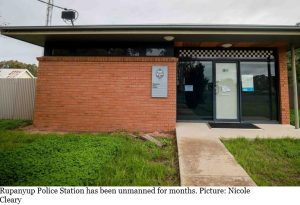
Out of the statistics produced by Frost, the most disturbing example has to be the situation at Rupanyup, a small country town in the central western Wimmera region of Victoria.
The town, not far from the Northern Grampians Region, with an increased crime rate of +47%, has had its Police Station closed for months.
So much for the idyllic country lifestyle.
It was reported by Frost that police patrolling regional closed-station areas were twice as likely to be resisted by offenders as anywhere else in the state.
A staggering 1094 resist or hinder police offences were recorded in locked-out country towns last year – up +45.7 per cent on 2023.
What is significant in these shocking numbers is the personal risk to the Police as well as the community, and the silence of the Police Association (TPAV).
Comparing the TPAV support for the functional ability of the Police organisation and the welfare of its members, with the efforts of the Fire Fighters Union supporting the firefighters and the community they serve, creates a stark contrast. Highly vocal and politically adroit, they shame the comparative inaction of the TPAV.
Police members deserve and should demand a lot better from their Union.
(We would be happy to publish a piece from the TPAV explaining their inaction.)
Further examples from data released by the Herald Sun make for a horrifying read.
- In just two years, regional communities stripped of 24-hour access to their local police stations have suffered a 24.6 per cent surge in criminal offences – the steepest rise across the state.
- A Herald Sun analysis of official data shows crime is now skyrocketing almost 80per cent faster in locked-out country neighbourhoods than in Melbourne’s CBD, according to data weighted to reflect population sizes.
- Crime had soared by 22.4 per cent in neighbourhoods where a police station had reduced its opening hours, compared to 15.7 per cent in areas that kept cop shops open.
- In fact, 80 per cent of the regional towns locked from their local stations recorded crime spikes on par with or worse than the state average – despite Victoria Police promises that increased patrols would keep those communities safe.
| Impacted regional council area | Total offences, 2025 | Change since 2023 |
| Glenelg | 2489 | +52% |
| Northern Grampians | 1584 | +47% |
| Moorabool | 3502 | +35% |
| Mount Alexander | 1458 | +33% |
| Colac-Otway | 1935 | +31% |
| Macedon Ranges | 2620 | +23% |
| East Gippsland | 6497 | +23% |
| Central Goldfields | 1441 | +20% |
| Latrobe | 14172 | +20% |
| Ararat | 1566 | +11% |
| Southern Grampians | 1267 | +3% |
Victims seeking shelter during the night in those country towns need to drive an average of 23km (about 20 minutes) to reach the nearest open police station
. Suffering the most extreme crime surges in the state were Glenelg (+52%) and the Northern Grampians (+47%), both of which had station hours reduced three years ago.
We would argue strongly that the problems of Victoria Police are not solely about the overall numbers, but more significantly, how the existing resources are managed.
The issue is clearly not solely with the front-line Police. Though change may face resistance, it stems from an organisation where promotions since the 2000’s have been predominantly based on nepotism rather than ability or actual performance; the community and the Police members are now paying the price.
Executive Officers and their staff also need to get out and visit stations unannounced at different times and review the actual functions of supervisors and those members on duty at any given time.
Station Commanders and lower-ranking officers then need to explain any anomalies in staff task management.
It won’t solve the problems overnight, but it will help if supervisors need to keep an eye over their shoulder to ensure they won’t be embarrassed or disciplined.
The necessity is for Force executives to develop proper performance measurement techniques in line with the Force objectives. All staff functionalities must be benchmarked and measured with extreme urgency, and the philosophy of “What gets measured gets done” must be adopted.

Co-founder and Deputy Chair/CEO of the CAA, a former Police Inspector with 32 years of service in Metro Uniform, Traffic Metro and Highway Patrol, Crime Cars, and CIB. Former Editor of Police Life and long-serving Public Relations Officer of VicPol. Founder and Life Member of the Blue Light Disco movement, Life Member of the Blue Light Federation, and completed his Police career as an Inspector after 6 years as a Patrol Officer. He then ran his own Business for 20 years until retirement. Ivan co-founded the CAA with former Victorian Chief Commissioner Kel Glare, and built the CAA into an influential voice for Victorians.
Those figures are amazingly alarming!
But, it is the Courts and the current laws enabling of bailing out constantly, when Members are putting their lives on the line with more often than not, the frustration of arresting the culprit, only to see them out within hours!
The culture is more disillusion than presence out on the streets! I don’t blame them.
Hence the need to get rid of a Government that shields the corruption and crime within unions and the walls of power!
Given that a malaise has spread across VicPol over the last few years in particular, it can be expected that it will take a focused effort and considerable energy to apply a successful antidote. It will not be an overnight simple fix. “Band-aid” treatments will not work. The existing Judicial system and culture, which contributes to the problem, will inhibit a recovery – so to, might the actions/inactions and attitudes of TPAV. If nepotism has enabled poor selections in VicPol Management, then the stealth and subtlety that achieved that situation will not be effective to remedy it. Besides, Victorians should not be required to accept the excessive crime rates any longer. The most effective and efficient remedy to the current ills of VicPol will be a major overhaul of numerous “Personnel” practices, which will almost certainly require external expertise. It could/should begin with an Organisation-wide redesign, resulting in revised Position Descriptions which must include measurable performance standards. Position incumbents who may fail to reach the standard specified, should be allowed to apply for positions that are suitable to their abilities. Some staffing losses can be expected, retention rates will improve, and some significant financial savings and morale benefits will accrue. The community will reap the benefits of a happier, healthier, more professional and efficient VicPol. [The Judicial system should also be made subject to a similar process.]