
Ivan Ray
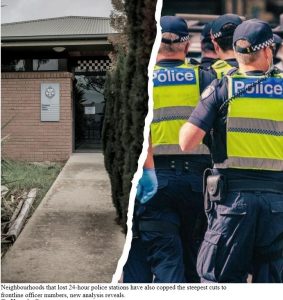
These new revelations in the Herald Sun of June 10 2026, under the headline
“’Shattered’: Data reveals Victorian areas with closed police stations also lost the most frontline officers.” is not big news to serving and former Police.
Fashionable activities like Task Forces and other special duties have been staffed at the expense of the Local Police Station.
What is often overlooked by Police management is that it may look good in the media that a task force or some other special unit has been created to deal with a particular criminal activity, but where are the staff drawn from to initiate the special unit – the Police stations, of course, where else?
There is an argument that the best and brightest are selected for these tasks, but this is talent and experience extracted from the Police Station, which can be very damaging to a Station and not only on the Roster.
These strategies damage, sometimes irreparably, the fabric and effectiveness of a Police Station. And members taken prematurely from Station rosters before they have gained essential experience will rarely evolve into useful leaders if they only know the Special Duty/Task Force genera of Policing. Good policing is more than just catching crooks.
Members overlooked for these positions, justifiably or not, can become despondent and lose their enthusiasm for policing. This can affect swathes of a Station’s staff adversely. A demoralised workforce, even if only a percentage, adversely impacts the overall performance and output of the infected unit and the most impacted is the community.
The visible Police presence (crime prevention) is continually eroded as any Police extracted from a station roster quickly adopt the dress-up look of the American Special Forces.
There is a concept decried by experienced police –we must build a Police force of specialists generalists, rather than a force of specialists, the trend of the last decade.
Not only will it build a more efficient Force, but job satisfaction will be elevated substantially.
By way of a practical example, we are aware of a Police response to an attempted car theft from a vehicle parked on the front lawn of a suburban residence.
Two Uniform Police vehicles attended, with one member speaking with the vehicle owner, taking the report, and the other three members standing in a group talking (with situational awareness, at zero, police at any scene are in the danger zone).
About 20 minutes after the first police car arrived, a Crime Scene vehicle turned up with another two members, a total of six for an attempted car theft during the previous night.
With the arrival of the Specialist Crime Unit, the group chatting increased by one, the member taking the initial report, and they all just watched as the Crime Scene crew fingerprinted and photographed the vehicle subject of the attempted theft and the crime scene crew then proceeded to do a door knock in the neighbourhood, not the other four police just hanging around.
Traditionally, one of those number would be responsible for investigating the crime, or in this new modern force, are all investigations just passed off.
If this is how modern policing is supposed to function, therein lies the key to the problems the Force faces.
The first of the two crews of General Duties should have been well capable of dealing with the crime scene and doorknocking, but they obviously do not see that as their role; it is a job for a specialist – that is absurd.

The time and resources wasted were incredible, and all the while, if other people were waiting for a police response in the area, bad luck, and as for crime prevention patrol- forget it.
This is but one incident that highlights poor supervision and the need for the Police to become specialist generalists rather than report takers.
Add to that, how can it be useful for policing to have operational members dressed up out of uniform, wearing all the normal police paraphernalia? A Police-Issue ballistic vest (usually emblazoned with POLICE), a utility belt with the full range of equipment, O/C spray, including a firearm often strapped to their leg, wild-west-esque.
There can be no tactical or other advantage in this dressing down or dressing up to mimic American Special Forces (ASF) for members performing a police task. Excluding covert operations, this half-in, half-out approach must be reined in – it’s one Force. Police members must learn to be proud of their uniform, which portrays professionalism.
Anybody in the vicinity of, generally, a large station, around lunchtime, will regularly see police in this dress-up rig going to buy lunch wearing full kit.
We didn’t know buying lunch was so dangerous. Do you really need all your trinkets to get a chicken sandwich?
Competent Police win the respect of the community, wearing their uniform with pride, and it shows.
A previous Chief Commissioner told a CAA meeting once that new members these days break their necks to get into the uniform, and after 2-3 years, do everything they can to get out of it.
We assume he experienced severe headwinds trying to resolve the problem and failed.
Perhaps the uniform itself is less than fit for purpose; it looks scruffy on many police, but more likely, the junior members, barely out of probation, are seeking status or the supposed thrill associated with specialist work. If that’s their motivation, they will never make a good Police member, as we continue to remind the Force that there is more to policing than catching crooks; crime prevention is a greater priority, just ask the community.
When the free-for-all of taking staff from Police Stations grew dramatically under previous police administrations, those leaders forgot one imperative – all crooks and their families live in a Police Station area of responsibility, so it should therefore be no surprise that areas where police numbers have been decreased, the crime rate has grown proportionally as a direct result, just like night follows day.
Importantly, the number of Police at a station can be misleading with the allocation of Police to a Special Duties group, usually hidden under a number of aliases, District Support, DSG, etc. (A force Inspectorate would sort this in short order), while the position still remains on the Station Roster, it looks like there are more Police than there are. On paper only.
We are the first to acknowledge that there is a need for specialists to focus their efforts on a particular crime or criminal, but targets must be selected with great care, and each task Force must have an end date, weighed against advances in their inquiries.
Chasing one crook with a team does not stop any group, whether loosely or formally organised. As the police knock off the kingpin, there is a conga line of deputies to fill the void, so the net gain for the community is close to zero; not always, but often enough to instil greater care in Police strategies.
Furthermore, it appears that being incarcerated does not interfere with a criminal’s criminal endeavours; it’s just a bit more inconvenient.
And all that time and effort does nothing to stop more young thugs from being recruited from the local police areas, and the local police are so busy just responding to the community’s direct concerns that they cannot take action to redirect some of these junior thugs from crime.
Police can do that; they did it regularly in the past.
A solution is not easy, but the Chef Commissioner could do no worse than a recommendation of the CAA to establish a Police Inspectorate attached directly to his Office that will ensure his policies are implemented.
The Inspectorate would field a team of senior Officers who would actually visit Police operations and locations to ensure policy is being implemented and that the operational supervisors of all ranks are providing adequate supervision and support for the front line. If they are not, they should be immediately removed from their position.
Our operational frontline police deserve nothing less.
Patrolling and checking young individuals or groups is a powerful tool that is underused because of poor resource management and a lack of members’ skills.
Interestingly, police managers could learn from the Ukrainian conflict.
Ukraine is currently having some success in its defence against Russia to prevent it from capturing more of Ukraine’s territory, early days, but the tide is turning in favour of Ukraine, because they deal with the frontal assaults in a conventional manner and focus on the logistical support that maintains the enemy. They have changed strategy from focusing on eliminating the Russian leaders to focusing on the logistics. That is not to say that if a Russian General is stupid enough to put himself at risk, he will more than likely be eliminated. But focusing on Logistics will grind the enemy army to a halt. Severely depleting food, fuel and ammunition, forcing capitulation
Any army, no matter its size or strength, cannot operate effectively without a reliable logistics supply. According to reports, the effectiveness of the Ukrainian Army in severely hampering logistics has had a large adverse effect on the Russian ability to attack further.
There is an argument for a similar approach in the war against Crime, particularly crime that is organised.
Like Ukraine, VicPol’s effectiveness in reining in crime lies with the development of new innovations, both technically, administratively, and in personnel/resource management. A role coordinated and managed by an effective Force Inspectorate.
If a Police member is promoted to a new rank, they must accept accountability for their subordinates’ performance, and the current practice of blaming them must be substantially tempered.
A system to reinforce accountability across all ranks will go a long way toward creating Force-wide improvements in operations and staff morale.
The reality is that the community’s discontent with Policing will continue to grow with the inevitable pressure on Politicians to implement a Royal Commission into Policing in Victoria, if only to take the heat off themselves.
A Royal Commission will take years, and the management of Policing will inevitably be impacted and wrested from the Chief Commissioner’s control.
That outcome will be a bad day for Policing and the Victorian community.
We are not adverse to a Commission of Inquiry to assist the Chief Commissioner
We have already seen the adverse impact of political interference in Policing during COVID, and it must not happen again.
We have a competent Chief Commissioner; we should do everything to support him.

Co-founder and Deputy Chair/CEO of the CAA, a former Police Inspector with 32 years of service in Metro Uniform, Traffic Metro and Highway Patrol, Crime Cars, and CIB. Former Editor of Police Life and long-serving Public Relations Officer of VicPol. Founder and Life Member of the Blue Light Disco movement, Life Member of the Blue Light Federation, and completed his Police career as an Inspector after 6 years as a Patrol Officer. He then ran his own Business for 20 years until retirement. Ivan co-founded the CAA with former Victorian Chief Commissioner Kel Glare, and built the CAA into an influential voice for Victorians.
The CAA proposes that the CCP form an Inspectorate of senior Officers to visit Police operations and locations to ensure policy is being implemented, and that supervisors of all ranks are adequately supervising the front line.
The CAA also proposes that a system should be introduced to reinforce accountability across all ranks.
Further, the CAA proposes that if a Police member is promoted to a new rank, they must accept accountability for their subordinates’ performance, and the current practice of blaming them must be substantially tempered.
The above three proposals, perhaps inadvertently, point to the readily observable view that VicPol is suffering from significant operational inefficiencies, and output shortfalls. The shortfalls alluded to in the above three paragraphs point out that “The Peter Principle” is well installed across VicPol. That contagion can take years to develop in a large organisation. Commonly it starts from an act of nepotism at a fairly high level. It spreads due to the introduced incompetence and usually includes a lack of accountability. It’s not unusual to find associated cover-ups and corruption.
The proposed inspectorate will be unlikely to fix the cause of the problems and may, in the long term, aggravate them.
The shortfalls indicated in the second and third paragraphs in this post, and numerous others, would be addressed by action outlined in the “NFP” post in CAA, “LOCKED OUT 2”, dated June 11th 2026.
Long before this article, I have often commented that there is no Force reserve that allows population of task forces. Rightly put, task forces are populated from Regional and district human police resources thereby depleting local police resources. Regardless of being in uniform or not all operational police are required to wear full operational equipment whilst on duty. The proviso that comes with that is those dressed in casual attire with full operational equipment must display there police identification but this is general not done. It is left to the public on seeing a person in jeans and “T” shirt armed to the the teeth to assume they are police which does bring angst into the community. Vic Pol have over 300+Inspectors doing what? They should be put in charge of police stations. The ones that are open and releasing the Senior Sergeants as overall operational supervisors on the road. Then the next tier down, Sergeants that are supervisors and operational and do respond to jobs behind the div van, similar to the American model. Recently that young mother with a 3 mth old baby called 000 to report a person trying to break into her house in Bendigo. Four front line police units were engaged with various jobs. Police stations have police radios quietly in each room so senior command and all are aware of incidents that are happening live in their patch. At a major police station like Bendigo you have Family Violence Unit, sex Offences Unit, Traffic Unit and Detectives and possible small task forces. Yet not one supervisor worth their salt knowing that no one was responding to an “offenders on” young mother with 3 mth old at 11am saw fit to delegate a unit at the police station to respond and ensure the safety of the young mum and infant. It’s the supervisors at any rank that must be held to account to use the human police resources at hand appropriately. All police have “Victoria Police” on their shoulders and ID not having taken the oath to a specific policing unit. Executive Command needs a please explain from the local supervisors for their inaction in keeping the community safe.
Re police numbers, I hear that they are going to open a training centre in Mildura, and if successful will consider other rural centres.
Why dont they open more in places like Benalla, Shepparton and say Sale, Cowes and so on at the same time so that any recruits that pass can work locally and fill vacancies in stations that are short of staff ?
I note that you referred to ‘managers’ several times in your article, there lies the problem.
Vic Pol hierachy like managers, must, as they have very few if any, Leaders. Leaders have, and voice an opinion based on the welfare of their staff, unlike many of my peers, I had ‘no illusions of grandeur,’.