
Ivan Ray
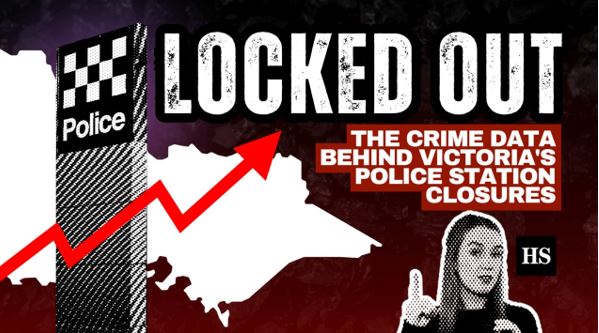
The Herald Sun journalist Grace Frost has ‘blown the gaff’ on the crime impact of Police Station Closures, in another embarrassment for Victoria Police.
Rather than accepting the fact that there was a simple error in the calculations that VicPol was relying on to justify the Police Station closures, VicPol doubled down initially until the journalist forced an admission that the figures the Force was relying on were not only misleading but blatantly false, feeding a false narrative that closing police stations had no negative effect on crime.
The Force response suggests that the error could have been deliberate rather than accidental. “It was just a typo”, doesn’t wash at all.
Typos get checked if anybody cares to take accountability for their command/management responsibilities.
It was reported that the response to the error being identified to VicPol indicates that this was no accident.
The response from the VicPol or Government spin doctors was,
“Reducing counter hours ensures police can continue patrolling each of these communities to prevent and quickly respond to crime.”
The truth is actually the direct opposite. Doh!, as the Simpsons would say.
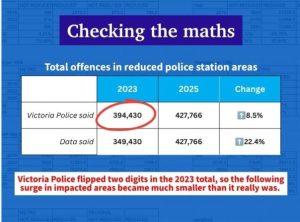
Graphics courtesy Herald Sun
No matter how the spin doctors might try to fudge the numbers, a 22% increase in crime in areas where stations are closed or have reduced opening hours is a monumental law-enforcement calamity.
It also goes some way to reinforce the problems faced by the Chief Commissioner when this sort of thing is allowed to occur under the watch of his senior officers.
The executive officers who presented the argument of closing police stations to the Force Command, on the basis that it will allow police to reduce crime, is a completely ill-informed crock, and they must be held to account.
It also shows how out of touch the Executive can become when ensconced in the Command environment, losing sight of the realities of the police role in the community.
This incident is a gross failure of the Senior Command responsible, and there is just no coming back from the conclusion that these nefarious data claims were either politically or internally created to justify a failed policy shift. Trying to cover someone’s exposed buttocks.
Most disturbing is that the authors of this blunder or mischief do not understand the community they serve and the role the local Police Station plays in crime prevention.
It cannot be dismissed that the introduction of Super Stations, generally around the early 2000’s, and the demise of smaller community-based stations coincide with the start of the crime tsunami we now endure.
We would have thought most senior people would be aware of this trend; if not, they should have been.
.A simple explanation of the roles of Police Stations and how they have changed gives proper insights.
.Super Station:
- Often referred to as the Fire Brigade approach, where Police exit the Station to attend events, similar to how the fire brigade responds, and return after the matter is resolved or they are redirected to another problem.
- Less “front counter centric” a “less service delivery strategy”.
- Focus on backend policing capability. Whatever that means, is clearly not working.
- Public contact may be centralised, reduced or eliminated to favour electronic contact (the impersonal call centre approach). Dealing with traumatised citizens by a call centre is an unconscionable and cruel policy.
Standard Station:
- Strong local visibility, connection, and ownership of their community.
- Community-facing (reports, walk-ins, local issues) “Increased service delivery”.
- The problem with the Super Stations and the demise of the Local Station breaks the contract between the Police and the community.
The bridge between the community and the police has been fractured, and we are now paying the price.
The impact of 22% increase in crime, reasonably attributed to Station closures or restricted hours, takes the heat off the Judiciary, as this number, a 22% increase in crime, is something the Courts have not achieved, although by their performance, they seem to be trying to.
There is a role for a Super Station or a Headquarters Station, but not at the expense of the Local Station, where the community has ownership, and there is a reciprocal connection between the Police and their community, a sense of ownership and responsibility for their community, not achieved in Super Stations, which are often many kilometres away from the fringes of the area they are required to Police..
The problem is that decision-makers within the Force and the Government lack a clear understanding of the immeasurable impact that an open Police Station has on the community, particularly on those involved in the commission of crimes. Equally, the importance of having somewhere to go if in danger cannot be dismissed as inconsequential; having the option is the key.
The argument that the Stations are not really closed but only the front counter is flawed, as what the community, including the crooks, see is what faces them.
The solution is blatantly obvious and has been at the forefront of CAA recommendations for many years. The move to recruit former Police as Force Reservists will provide an opportunity to reverse the current strategy.
It must be introduced as a matter of urgency.
Moreover, the Reservist postings must also be open to serving members who are struggling with operations and can move to the reserve list after an initial period of 5 years of front-line operations – a better option (and cheaper) than having them crumble and be boarded out.
Although unlikely, the Police Association should be very vocal on this issue, supporting struggling members.
The Chief Commissioner must put pressure on the Government to remove an upper limit on the number of reservists that can be employed. The numbers would only be limited by the overall Force authorised strength.
The current allocation of reservists is 200+, whatever that ‘+’ means, and the functions for Reservists as part of Service delivery are only a third-tier priority.
So, the likelihood of substantial gains in the number of Police Stations opening is very problematic.
The anticipated work for reservists includes:
- Front desk enquiries
- Non‑urgent reports
- Public assistance and referrals
- Victim follow‑up contact.
Add to that, telephone inquiries and their impact may be more substantial; however, the numbers are of great concern and need to be closer to 1000 to enable 24/7 functions to cover reservist leave and rest days rather than just 9-5 pm. This will allow more reservists to be attracted and accommodate part-time commitments.
Simply providing the low numbers anticipated will have little material effect on Police Station opening hours.
This raises the question of at what stage in the growth of crime will activate the Government and the Force to address the problem with the available resources sitting in the community, the ubiquitous Reservist.

Co-founder and Deputy Chair/CEO of the CAA, a former Police Inspector with 32 years of service in Metro Uniform, Traffic Metro and Highway Patrol, Crime Cars, and CIB. Former Editor of Police Life and long-serving Public Relations Officer of VicPol. Founder and Life Member of the Blue Light Disco movement, Life Member of the Blue Light Federation, and completed his Police career as an Inspector after 6 years as a Patrol Officer. He then ran his own Business for 20 years until retirement. Ivan co-founded the CAA with former Victorian Chief Commissioner Kel Glare, and built the CAA into an influential voice for Victorians.
Interesting Ivan. However as an ex member who left as a DSSGt, I’ve spoken to many ex members about the Reservist role. They all say it won’t work because of the appalling lack of discipline and respect of the current crop of junior members. The pathetic pay rate which sits just above a VPS 2. Some in different circles are even joking about going back in as a Reservist, and on day one or two putting in a Work Cover claim for ‘stress’ and having their revenge on how they were treated by Vicpol when they were previously exited.