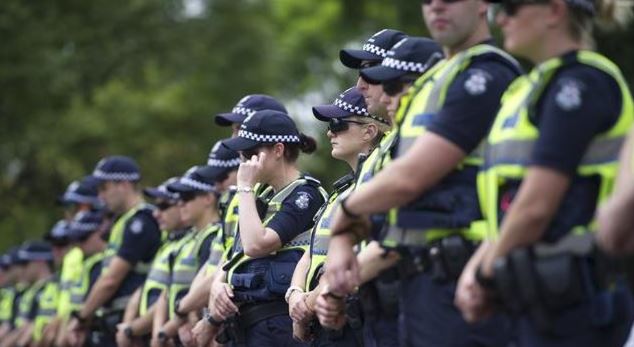
But two swallows can herald a fine summer is near.
Applying Aristotle’s theory to policing may seem odd and even a stretch, but recent events have given strong indications that the winter of discontent with policing in Victoria is drawing nigh, and a good summer looks to be invitingly within reach.
We refer to two recent events indicating that VicPol is quickly implementing change since the appointment of Mike Bush as the new Chief Commissioner.
With apologies to the two members for the analogy used, but it sort of works.
The first incident involved a news conference by Detective Inspector Graham Banks, whose straight-talking, candid comments about Juvenile incidents, including the Cobblebank murders of two young boys by machete-wielding thugs, was a refreshing departure from standard police rhetoric, telling the community the truth without any hint of political or other filters.
The second incident, following the most recent violent demonstrations in Melbourne, was a news conference by Commander Wayne Cheeseman, supported by props collected from the demonstration site, who provided an unsanitised, non-partisan description for all Victorians to absorb.
Telling the truth also contradicted sections of the media that had tried to fudge the actual actions of participants in the violent demonstration, leaving it open for the Advance Australia group, predominantly mums and dads, to be as culpable as the radical left.
His forthright approach left nobody in doubt that they were not responsible for the violence, as they were cooperative with the police throughout their demonstration, and it was the cowardly masked suspected professional protesters who instigated and pursued violence.
These thugs have lost any connection to a specific cause; they only aim to cause chaos.
It is essential to provide the police with the resources needed to handle this rabble, who cast a negative pall over any Victorian or group of Victorians wishing to express their views through a demonstration. We all should feel free to speak our minds without being lumped in with the rabble of the extreme left, better described as Anarchists.
One of the tools that would give the police the edge and reduce the dangers to police members and the community from improvised weapons that the anarchists use is to supply VicPol with a water cannon.
VicPol has a duty of care to all its members to ensure they are equipped to deal with issues that confront them in performing their duty.
Minimising the risk of incurring harm while performing that duty must be a given.
We have recently written on the difficulties that some police have encountered in trying to gain compensation for injuries suffered, with a number of legal decisions going against the members.
There is no doubt that equipping Victoria Police with suitable water cannon vehicles, ideal for crowd control, will cost, but the cost will be well offset by a reduction in Workcover claims caused by this duty.
We will also see a marked reduction in violence at demonstrations when the troublemakers know they are certain to be hosed down.
However, the Premier has now announced that the Government is pursuing face-covering legislation to combat the surge in violent acts.
Talk about underwhelming.
Since when does making the wearing of facemasks illegal stop scum from throwing rocks and other missiles at police?
This approach by the Government flies in the face of what the new Chief Commissioner is trying to change.
The Force’s direction, from one that’s focused on arresting perpetrators as the first line of defence, to a more effective method, which we support, is to stop crime in the first place.
An enlightened Chief Commissioner knows that arrests may seem effective, but it is the Courts’ handling of the criminal that makes the difference, and at this stage, penalties imposed are manifestly inadequate, hence the escalating crime rates and lawlessness.
The legal system isn’t effective, so the effort to reduce crime by prevention is and should be a no-brainer, as the new Chief espouses.
A force that prioritises compliance through measures like water cannons, primarily to be used as a deterrent, but if compliance is not achieved, to prevent the situation from getting totally out of hand, without injuring not only the police but also innocent members of the community who might accidentally get caught up in a confrontation, is on the right track.
The current strategy has no fail-safe approach should the anarchists raise their level of aggression.
The stress level of the Police will be substantially reduced if the big brother standing behind them has the power of a water cannon.
If you were in their shoes, you would feel the same anxieties and sometimes fear that the Police feel when confronted by the anarchist types they are currently dealing with.
The problem is that these particular lowlifes use any means to inflict injuries on police, and the unpredictability as to what weapons they employ increases the negative pressure on the police members, a deliberate tool in their arsenal.
That anxiety can escalate to become a debilitating consequence, so all Victorians are obliged to take whatever action is necessary to provide police with the ability to reduce their risk factors, and that is where Water Cannons are so important.
The basic approach to the use of these tools by the Police would require legislation to protect the members and the Force from litigation arising out of their use.
Proper use in conjunction with a permit system for demonstrations mirroring the highly successful New South Wales model would ensure permit compliance and where the permit is breached, the capacity to douse miscreants with a spray would generally reduce violent demonstrators resolve; however, if that fails, the cannons can be used to physically remove people from their intended path without exposing members to undue physical or psychological damage.
Simply making masks unlawful is not a great help, only assisting with identifying perpetrators post-event – we want the action pre-event to avoid Police being tied up pursuing offences which may attract only minimal sanctions – police have more important things to do like protecting us from machete attack.
“In a move that has sent shockwaves through the Force, lawyers have successfully argued against any State liability because police officers are sworn officers, not employees.
The argument has been upheld in a number of recent decisions in the County Court that have prompted calls for the Allan government to urgently reform existing legislation that has become a barrier to claims by psychologically injured officers.”
In knocking out the claim, the County Court held that there was no basis for the imposition of a duty of care in favour of the officer.”
Resulting from this legal decision, the indemnity of the State from liability to compensate police injured on duty or who later suffer from PTSI is deplorable. The issue of vicarious liability was also discussed, but faced the same fate for the Police.
“The issue of vicarious liability being owed to injured officers has drawn comparisons by the court to a recent High Court decision, known as Bird v DP, that held that institutions could not be held liable for sexual abuse if an offending priest or member of an institution was not in an employment relationship.”- HS
All of these legal manoeuvres to avoid liability by the government have not been happening behind closed doors, or in a vacuum, so the Government must have been aware of what was being foisted on the Police, and, for that matter, every other sworn person employed or otherwise in the State who are not covered by specific legislation.
Which brings us straight to the Premier, who surely would have been briefed on the risks of these legal findings posed.
Having considered the risk, I wonder if the Premier will be bothered to walk outside and have a friendly chat with her own personal security detail.
The conversation might be along the lines of;
“Hi, guys. You may have read about the court’s finding that you are not covered, should you take a bullet for me? The mental anguish is not covered, but rest assured, we will do something about it at some time.”
“You can at least take heart that should the unthinkable happen and you make the ultimate sacrifice, I will very much appreciate it, and your family has your super, and we promise to leave that alone (at this stage), apart from taxes”.
The State does not owe you a duty of care, but I care; No, I mean I really, really, really do care, believe me, now back to work”.
Equally inane in this legal debacle is that the Judiciary also relies on the police for their safety. Although for obvious security reasons it is not public knowledge, there is no doubt that in certain high-risk proceedings, the jurists are provided with close personal security. We wonder how those Police feel now.
It was also reported in the same article that;
“Australian Lawyers Alliance Victorian President, Susan Accary, on Wednesday called for urgent reforms”.
“Recent court decisions that have allowed Victoria Police to avoid responsibility for injuries to police officers do not reflect the general understanding of the employment relationship between the police force and its officers,” she said”.
“Police officers are employed by the state and are engaged in critical, dangerous and sometimes, traumatic, work.”
“It is unfortunate that the law as it currently stands allows the state to avoid their obligations to their officers.
“Police officers, who often work in a high-risk environment for the benefit of the community, should be able to rely on the state to provide them with the support they need if they are injured at work.”
The risk of more police industrial action is real, as no police member would want to or should be forced to go to work without protection, so it is somewhat interesting that the Police Association is not pursuing a mass walkout of Police.
It is ironic that the last Police strike in 1923 occurred just before the Spring Racing Carnival. The Victoria Police force at the time was understaffed, poorly paid compared to other State police forces, and lacked an industry pension. Although the Police now have Superannuation, the rest of the similarities have a certain Déjà Vu ring.
To follow the illogical legal argument proffered in the courts, the relationship between any sworn person and their employer is a relationship without a ‘duty of care’.
The list of people who are now exposed is extensive, but not limited to,
Clergy, Municipal Office bearers (Mayors), all politicians, the Governor, all Judges and other jurists, even your local scout master, in fact, anybody that takes an oath as part of their employment, paid or otherwise, would seem to immediately exclude their employer from any ‘duty of care’.
If this logic is followed, the employee ceases to be an employee in the usual sense of the word, making it equally outrageous.
Victoria’s New Chief Commissioner, Mike Bush, has announced a major restructure of Victoria Police in an effort to make inroads into the burgeoning crime rates.
Although we may not know the full extent of this restructure, what has been reported is extremely good news.
Good news for those of us who favour effective policing based on the community’s needs.
The CAA has advocated these changes for over a decade, through the tenure of five Chief Commissioners who couldn’t or didn’t want to witness the flawed process of ineffective Reactive policing.
Coupled with their lack of leadership skills, the current crime imbroglio was inevitable.
The legacy left behind is that a number of Police officers who were promoted under the flawed reactive model will have difficulty adjusting to the new and modern policing methodology.
They should seriously consider their future and perhaps step aside.
For those who won’t accept the change and take the honourable option, Chief Commissioner Bush has no other choice but to take decisive action to prevent these members from tainting the Police workforce as they adopt this critical change.
The broad principles of freeing up desk-bound police to bolster the proactive function of the force are long overdue.
Similarly, reducing a top-heavy structure that has, for years, consumed both resources and hindered decision-making, drawing decisions up to the hierarchy, far removed from the issue, has effectively diminished the Force’s effectiveness rather than enhancing it.
Solutions to challenges by successive Chiefs Commissioners have led to the creation of more bureaucracies, resulting in more Police being promoted to executive roles and their staff being drawn from the frontline.
The vision by Bush is laudable, focusing on reducing crime before it happens is not a soft option, as some Police hardheads will argue. Their views on reactive (lock ’em up) policing as the way to curb crime have been a failure over the last decade, and it is refreshing to talk about a renaissance of good policing.
It is reported that the Force is facing a mass exodus, which may turn out to be a blessing for the Force and the State.
Some serving members eyeing retirement to escape the fundamentally flawed Police strategy of the last decade may be persuaded to change their minds upon seeing the new direction. Hopefully, many of the hardheads will exit rather than try to adapt to the proactive model.
That would be a significant win for Policing in this state, as many of the ranked members are entrenched in the reactive model and were promoted on this basis.
Their future promotion or retention looks bleak.
The announcement that former or retired Police officers will be offered positions to relieve operational members of administrative duties is not only very sensible but also highly desirable for the benefit of the Force and the Community.
As many of these former members served the Force when it was focused on prevention, they will be an excellent role model to convert sceptical members who have never had that experience.
There are many ex-members who are not so old but resigned for family reasons. Now, as their families grow older, they may relish a return to the Policing fold to restart their careers, given that many of them served before the Force became reactive.
This recruiting cohort could provide the Force with the numbers boost needed to strengthen the proactive model implementation.
The key will be the flexibility and attractiveness of the employment offer.
We hope that this new direction includes a proper Police In Schools Program, which supports Secondary Schools from which most of our juvenile cohort emerge. Not only will this divert many from crime, but it will also create fertile ground for recruiting young people to pursue relevant studies that will equip them to join the Force after leaving school.
We also hope that the Blue Light Disco project is reinvigorated to provide direct interaction between youth and Police aimed at developing long-term positive influences with our youth.
To round out this particular trilogy, the Force needs to take a fresh look at Operation New-Start, designed to keep children in school and off the streets.
Recently published figures on school attendance are abysmal, likely due to schools simply sending problematic children home. Hence, the contribution by this cohort of bored children to the crime epidemic.
Probably a product of the Super School concept, where young people are lost in the system, the only way to improve the situation is to make the necessary legislative adjustments so these children can find employment.
If school doesn’t work for them, joining the workforce at a young age will equip them with life skills for the future, rather than sitting around wasting their life and being drawn to crime.
The current VCAL option is education-focused rather than career-focused and fails troubled kids.
Idle hands are the devil’s workshop.
By adopting this strategy, the net benefit to the State would be immeasurable as opposed to the impact of them committing crimes.
Each of these projects works well in isolation but are highly successful when worked as a trilogy.
This strategy will be far more effective and cheaper than the much-vaunted boot camp concept.
In this “And Why Is That?” Podcast interview, Francis Galbally—a Melbourne businessman, former barrister, and descendant of one of Victoria’s most distinguished legal families—speaks candidly about law and order, judicial culture, immigration, and political decay in Victoria. The discussion paints a grim portrait of a state in moral and institutional decline, and a political class indifferent to citizens’ safety. Watch now: https://www.youtube.com/watch?v=DxmN2opbWkQ&t=24s
Legal heritage and background
Galbally opens by tracing his family’s long association with law and politics. His grandfather, Sir Norman O’Brien, and his uncle were Supreme Court judges. His father, Frank Galbally, was one of Melbourne’s most celebrated criminal lawyers, while his uncle Jack Galbally was both a barrister and Labor parliamentarian. Though raised in a Labor household, his father later defected to the Liberal Party under Malcolm Fraser, frustrated with Gough Whitlam’s economic mismanagement. Francis notes that his father played a key role in establishing the SBS network and migrant support services. Proudly Irish-Catholic and a lifelong Collingwood supporter, Galbally represents a lineage of civic engagement and public service.
Lawlessness and the erosion of order
The interview’s central thread is the perceived collapse of law and order. Galbally responds to the brutal murder of two Sudanese-Australian boys in Melbourne’s west, describing it as emblematic of societal decay. He blames government failure, weak policing, and soft judicial culture for creating conditions in which violent youth gangs and organised crime flourish. “We have a government out of control,” he says, accusing Premier Jacinta Allan of ignoring lawlessness in the construction industry and broader community. Public safety—the most fundamental responsibility of government—has, he argues, been abandoned.
Galbally fears a drift toward vigilantism, recalling incidents where citizens have fought back against carjackers. While understanding the impulse, he warns that this path would lead to “a total breakdown of society, a law of the jungle.” Instead, he urges government leadership, cultural renewal within the police force, and stronger judicial resolve. The new police commissioner, he says approvingly, is “a hard-ass” from New Zealand who may finally restore discipline, but entrenched culture will take years to fix.
Judicial accountability and community safety
Galbally’s sharpest criticism is reserved for the judiciary’s handling of bail and repeat offenders. Police morale, he argues, is crushed when offenders are repeatedly released. He calls for tougher bail laws and for magistrates and judges to “respect the community.” Judicial independence must not mean judicial detachment. Parliament, reflecting public expectation, should clarify the law to remove excessive discretion in youth and violent cases.
He also urges parental responsibility: parents of minors who commit crimes should face financial penalties for damages. This, he believes, would reshape attitudes in households where children drift into crime. He also calls for adult sentencing of violent offenders over 14, echoing recent Queensland reforms: “If you knife somebody at 14, you should be tried as an adult.”
While acknowledging a few positive judicial examples—such as the judge’s reasoning in Victoria’s “mushroom poisoning” case—Galbally insists systemic leniency has destroyed deterrence. Yet he is careful to defend the institution of the judiciary, praising Victoria’s judicial appointments process as merit-based and free from political interference, unlike the partisan U.S. Supreme Court.
Government distraction and media complicity
The hosts and Galbally agree that serious crime stories vanish quickly from news coverage, replaced by “shiny distractions.” He accuses the government and compliant media of deliberately shifting attention away from violence, using the announcement of new Indigenous treaty initiatives as an example of political deflection. The Premier, he says, has failed even to meet the families of slain children: “She has no interest. It’s indecent.” For Galbally, this symbolises moral cowardice and misplaced priorities in Victoria’s leadership class.
He broadens this critique to the “crisis of leadership” generally. Citizens, he argues, now march in the streets over overseas issues while ignoring violence at home. “Where is the outrage?” he asks. “We are frightened in our own streets.” He describes personally carrying defensive tools when walking in Melbourne, reflecting widespread insecurity.
Culture, patriotism, and social cohesion
Galbally sees this insecurity as part of a larger erosion of civic identity. He contrasts Australia’s cultural ambivalence with America’s unapologetic patriotism—its ubiquitous flags and sense of unity. Australia, he laments, now regards flag-waving as “fascist,” while tolerating terrorist symbols like Hamas or ISIS flags: “That’s rubbish. People flying a terrorist flag should be jailed.” Burning the national flag, he adds, should also be a criminal offence, as it “insults every citizen.”
Turning to technology and governance, Galbally dismisses the government’s “e-safety” agenda as a distraction from real threats. He warns that such programs risk morphing into surveillance and censorship, arguing that digital regulation is futile when technology evolves faster than government oversight.
Crime, commerce, and fear in the city
Galbally describes how rising urban crime has hollowed out Melbourne’s retail life. Luxury retailers in Collins Street, he says, have seen foot traffic fall by 40% post-pandemic because customers feel unsafe. CCTV footage shows regular smash-and-grab attempts, scaring both staff and patrons. As a result, consumers stay home and shop online, eroding civic life. He points to U.S. examples—New York under Giuliani and Eric Adams—where heavy police presence restored safety and revived urban life. “Zero tolerance works,” he insists.
Immigration, integration, and the economy
Galbally supports immigration but warns that poor management of volume and composition can strain housing and cohesion. He recounts Australia’s long history of migrant waves—from Irish and Italians to Vietnamese—each facing early suspicion before integrating successfully. Problems arise mainly with second-generation youths who feel detached from both cultures. Migration, he insists, is essential to Australia’s prosperity, but must be tied to housing capacity and clear vetting standards: “This is not the White Australia policy; it’s about realism.”
Leadership and political decline
In closing, Galbally laments the absence of true leadership in Australian politics. Both major parties, he argues, are structurally incapable of renewal. Labor is dominated by “union hacks” and career professionals with no real-world experience; the Liberals, conversely, are inward-looking, male-dominated, and disconnected from working Australians. Smart, capable people avoid politics altogether. “Why would anyone want to go into politics today?” he asks. “It’s ugly, brutal, and unrewarding.” His prescription is radical but simple: Australia needs a new political movement built on integrity, civic pride, and competence.
Conclusion
The interview paints Francis Galbally as a tough-minded realist alarmed by Victoria’s moral and institutional decay. His central thesis is that public safety is the foundation of civilisation—without it, no social policy or moral vision can stand. He believes leadership, judicial clarity, and civic pride must be restored before Australia loses confidence in its own laws and values. For Galbally, law and order are not partisan issues but existential ones—the cornerstone of a functioning democracy.
It was reported in the Herald Sun on the 6th of October 2025 that “Magistrate Carolyn Burnside late last month warned corrections officials and police they were ‘in contempt of court’, effectively for not bringing a prisoner to court, in defiance of a ‘jail order’ requiring them to do so.
It would seem that in making an internal political administrative point, it is acceptable to publicly disregard evidence and ignore community safety issues, which the magistrate has failed to consider.
Once under the control of Corrections, it is their task to convey prisoners to courts, not the job of the police.
The Prisoner, a lifetime heroin addict, was tossed out on the street by the magistrate, trying to make an internal point over the inconvenience to her Court.
With the judicious use of technology, prisoners would not be required to attend court for procedural matters or, for that matter, their Trial.
While the vast majority of us have a great deal of admiration and respect for Judges, Magistrates and other jurists, our collective community attitude and trust in the court system is severely damaged by intemperate comments from a member of the bench who is obviously an outlier.
It is an absolute disgrace that a Prisoner who has not been found guilty of any offence, only charged, must wait so long to have his matter resolved.
Ms Burnside apparently invited prisoners to start applying for bail and said she would find it a “very attractive” proposition to release them.
Without considering the consequences of each case, this pronouncement is tantamount to contempt of all the courts that have refused bail for prisoners.
These prisoners she refers to are not your Sunday School types, but generally the worst of the worst, an unacceptable risk.
The Government must take action to ensure this Magistrate does not implement her threat, so we do not have at-risk prisoners free to roam and commit other crimes.
The current imbroglio of the impact of youth and other criminals has the community firmly pointing the finger at the Courts, highlighted by the recent granting of bail to a recidivist offender to go on an overseas holiday.
The reality is that in a democracy, the government of the day must respond to community concerns about lenient sentencing and the manipulation of bail laws by Courts, or face electoral consequences.
Although they might not want to, the Government has to respond positively or face the backlash, which means more than just ‘tightening’, a euphemism for, fiddling around the edges, to fix the legal system failures and then exercising the dark art of trying to convince the electorate they are doing something and hoping to get away with spin instead of adequately addressing the problem.
We wonder if it’s the role of the Government to fix the issue or whether the Courts themselves should be held accountable for the current malaise.
It is perhaps time that the administrators of Justice in this State take responsibility and take some action to ensure continuity in proper jurisprudence.
If the administrators do not take decisive action, the government will inevitably be compelled to intervene, which will further erode the independence of the judges.
The Magistrate responsible for allowing a recidivist to continue on bail so he could travel overseas on a family holiday, irrespective of what excuse can be conjured up, is outrageous and totally unacceptable, reinforcing in the mind of the child that his offending is not serious. He goes on an overseas holiday while the victims are left to stew in their damaged emotions.
The family would have had to cancel the trip if their son had been bailed – there was always a simple and obvious option for the Magistrate – refuse bail, problem solved.
The bureaucracy of the Court administration is culpable for not immediately transferring this Magistrate to an administrative position; that action would send a message to all members of the bench.
As jurists make more inappropriate decisions, the only ones hitting the headlines are the most outrageous. However, every day, poor choices that work against the law’s objective of maintaining community safety are flaunted mercilessly by unaccountable jurists. And we wonder why crime is escalating?
Their independence will be further eroded as the public demands that the government take action, and that action will, by necessity, restrict jurists’ independence even further.
We are not convinced that it is necessarily a good thing, in the long term, because it won’t address poor oversight, training, and management of the judiciary.
The jurists must learn to ‘read the room’ and listen to the community or face the consequences.
The second and equally important issue that Court administrators face is the inordinate delay in bringing miscreants to court to be held to account for their behaviour. ‘Justice delayed is justice denied, ’ an ancient legal maxim attributed to William Ewart Gladstone,circa 1868, is regularly ignored by Victorian Courts.
Whether it is poor administration of Court lists, poor performance and failure to meet KPI’s by Jurists, delaying or exacerbating proceedings, or they are overloaded, the latter an administrative failing, we don’t know, but what we do know is the Courts have focused entirely on the perpetrator, and that is not the absolute role of the Courts.
Continually overlooked in the legal process is the impact of Court decisions and delays on the sector of the community that is the INNOCENT; the victims, a cohort to proceedings continually overlooked by the Courts.
The victims not only have to suffer the financial and or physical consequences of a crime, but, to rub salt into the wound, many of which are very deep, they also suffer the indignity of not being considered appropriately in the court process, with their convenience not a consideration.
We never hear of a Court rejecting a procedural delay in proceedings, such as a bail application, due to the unfair impact on a victim, which would drag the case out and penalise the victim further.
The Courts are guilty of facilitating these delays and punishing the victims.
The failure of courts to ensure reparation for victims, whether the perpetrator has the capacity to provide reparation to the victim or not, should not be a court consideration.
The level of reparation should be based entirely on the facts of the case and be commensurate with the damage done. The recovery of the reparation should be referred to the Sheriff for action. If an offender is unable to pay and has that debt hanging over their head, they might think twice before committing further crimes, which is an effective deterrent.
It is well past time that a Royal Commission be established to examine the Courts’ processes, the accountability and application of the law by Judges, and critically, the treatment of victims.
The headline in today’s Herald Sun,Thin blue line: Police exodus exposed, 24th September 2025, is not good news, particularly for a State where crime is rampant and the safety of all of us is severely compromised.
With over 1,000 job vacancies at the Victoria Police, it is no wonder that the tolerance for criminals needs adjustment, but without the necessary resources, the chances are next to zero.
It is time to apply some lateral thinking to the issue, because doing nothing is as criminal as the problem that needs addressing.
Closing Police Stations is not the answer, and the negative impact on communities in the closures has a profoundly adverse effect on the communities they are designed to serve.
It is often said in police parlance that the visible police presence is one of the most effective anti-crime strategies available, but it extends just as strongly to the cop on the beat as to the cop at the station.
A closed station sends the message that there are no police present.
The reality is that police are still generally engaged in mobile patrols and other policing activities, but this doesn’t sit well with a victim trying to report a crime or seeking refuge in a police station, which is seen as both a symbolic and real safe haven in times of crisis.
It is like having a hospital in your neighbourhood. Even if you don’t use it, it’s nice to know it is there. If it were removed, it would leave a vacuum in your healthcare.
Perhaps more critically, anybody with substantial experience with the crooks in our society will tell you that overall, they are not the ‘sharpest tools in the shed’, and this is multiplied dramatically with juveniles, our worst offending cohort.
The dots incorrectly joined by this cohort when a Police Station is closed is that there are no Police working, any deterrence evaporates, leaving in their minds a free kick, often to some poor victim’s head.
But how do we fix this problem and reduce the pressure on the Police trying to do their job in a Force that is so poorly manned, while also addressing the exodus of police to the North and the lack of service capacity here?
Improving conditions for the approximately 18,000 members in this State is not the solution. Victoria Police have one of the best employment conditions in Australia, and we would argue that this likely compares favourably internationally.
Having achieved all these conditions, there is little, if any, effort to promote just how good they are.
The current state of IR with Victoria Police is akin to the Hawthorne experiment by Psychologist Elton Mayo, but applied force-wide.
Known as the Hawthorne effect, Mayo demonstrated that merely improving physical conditions was not itself the primary factor in increasing productivity and, in turn, job satisfaction.
The studies highlighted the importance of social factors, teamwork, and improved communication in motivating employees; shifting focus from purely physical or financial incentives to the socio-psychological aspects of work was the key.
There is, however, a broad spectrum of suitable people who could be used to relieve the pressure on members, enhancing the one thing that industrial action cannot achieve: job satisfaction.
The final thing to consider is a lowering of standards and the negative impact this could and will have on the workforce. Creating a dual approach to standards and driving a substantial wedge between those who achieved the standards and those who joined via a lowered standard.
Any missteps professionally or socially within the Force by members who joined when standards are lowered will have an immediate and negative impact on the member. ‘You were not good enough.’
Long-term pain for short-term gain is never a good strategy and reflects poorly on police management, which is unable to fix the problem.
The lowering of standards has a negative effect, even if subtle, on all former and serving members who have achieved the normal high standard. They are very proud of this, but it has been undermined by management’s inability to address the problem.
There is also a risk that members who join at a lower standard could be spurned by those who meet the higher standard, a second-grade Force.
The answer to this issue lies not just with effective recruiting to attract new members but with utilising the vast resource of former members who, for whatever reason, left the Force.
And they are not all geriatrics.
There would be a very large number of former Police Officers who resigned for family reasons, and now that their children are old enough, they would love to return to the Force in a limited capacity.
The advantages are substantial.
These applicants would only need limited retraining to update.
Their life experiences outside the Force bubble will make them better equipped for interpersonal public contacts.
A substantial number of these re-appointees could offer the Force a substantial increase in resource capability and flexibility, relieving operational members from tasks of low risk for public order responses.
The influx of these re-appointees could have a dramatic and positive effect on the public perception and the Force’s perception of the negative impact of increased job vacancies.
What is hidden from the Public, and perhaps not acknowledged by senior Police administrators, is the number of patrols that are not provided due to resource deficiencies.
The current imbroglio, rampant and climbing crime rates, substantial police exodus from the Force and poor recruiting, based on quantitative rather than qualitative principles, must be addressed as a major threat to the Force’s administration.
The Force cannot just cry poor to avoid addressing this problem. With over 1,000 current vacancies, those positions must be funded, or they wouldn’t be vacancies, but Force staffing reductions.
A cynic may suggest that the current situation is nothing more than a ‘clever way’ for the Government to reduce expenditure, irrespective of the adverse impact on the community.
With other public service jobs being slashed, there may well be an increased pool of suitable applicants for the Victoria Police.
The CAA calls on the Government to immediately implement a highly public recruiting drive to bring the Victoria Police staffing numbers up to authorised strength.
We live in hope that in this country we will not stoop to such ridiculous levels to justify criminal behaviour.
There is no sound justification for allowing Drug users to be part of the solution when they are the problem. It’s like handing over the problem of alcoholism to alcoholics. A free grog policy is inevitable.
These hair-brained strategies are often argued to be a solution, perhaps a solution like solving the speeding problem by eliminating speed limits, solving shop stealing by legalising the removal of items from a shop, the list goes on.
The endgame is a complete breakdown of law and order, chaos in all our lives.
Having users and addicts designing and implementing drug policy can never succeed, especially when those groups are in denial. Ask any drug addict or alcoholic if they are addicted, and the answer is, by and large, emphatically, “No, I could give it up at any time”.
What is often overlooked in the entire drug addiction debate is the real victims of this vile trade—not the addicts themselves, but their families and all the innocent people affected by the crimes committed to sustain their addiction. All the resources spent on their self-inflicted dependency and treatment come at our expense. Yet, that is never acknowledged by the progressive “harm reduction” advocates, who seem hell-bent on normalising the behaviour and creating a society based on a Drug nirvana, all while they are high on the drugs they are supposed to manage.
Instead of the harm reduction approach, drug use or addiction must be excluded as a mitigating factor in criminal prosecutions and sentencing, with a focus on the offence and the perpetrators’ culpability.
The bottom line is that very few of the many thousands of addicts were forced to take the drugs they became addicted to. Equally, they never sought help, but addicts taking responsibility is very rare indeed.
Canada’s policy of deferring to the “leadership” of drug users has proved predictably disastrous. The United States (and Australia) should take heed.
Progressive “harm reduction” advocates have insisted for decades that active users should take a central role in crafting drug policy. While this belief is profoundly reckless—akin to letting drunk drivers set traffic laws—it is now entrenched in many left-leaning jurisdictions. The harms and absurdities of the position cannot be understated.
While the harm-reduction movement is best known for championing public-health interventions that supposedly minimise the negative effects of drug use, it also has a “social justice” component. In this context, harm reduction tries to redefine addicts as a persecuted minority and illicit drug use as a human right.
This campaign traces its roots to the 1980s and early 1990s, when “queer” activists, desperate to reduce the spread of HIV, began operating underground needle exchanges to curb infections among drug users. These exchanges and similar efforts allowed some more extreme LGBTQ groups to form close bonds with addicts and drug-reform advocates. Together, they normalised the concept of harm reduction, such that, within a few years, needle exchanges would become officially sanctioned public-health interventions.
The alliance between these more radical gay rights advocates and harm-reduction proponents proved enduring. Drug addiction remained linked to HIV, and both groups shared a deep hostility to the police, capitalism, and society’s “moralising” forces.
In the 1990s, harm-reduction proponents imitated the LGBTQ community’s advocacy tactics. They realised that addicts would have greater political capital if they were considered a persecuted minority group, which could legitimise their demands for extensive accommodations and legal protections under human rights laws. Harm reductionists thus argued that addiction was a kind of disability, and that, like the disabled, active users were victims of social exclusion who should be given a leading role in crafting drug policy.
These arguments were not entirely specious. Addiction can reasonably be considered a mental and physical disability because illicit drugs hijack users’ brains and bodies. But being disabled doesn’t necessarily mean that one is part of a persecuted group, much less that one should be given control over public policy.
More fundamentally, advocates were wrong to argue that the stigma associated with drug addiction was senseless persecution. In fact, it was a reasonable response to anti-social behaviour. Drug addiction severely impairs a person’s judgment, often making him a threat to himself and others. Someone who is constantly high and must rob others to fuel his habit is a self-evident danger to society.
Despite these obvious pitfalls, portraying drug addicts as a persecuted minority group became increasingly popular in the 2000s, thanks to several North American AIDS organisations that pivoted to addiction work after the HIV epidemic subsided.
In 2005, the Canadian HIV/AIDS Legal Network published a report titled “Nothing about us without us.” (The nonprofit joined other groups in publishing an international version in 2008.) The 2005 report included a “manifesto” written by Canadian drug users, who complained that they were “among the most vilified and demonised groups in society” and demanded that policymakers respect their “expertise and professionalism in addressing drug use.”
The international report argued that addiction qualified as a disability under international human rights treaties, and called on governments to “enact anti-discrimination or protective laws to reduce human rights violations based on dependence to drugs.” It further advised that drug users be heavily involved in addiction-related policy and decision-making bodies; that addict-led organisations be established and amply funded; and that “community-based organisations. . . increase involvement of people who use drugs at all levels of the organisation.”
While the international report suggested that addicts could serve as effective policymakers, it also presented them as incapable of basic professionalism. In a list of “dos and don’ts,” the authors counselled potential employers to pay addicts in cash and not to pass judgment if the money was spent on drugs.
They also encouraged policymakers to hold meetings “in a low-key setting or in a setting where users already hang out,” and to avoid scheduling meetings at “9 a.m., or on welfare cheque issue day.” In cases where addicts must travel for policy-related work, the report recommended policymakers provide “access to sterile injecting equipment” and “advice from a local person who uses drugs.”
The international report further asserted that if an organisation’s employees—even those who are former drug users—were bothered by the presence of addicts, then management should refer those employees to counselling at the organisation’s expense. “Under no circumstances should [drug addicts] be reprimanded, singled out or made to feel responsible in any way for the triggering responses of others,” stressed the authors.
Reflecting the document’s general hostility to recovery, the international report emphasized that former drug addicts “can never replace involvement of active users” in public policy work, because people in recovery “may be somewhat disconnected from the community they seek to represent, may have other priorities than active users, may sometimes even have different and conflicting agenda, and may find it difficult to be around people who currently use drugs.”
The messaging in these reports proved highly influential throughout the 2000s and 2010s.
In Canada, federal and provincial human rights legislation expanded to protect active addicts on the basis of disability. Reformers in the United States mirrored Canadian activists’ appeals to addicts’ “lived experience,” albeit with less success. For now, American anti-discrimination protections only extend to people who have a history of addiction but who are not actively using drugs.
The harm reduction movement reached its zenith in the early 2020s, after the COVID-19 pandemic swept the world and instigated a global spike in addiction. During this period, North American drug-reform activists again promoted the importance of treating addicts like public-health experts.
Canada was at the forefront of this push. For example, the Canadian Association of People Who Use Drugs released its “Hear Us, See Us, Respect Us” report in 2021, which recommended that organisations “deliberately choose to normalise the culture of drug use” and pay addicts $25-50 per hour.
The authors stressed that employers should pay addicts “under the table” in cash to avoid jeopardising access to government benefits.
In 2024, British Columbia’s top doctor even called for the legalisation of all illicit drugs (“non-medical safer supply”) primarily on the basis of addict testimonials, with almost no other supporting evidence.
For Canadian policymakers, deferring to the “lived experiences” and “leadership” of drug users meant giving addicts almost everything they asked for. The results were predictably disastrous: crime, public disorder, overdoses, and program fraud skyrocketed. Things have been less dire in the United States, where the harm reduction movement is much weaker.
But Americans(and Australians) should be vigilant and ensure that this ideology does not flower in their own backyard.
This headline screamed in the Herald Sun, 8th of September 2025, suggesting a rift has been triggered between the Government and the Police.
It is a pity that the reality escaped the journalist because in this instance, a Detective Inspector gave a press statement expressing his professional view, and that should be encouraged, not pilloried.
We do not see a rift, breaking ranks or anything resembling that. What we do see, however, and it is very pleasing, is the Police exercising the separation of powers.
The Politicians are entitled to express their views, and because the Police Force is an independent authority, they should be able to express theirs.
Something we have failed to see for over a decade, as consecutive Police Commissioners gagged Police members.
It does not help us at all to have the Government, the Judiciary and the Police collaborating on communication to the people who employ them, us.
An independent approach is much healthier for the community and the State overall, as it will highlight where the problems exist and make the various Pillars of Law enforcement accountable; they can’t hide behind each other.
If the Judiciary, the Government, or the Police are not performing to community expectations, it is incumbent on the professionals within these branches of law enforcement to expose the truth. Law enforcement will benefit, as will the community.
We may now see many more members of the Force who express their professional views, like Detective Inspector Graham Banks.
There will be several major benefits in this shift away from gagging the Police.
A better-informed community will therefore pressure the areas of Law enforcement that are failing to perform to their expectations, and we accept that on occasions this will impact the Force; however, exposing factual information about police failings makes for a better Police Force.
A former Chief Commissioner, the late Mick Miller, once told me that praise for the work of the Police was welcome, albeit warm and fuzzy, but the real benefit came from the Force critics that bring about improved performance.
The Force has no hope of improving without positive feedback.
For too long, the Force has operated under a cone of silence, hoping that any failings will go unnoticed and unexposed by the Police themselves.
The immediate and positive consequence of this change will be a dramatic improvement in the satisfaction levels and confidence the community has in their Force.
This change will also have a dramatic and positive effect on Police morale. Seeing their leaders demonstrate leadership is very healthy, and it gives confidence to all Police that others are not manipulating them. This approach also ensures that the views of the police are being heard.
It behoves all former Police to make themselves heard on this issue in support of Banks and the Chief Commissioner.
The experiences the Police were exposed to during the COVID-19 Pandemic at times were akin to stormtroopers, and had a deleterious effect on all members, current and former, and most of the impact resonates to this day, having perhaps irreparably damaged the relationship between the Police and the community.
Seeing the Police Force used as an instrument of Government must never happen again.
To avoid repetition, more Police leaders like Banks should stand up to express their professional views, making the force healthier.
There have been far too many good former Police officers who lost their careers because they spoke out, making this change even more refreshing, if not bittersweet.
The New Chief Commissioner, Mike Bush, can proudly accept the plaudits for this change under his regime and leadership.
The CAA has had reports from concerned citizens that when they reported a crime in progress, the police refused to accept the report of a crime or respond to an incident.
They were told the offence was not committed on the caller, and it was up to the victim to contact the police.
We have now had the practice confirmed by Nick McGowan, a Member of Parliament, and consider the act a total abdication of the police role, by Police Force policy.
Based on the rationale of this strategy, it means that if a victim is unable to report the crime, perhaps because they are comatose as a consequence of criminal activity, any responsible citizen reporting the matter, not being the victim, would not have the report accepted or responded to.
Contrast that approach to the Police response to the home invasion experienced by Mick Malthouse, who fought off three perpetrators. Mick had nothing but praise for the police response, but isn’t he fortunate that his wife (also a victim) made the call to the Police and not a neighbour?
Mick was fortunate to avoid serious injury, but as with all these incidents, he was only a hair’s breadth away from serious injury from the crowbar-wielding crooks and took a blow to the arm rather than the head and narrowly avoided being seriously stabbed with a screwdriver.
The comparisons between McGowans’ and Malthouse’s experiences are hypocrisy writ large, or more accurately, seriously flawed policy.
We call on the Chief Commissioner to publicly apologise to McGowan and advise the public that the policy of rejecting a Police response on matters reported by non-victims is overturned. Vicpol will respond as soon as they can to all calls for help.
A cynic may suspect this is nothing more than some idiot trying to reduce the crime rate. If so, it is not the first time, and at the highest levels..
As the whole community reels from the shocking news of the wanton slaughter of two of Victoria’s finest and the severe wounding of their colleague at Porepunkah, in Northeast Victoria, there is substantial disquiet on social media about the Police Force’s media response.
The operational response from Victoria Police after the tragedy was as expected, and while the devastating news impacts everybody in the State and wider Australia, one group does it substantially harder: other Police.
The new Chief Commissioner, Mike Bush, spoke well to the media; however, it was questionable protocol that the Secretary of the Police Association, Wayne Gatt, should have also been given that privilege. Putting the Union Boss on the same level as the Chief Commissioner will have its critics and drawbacks as Bush evolves into the Chiefs’ role.
Accompanying the Chief Commissioner should have been the Officer in Charge of the operation. As there were ten members assigned, some planning would have been necessary, given that risks were already perceived, hence the necessity of swearing out and justifying the issuing of a warrant by a judicial officer. The local Area Commander, who should be in charge of such operations in the area, should have been present. A large portion of responsibility may rest with that officer.
The Commander didn’t need to speak, given the emotional impact of losing members under their command and their responsibility; however, it would be far more appropriate than the Union Boss, who has no operational responsibilities in this circumstance.
With social media abuzz with criticism of Gatt’s appearance, particularly from former members, it was a tactical error on the part of the Chief to allow this; it diluted his role.
All former Police will be disappointed that the Chief did not include them; however, the fact that the Union Boss didn’t include them either was not surprising given the Police Association’s long antipathy towards former members. The Chief, however, needs to be cut some slack; it is a horrific issue to deal with, as he is probably only just coming to terms with his new role.
Gatt, however, should have had the maturity and experience to hold his own press conference.
Again, the Force has failed to acknowledge the thousands of former Police officers who are just as impacted as the serving officers, some more so, particularly those who were involved in similar incidents during their service in the past.
The Shire of Mansfield, in their press release, were the only one, so far, to acknowledge former Police and the impact on them. Not surprising for Mansfield, as it is the only Town in Australia that has built a monument to fallen police in the town’s centre.
Ironically, Mansfield, also in the North-East of the State, had three police officers shot on the 26th of October 1878, in an ambush, but none survived.
The substantial monument in the centre of Town that everybody arriving and leaving must circumnavigate is a testament to the view that the community holds of the Police, both serving and former.
As the saying goes in Police parlance, ‘There is no more ex than an ex’ is a truism that the Force must deal with.
The silence that has fallen over the Force, referred to by Bush and Gatt, does not stop at the Police Station’s front door but extends into the former police community just as strongly.
One day, we can only hope that a Police executive will realise the value that the former Police continue to serve in the community long after they have handed in their batons.
There is a high degree of probability for all the rhetoric that the Force has espoused over the years about the value of a Police career and the bond of policing, it does not complete the circle, as once Police leave the Force, they are discarded, something not explained to new aspirational applicants who want to join the Force; callously you are only looked after when they need you.
Proud former Police, and that is by far the majority, do not hide from their former career and therefore are often sought out within their social groups and their community for advice on Police-related matters. Former police are overrepresented in leadership roles in the community, giving them significant influence.
Although their Oath of Office no longer binds them, the removal of that obligation is legislative and does not account for a career spanning 20-40+ years of living by that standard.
‘You can take a police officer out of policing, but you can’t take the policing out of police.’
At this time of grieving, it is opportune that the Force be reminded of the whole of the Police family and act accordingly.
Royal Commissioner Natasha Stott Despoja urges South Australia to end ‘double standard’ on parents smacking children, Herald Sun, 20th August 2025.
“Smacking should be outlawed to stop parents abusing their children under the guise of discipline, according to a landmark inquiry into family violence in South Australia.
Children have told of being beaten or kept like prisoners by parents or carers who argue it is necessary to “correct” their behaviour.
Now Royal Commissioner Natasha Stott Despoja, who heard their heartbreaking stories, has called for an end to this “double standard”.
Interestingly, a poll of 3528 voters was asked, “Do you support a smacking ban?”
19% said, “Yes”, and 81% said, “No”.
In Victoria, there are already a plethora of rules and legislation preventing any form of corporal punishment in a vast range of circumstances where children need to be disciplined, with one common denominator: corporal punishment cannot be delivered to a child unless by a parent or carer.
Common law permits only “reasonable” physical punishment, meaning:
The child must be capable of understanding what they did wrong.
The force used must not be excessive or unjustifiable.
If the punishment crosses into abuse or causes injury, it may be prosecuted under existing assault legislation.
The current laws are adequate and have stood the test of time. The exposure during this South Australian Royal Commission highlighted not a flaw in the legislation but in those who administer it.
Reportedly, there were shocking incidents of child abuse presented to the Royal Commission, but if they were as bad as alleged, then why weren’t the perpetrators prosecuted?
The risk of this move by the Royal Commissioner risks colliding with another legal principle, as young children cannot be reasonably assumed always to tell the truth or understand the possible consequences of untruths. Without some form of corroboration, there is a need for caution.
Within a domestic dispute situation, it cannot be ruled out that the corporal punishment issue will not be weaponised, with coaching from one or the other of the domestic combatants.
A move for legislation to be inserted in the parent-child relationship exposes the community to another legal principle.
It is better that ten guilty persons escape than one innocent suffer – William Blackstone, 1760, English jurist.
This principle is one of the cornerstones of democracy as we know it, and any interference must be viewed through that prism.
There is no question that children must be protected, and as a general principle, must be listened to; however, as with most criminality, the accuser must be supported by corroborative evidence.
Again, the problems appear to be with those who administer the law, not the law itself.
However, the major flaw in taking this approach is that the defences that currently exist for corporal punishment work as a deterrent; the future without these guiding principles could have the opposite effect to that intended.
Parents who exercise corporal punishment outside the principles are not likely to comply with the legislation when they lose their temper, or are under the influence of alcohol or drugs, or are just belligerent in disciplining their children. The legislation in its current form is adequate to deal with these issues; it is more about how the law is administered, not the law itself.
We hear continually the whining of those in authority that the problem with miscreant children committing significant criminal offences, often against innocent victims, is parent-blaming. Perhaps the lack of discipline as a young child has a lot to do with it.
The courts, by not ensuring consequences for illegal behaviour, are a major contributor to the no consequence principle and, therefore, adverse outcomes for children and young people.
An unintended consequence of this move will remove any vestige of consequences for inappropriate behaviour, leading to more pain inflicted on the child as they grow to live in the real world without understanding that indiscretions come with sometimes very unpleasant consequences.
The ability for a child or young person to ‘Think twice’ before acting is lost.
The removal of the ability of a parent to physically discipline a child will sentence the child to convoluted lectures and verbal assaults, potentially causing much more damage to them than an appropriate tap on the backside to correct behaviour.
The psychological harm that is inflicted on young children can be more damaging than any smack, and a parent without parenting skills can cause irreparable damage by the use of verbal or non-verbal discipline incorrectly.
An experience where a mother in a supermarket with a misbehaving child entered into a rationalisation diatribe with the two-year-old to correct behaviour is a case in point. If that is the standard, the parent who adopts it will do more harm than good over the medium term.
The child was too young to understand, and being lectured to is highly probable a common experience with little weight given the child’s lack of reaction. Of course, the real shame is that the parent’s performance was perhaps more theatre for those around her, and the child suffers.
Perhaps removing the only method a parent can exercise within the given legal parameters of ‘reasonableness’ to discipline their child is the real hypocrisy, not the comparison with adult dysfunction.
As the CAA prepares for a meeting with the new Chief Commissioner, we ponder the circumstances that the Force now finds itself in.
As we reflect on the machinations that led to the appointment of Mr Bush, we cannot help but be concerned for the future of Policing in this State.
Without negative inflection on the current or former Chief Commissioner, the process, however, leads to some very grave concerns.
According to the Government, Shane Patton was removed because of a vote of no confidence by the membership.
Now, four Victorian Chief Commissioners of Police have faced votes of no confidence by police members, a worrying trend:
Reg Jackson (1971–1977)
Jackson faced a vote of no confidence during his tenure, but remained in the role until his retirement. The specific reasons for the ballot are less documented, but it did not result in his removal.
Mick Miller (1977–1987)
Like Jackson, Miller also faced a no-confidence vote but survived it and continued to serve until the end of his term.
Kel Glare (1987-1992)
Although Kel Glare faced a Vote of no confidence during his tenure as Chief Commissioner, the vote was defeated.
Shane Patton (2020–2025)
In early 2025, 87% of the 14,571 Police Association members who voted expressed no confidence in Patton’s leadership. The vote was primarily driven by dissatisfaction over a prolonged pay dispute, staffing shortages, and rising crime rates.
Amongst those Chiefs that faced off with the membership, organised by the Police Association, Miller was arguably one of the longest serving Chiefs in recent history.
The no-confidence vote in Patton was driven by:
A prolonged and unresolved pay dispute between the Police Association and the State Government, which had led to multiple stop-work actions and dissatisfaction among officers. ( A Government-controlled issue.)
Concerns over leadership and morale, with police members feeling unsupported and frustrated by systemic issues such as resource shortages and repeat offending. (The repeat offending is primarily driven by the Courts and the Government’s lack of decisive legislative action.)
Political pressure, with some Opposition figures suggesting Patton was used as a scapegoat for broader government failures in law and order, cannot be dismissed. (A not unreasonable assumption given the woeful efforts of the Government to provide a strong legislative base for effective policing.)
In each of these challenges, we would argue that although the number of members voting was substantial, the police members were led by the Bears within the organisation.
Now we have a new Chief Commissioner, Mike Bush, whom we hope will provide the leadership and direction that VicPol and the State so desperately need.
But our most significant concern is the precedent that the Government has established by sacking a Chief Commissioner on what seem to be spurious political grounds.
When analysing the causes of the Police discontent, the Government has not addressed the problems but kicked the can down the road, and members are no better off today than when they rose to challenge Patton.
All that effort for a sum-zero game.
And what is more alarming is that there does not appear to be any action on the horizon to address the members’ concerns.
It should be noted that Patton was not sacked for the unsatisfactory crime rates, or the burgeoning crime and the juvenile crime surge. The lack of safety the community experiences or the Road toll.
Neither was he sacked for the lack of prosecutions of those, particularly of high rank, who allegedly committed criminal acts surrounding the Gobbo Affair, which has left a sour taste with all former and serving Police officers of good character, a significant factor in Police disquiet.
He was, however, sacked because the Rank-and-File lost confidence, so it was their fault he was sacked, not the Government.
Now, where does that leave Mr Bush and other Chief Commissioners following him?
The Police Association now has a weapon to use against the Government, expecting any further votes of no confidence will see the sacking of the incumbent Chief Commissioner, and/or the Police leadership. It all comes down to whether the Bulls or the Bears hold sway within the Police Association Executive.
It is also concerning that this action by the Government opens the door for other industrial action of a similar nature by other Emergency Services at a minimum.
With their current action, the Government has substantially reduced their bargaining position and depleted the authority of the Chief Commissioner, which is likely to create more industrial friction rather than settle the disquiet.
You can bet that now, every time the Association comes to loggerheads with the Government or the Chief Commissioner, the threat of a vote of no confidence will be writ large.
We can foresee troubling times ahead, and ultimately, the concerns of the members that precipitated this vote will be left unaddressed; the Government will simply appoint a new Chief Commissioner.
To outsmart the poor treatment of Police members, the smart move will be for the Bears and the Bulls to support the New Chief.
A successful Chief, in the main areas of public concern, is far less vulnerable to the machinations of any Government. It empowers the Chief into a stronger negotiating position with the Government, to the benefit of all members and the community.
Reports in the Herald Sun on the 13th of August 2025, relate to a double murder in Mount Waverley, where a neighbour had the misfortune to find the deceased couple in a horrific crime scene.
The murders were allegedly committed by a 34-year-old male, who was reportedly homeless and destitute.
What is concerning is the rush to defend the horrific actions, implying mental issues.
The unfortunate neighbour was quoted as saying,
“It’s always ‘justice system this, punish them harder, that’. The guy who did this is a mentally ill homeless man who fell through the cracks.
“You don’t prevent this thing by punishing any harder. People like that need help.”
A not unreasonable position, probably shared by many.
However, it does highlight the failure of the ‘System’ within this State.
If this case is a matter of somebody falling through the cracks, the bureaucrats responsible will no doubt paper over their failings as they have in the past and will continue to do so in the future to protect their fiefdom.
How long will we continue to tolerate a systemic failure of unaccountability within the State bureaucracies?
Tolerating and indulging mediocrity will sentence this community to face more horrific incidents.
The problem that we as a State are currently faced with, across a broad tranche of bureaucratic performance, is the ethos they are aligned to.
They are, and have for many years been, captured by the ‘serve yourself first,’ coupled with an ‘unhealthy political bias.’
They have lost the concept of ‘service to the State’ in a morass of political alliances and self-indulgent practices.
The argument that there is seperation between the bureaucracies and the government has long been a fallacy, and the role of the bureaucrats to provide fearless independent advice to the Government has evaporated.
And that is why there are ‘cracks’ for individuals to fall through?
This recent tragedy, in which three lives were lost, including that of an unborn child, has once again exposed the dangerous cracks in our public systems. If it is established that the alleged perpetrator was known to authorities and yet allowed to fall through these ‘cracks’, then the leadership responsible must be held to account.
It is not enough to express regret or to claim that no system can anticipate every eventuality. That defence, while convenient, is unacceptable. The role of public administrators and executives is precisely to foresee, manage, and mitigate risk, especially when lives are at stake. When they fail in this duty, consequences must follow.
The Chief Executive of the responsible agency must either offer their resignation or be replaced. Leadership is not merely a title; it is a responsibility. And when that responsibility is abdicated, the public deserves more than apologies – they deserve action.
As for the alleged offender, while there may be indications of a psychotic component to his behaviour, this must not be used to diminish the severity of his actions. Accountability must apply equally to individuals and to the systems that failed to prevent this tragedy.
The system should be capable of identifying people at risk or at risk of harming others. Early intervention is essential.
The Community Advocacy Alliance calls for a full, transparent investigation and for immediate steps to ensure that such systemic failures are not repeated. We owe it to the victims, their families, and the broader community to demand better and to ensure that justice is not only done, but seen to be done.
It would be interesting to know if the weapon/s used were supposed to be in the Machete bin?
There is a serious lack of Justices of the Peace (JPs) in Victoria. JPs provide an invaluable service to Victorians. All act in an Honorary capacity, saving the State millions of dollars.
JPs provide official certification of copies of documents for:
Birth Certificates. Immunisation School docs. Driver’s Licence – certified copy. Certified copies of student records. Statutory Declarations re Intent to Marry. Witnessing documents relating to loans. Certified copies of a plethora of other documents relating to job applications, professional registrations, affidavits, divorce documents, powers of attorney, advanced care directives, voluntary assisted dying, death certificates, probate and the list goes on. Providing a service from the cradle to the grave.
JPs sign about 2.4 million documents each year, help about 600,000 people, volunteer more than 625,000 hours of their time and save the community an estimated $39 million in real costs.
A lack of JPs is imposing a burden on overworked police, and it is estimated freeing up police from things JPs could do would release the equivalent of 415 police per annum.
Taking the number of JPs in each State in 2025, Victoria has 3,500. New South Wales has 75,800, Queensland has 80,000, South Australia has 7,000, Western Australia 2,000 and Tasmania 700.
Victoria’s Honorary Justice System is teetering on the edge of collapse. The Government seems utterly indifferent to the looming crisis and is doing nothing to ensure such a valuable and essential service continues. No new JPs are being appointed.
The time for action is NOW.
The Community Advocacy Alliance calls on the Government to immediately appoint sufficient new JPs to ensure this essential service can survive and prosper in the interest of all Victorians.
While this headline may confuse some who are not culturally literate, the meaning relates to fairness, and the colloquialism highlights what we should be offering our new Chief Commissioner: support.
After his appointment was announced, the reactions from many within Policing and those external to the genre were mixed. Generally, they came down in favour of the Force having an opportunity to reset with a leader not restricted by harmful biases, a new broom.
Mike Bush was appointed Chief Commissioner of the Victoria Police on the 27th of July 2025. He had previously served as the Commissioner of Police in New Zealand.
He has been in the chair 29 days, and rumblings of discontent are spreading both within and outside the Force.
These rumblings are grossly unfair and misguided in light of the realities of being Chief.
We have no idea of the knowledge of this State or its police force, the new Chief possesses, but it must be understandably limited, not only professionally but culturally (hence the title of this piece may need interpretation for him). It is a huge leap to lead one of the largest police forces in this country.
Just establishing who he can trust within the organisation is a huge and critical function.
Since he was appointed, even with all his personal adjustments, moving to a new country, albeit just across the ditch, the new chief has hit the role at full pace. He really hasn’t had a chance to unpack his bags.
His other major challenge is the culture at VicPol. We have been accustomed to Chief Commissioners being appointed from within Australia. Christine Nixon, who came from New South Wales, went on to attack the force’s culture with very mixed results. Two others came from the Australian Federal Police with little or no community policing experience.
The folly of appointing an outsider is always fraught with difficulty, and it is far too soon to cast comparisons of the new chief, although early signs are encouraging.
Much of the criticism has been about his lack of media appearances, something those same critics conversely levelled at several recent Chiefs who were employed as nodding heads behind political leaders, designed to show the citizens that politicians are in charge, effectively overriding the Force’s operational independence and demonstrating its subservience to the political masters.
Appearances are everything.
Moreover, the use of police chiefs in this way is akin to the school yard bully who always arranged to have the biggest and strongest kid behind them in any confrontation as a backstop to project power and control.
Our view is that if the politicians want to front the media, that’s their prerogative, but please, do away with the “Noddies”.
It is often said that the most dangerous place to be is between a media camera and a politician; they will bowl you over (physically and metaphorically).
However, the idea of joint press conferences must be abolished.
If the situation requires the Chief Commissioner or the Force members more broadly to address the community, they should hold their own press conference.
To all the current critics, rather than criticising the Chief, you might be better off asking where the rest of the Command is?
They are conspicuously absent, with a rare exception, from the media, suggesting an interesting dynamic.
Rather than supporting their New Chief and ‘cutting him a break’, they are ‘keeping their heads below the parapet’, and for many of them, a very wise move, albeit the parapet will not protect their performance or lack of it, but rather than worrying about their careers, they should be worrying about the Force and support the new CCP.
The core of the issue, according to the critics, is just what this new Chief has been doing in his 29 days.
He has been visiting Stations and workplaces, talking with members to gain an understanding of the status quo and identify their issues. He has also been meeting individually with all the Force’s senior personnel, both sworn and unsworn, and there are a lot of them numerically, a major problem with VicPol. He has familiarised himself with all the major Police complexes. He has attended a police funeral and attended the scenes of a number of major incidents during this period.
On some of these, he has attended in plain clothes so as not to be seen to be taking over, but to observe and support.
By any measure, he has been doing what a new Chief Commissioner should be doing, and there should be no argument that what he is doing is what is expected of him.
Speak to any former Chief Commissioner, and even those promoted internally, and they will tell you it takes 3-4 months to get a good grip on the organisation from the perspective of the Chief Commissioner role. Furthermore, if you talk to any of the former Victoria Police who were fortunate enough to lead other Police Forces in Australia, the bedding-in period was more like 4-6 months.
For the good of this State and the Force, premature criticism is ill-placed.
Let’s give this guy a ‘fair suck of the sav’, there will be plenty of time to throw bouquets or bricks at his performance going forward.
Let us all get behind him and give him ‘afair go’, that is the Aussie way.
The hope that at last we were, seeing some semblance of justice in our community after the introduction of new bail laws has been wiped, by the reports in the Herald Sun, 22nd of July 2025, that a 15-year-old thug has been released without further supervision, because ‘he wouldn’t comply anyway’.
It is reported that the thug first came under police notice at the age of 11 and since then has racked up over 400 offences and been bailed over 50 times, continually breaching Bail.
This case highlights the inadequacy of the justice system, the judiciary, and Child protection, which have failed dramatically.
It is time these bureaucrats are held accountable, and if their current management can’t deliver good results, then the solution is clear: remove them and find someone who will make the system work.
There is no need for an inquiry, the popular go-to diversion used by Governments.
What is needed is capable management with a focus on innovation and repairing a broken system.
What is particularly appalling is that, given the high number of offences that this juvenile has committed, why should the Court foist this one-person crime wave back on the community? They must take responsibility for the actions of this youth.
The courts will not learn that protecting the community is an essential role of their being. The chances of reoffending and the possibility that someone will get injured or killed by them are real.
The argument of avoiding this child thug from being institutionalised just doesn’t wash with the community, nor should it. This thug is the master of his own destiny, good or bad, and while he chooses bad, then the community must be protected, and if, consequently, he is institutionalised, so be it. It’s up to him.
The risk to the community from this thug is in the extreme range, with a real potential that he will kill or maim an innocent citizen in a high-speed jaunt he has regularly performed over his thus far criminal career.
The same risks apply to the thug himself, from which the risk of institutionalisation would be a small price to pay to protect him from himself.
If the worst happens, where does that leave the Magistrate who had the opportunity to mitigate that risk?
The Magistrate sentenced the youth to four months’ Youth Detention, meaning with time already served, he was able to walk from the Court back into society and his normal criminal lifestyle without any supervision.
The boy had previously had 388 criminal charges against him struck out, due to the doli incapax rule, which states that a child aged 10 to 14 can’t be held criminally responsible.
And that is how this rule change works against society and perpetrators alike. How can it possibly be that after being charged with 388 criminal charges, and multiple Court appearances where the judiciary would have berated him on his behaviour, the perpetrator still claims the doli incapax rule applies and that what he was doing he didn’t know was wrong.
There is an urgent need to place a cap on offending where the doli incapax rule allows protection against prosecution. After two or three Court appearances for a crime, the doli incapax rule for that individual must be modified and or removed.
If the Courts won’t do it, then the Legislators need to step in to protect the community.
The changes in the age of young people accessing protection by the doli incapax rule have now been exposed by this criminal as wrong, and the ages of criminality should be re-adjusted back to where they were.
The status quo allows for the intent of this rule and the age limits to be abused.
It is staggering that, as a country, we have offered this child protection and a new opportunity by granting him a Temporary Refugee Visa.
His abuse of this country’s generosity and the danger to its citizens, despite multiple chances, has demonstrated clearly that he has abused the gift.
He must now be referred to Immigration to take action to withdraw the visa and return the individual to his country of origin.
[See: caainc.org.au or search ‘vic gov petitions’.]
Just last weekend there was a report relating to 3 drowned platypuses in an illegal fishing net in the Little Yarra River in Yarra Junction.
The most disturbing aspect of this is that the location of the deaths of these superb creatures was within the operational boundary of the now closed Braeside fisheries station, where now axed Fisheries Officers would have investigated this crime with a view to prosecuting the offender. Platypuses are already significantly threatened because of human impact, and their populations are severely limited. These individuals are likely to have young in burrows at this time of the year, and are now likely to perish without their guardians, wiping out a large portion of the local population in this area.
In recent weeks, Fisheries Officers have seen alarming increases in fisheries-related offending, particularly in relation to Marine Park Incursions. Port Campbell local residents were concerned at the number of recreational vessels fishing inside the iconic 12 Apostles Marine Park. A reactive response by the Victorian Fisheries Authority resulted in vessels being detected inside the Marine Park and offenders being dealt with. Also in the last fortnight, remaining Fisheries Officers at Mallacoota (who had to be assisted by NSW Fisheries Officers due to limited resources), detected and apprehended a licensed commercial abalone vessel illegally taking 800+kg of abalone from the Cape Howe Victorian Marine National Park in Far East Gippsland (near Gabo Island).
In central inland Victoria, compliance rates have also declined amongst Murray Spiny Freshwater Crayfish fishers, with numerous individuals being detected exceeding catch limits, taking undersized and oversized crayfish, as well as taking female crayfish in berry (carrying eggs).
On social media, there have been increases in racially motivated vigilante behaviour by unauthorised individuals seizing catch from fishers and berating them on video. This sort of behaviour is going to become far more common, particularly as we head into the busy summer months, with the knowledge that there are so few Fisheries Officers patrolling and officers unavailable to respond to 13FISH calls.
Please support the CAA Petition by signing immediately. We cannot jeopardise our future fisheries by slashing the number of fisheries enforcement officers.
THE PETITION CLOSES ON 31/07/2025 – TIME IS RUNNING OUT!
Reported in The Herald Sun on 23 July under the headline, ‘Magistrate hits out at youth crime, etc,’ a 14-year-old boy appeared before a Children’s Court charged with serious offences, including assaulting an innocent victim with a machete and nearly severing his hand.
The hearing related to a bail application by the offender.The youth had previously been charged with 400 offences, most of which were wiped by the Court.
Magistrate – “This is exactly what the government has asked to stop. And what happens? It happens again. How do I have any comfort that a bladed weapon is not to be produced again?”
Lawyer – “Doesn’t have a history? I’ll tell you what, that knife came out with experience”. (meaning obscure)
Magistrate – “The government has an apparent position as to knife crime, and if people don’t understand it, they are not reading the papers or not understanding what politics is.”
The crux of the issue is the apparent disconnect between the judiciary and the reality of the perpetrators they are required to adjudicate.
If the Government wants to communicate a message, it is no good telling those who are not involved other than as Victims.
They should explore ways to inform young potential perpetrators, perhaps through social media platforms they follow and understand. Billboards in Shopping centres or other places where young people gather would be another useful start.
If a Magistrate believes that a 14-year-old has the slightest idea of a Government position on knife crime or the likelihood they read the papers, then woe betide the future of our justice system.
A 14-year-old is still a child, and that’s why they appear before a Children’s Court. It is an indictment of the judiciary that the Court has a poor understanding of the people it deals with.
The Magistrate has some redemption in refusing Bail for a particularly gruesome crime. However, the lack of understanding of the psychology of the youth appearing before the Court needs urgent adjustment.
Equally or more significant to the failure of our legal system, especially regarding children, is that this child appeared before the Court as a first offender. While that may be true, it is unlikely that he is.
Under the new age restrictions allowing Doli Incapax to be more widely used, the child may have committed substantial crimes of which the Court is never made aware.
It may be the first time he has appeared in Court, but there is every possibility this is not his first offence.
The practice of withholding from the judiciary the history of whether a child has previously committed offences or received an Official Police caution is a disgrace. It restricts the judiciary’s ability to understand the proper development and behaviour of a juvenile, effectively keeping them in the dark.
This is also true of the application of the Doli Incapax rule, where a child cannot be charged, although the crime may be as severe or as serious that they would appear before a court once they turn 14.
It is up to the judiciary to decide how much weight to give a police caution, but whether a child has never received one or has received multiple cautions, especially considering the type of offences involved, should be a mandatory consideration.
What has been lost in all the recent changes in the legal status of children has been not only the impact on victims not seeing justice done, but, as necessary, the Justice for the children.
Arbitrary ages applied to children don’t work. What changes in a child between 13 years and 11 months and 14 years old, where they can be charged; nothing.
The major flaw with the current approach is that early intervention, the most likely intervention to succeed, is blocked. Why does a child who commits offences not be held to account at any age? It is the penalty where adjustments are made.
This young serial offender was excused for committing almost four hundred crimes under the Doli Incapax rule, despite having been bailed fifty times. For Doli Incapax to apply, the offender should not know that what he was doing was wrong. After so many court appearances and instances of bail, how could the rule have applied in this case and on this scale? Surely a miscarriage of justice to all his victims.
The application of Doli Incapax should be the purview of the Courts. The police should be enabled to charge any person, irrespective of age, with crimes they have committed, and the Court can decide whether Doli incapax applies, by considering evidence on the issue, not an arbitrary age one-size-fits-all approach.
Taking no action is equivalent to accepting the behaviour, and the outcome is likely to lead to more criminal behaviour.
Why are our children blocked from benefiting from early intervention?
It is past time for a realistic and practical approach to be applied to juvenile crime in this State.
Our history demonstrates we are woeful at dealing with the issue, and thousands of children’s lives are ruined by inaction, with thousands of victims left behind.
Moreover, the judiciary must be exposed to the realities of life, as they often appear to live in a bubble devoid of practical knowledge and the wisdom that comes with that exposure.
We have long advocated for the use of Water Cannons for crowd control, but there continues to be reluctance both within the force and outside; however, most of the criticism from outside seems to come from those in the community who likely promote and drive unlawful behaviour in demonstrations.
We strongly support the notion of people’s right to peacefully demonstrate in public places for whatever legal cause motivates them; however, we are equally opposed to violent or destructive behaviour that disrupts the rest of the community from going about their lives.
What is often not discussed is the large number of police needed to manage violent or disruptive demonstrations. The impacts are not only on the people directly affected in the vicinity of the rally, but also on the broader community, where police are drawn away from the protection services they provide.
Crime and other community disorders do not stop because the local police are drawn away for these other duties
The effectiveness of policing and their ability to maintain law and order are directly proportional to the number of Police deployed as well as their deployment strategies.
The first major step is to convince the Government to introduce a permit system similar to the systems introduced in other States. At least that way, the line can be drawn to minimise the impact on other citizens and remove the grey area of legal or illegal demonstrations. A legal demonstration with parameters of a permit reduces the likelihood of the rally getting out of hand and becoming an unlawful gathering.
With the lack of Police, the provision of an effective alternative that can dramatically reduce the demand on police numbers to deal with these matters is a sensible and, we would have thought, urgent issue.
The use of Water Cannons should not be contentious, as the benefits far outweigh the negatives. The community is sick of non-decisive actions by police, particularly when they engage in running street battles, evident during COVID.
The most significant effect that Water Cannons can have is one of prevention, a key component of effective policing.
The main points are,
Purpose and Tactical Value
Non-lethal deterrent: Water cannons offer a forceful but non-lethal method of dispersing crowds when unrest escalates beyond verbal negotiation or breach of physical barriers.
Area-wide impact: Unlike batons, pepper spray or other alleged non-lethal devices, Water Cannons can affect a broad zone, reducing the need for close-quarters confrontation that may provoke further violence.
Equipment-based control: By utilising mechanised dispersal, law enforcement can minimise direct physical engagement, limiting the potential for personal injury to both Police and protesters.
Safety and Risk Mitigation
Lower risk than alternatives. When appropriately calibrated, water cannons pose fewer long-term health risks than chemical agents like tear gas, rubber bullets or other alleged non-lethal equipment.
Controlled escalation: They offer a step between passive observation and full riot gear deployment, aligning with principles of measured response and proportionality.
Visibility and accountability: The use of water is visible and recorded, which promotes transparency. Water cannons are used openly and can be appropriately managed.
Legal and Ethics
Compliance with use-of-force guidelines: When deployed with clear protocols and oversight, water cannons can comply with international standards on crowd management.
Supports lawful assembly while responding to violence:
Their use can be strategically restricted to situations where protest becomes violent or dangerously obstructive, thereby preserving the rights of peaceful demonstrators while curbing escalation.
Other Considerations
Public safety alignment: In urban settings prone to high-density gatherings, water cannons offer scalable, crowd-reshaping options that uphold infrastructure integrity and prevent stampedes.
Deterrent psychology: The visual and auditory presence of water cannons alone may dissuade violence without active deployment, serving as a psychological buffer.
The issue, in part, is the overall cost of this equipment. However, the savings on police costs alone would quickly outweigh the purchase cost of a water cannon.
It is time for action, not the inaction we have experienced for years and the hidden costs the community endures from lawless behaviour. It is not only the inconvenience, but also the danger of out-of-control demonstrations, that must be reduced.
The CAA calls upon the Government to provide the Victoria Police with a water cannon immediately. To do so makes operational and economic sense.
Depending on who you’re speaking to, the responsibility for managing drugs and crime in our community varies. While the issue should be clear, we can only assume that politicians, departmental mandarins, and executives in affected authorities are more interested in their own biases and statistics than in addressing the problems the community faces, with the dangers intrinsic in their lives.
Many in authority have a straightforward, divisive mantra: crime is a Law-and-Order issue, illicit drugs are a health issue. While that is true, it is a matter open for interpretation, and it shouldn’t be. At first glance, this seems unambiguous, but it is quite misleading. While the effects of illicit drugs on individuals are indeed a health matter, until the drugs are ingested, it remains a Law-and-Order issue.
Additionally, the act of ingestion is criminal, as are most activities leading up to it. The promotion of the drug issue as a health matter is a manipulation of reality by the pro-drug lobby, who are relentless in their quest to decriminalise the use of illicit drugs. The drug apologists are a clandestine group not easily identified until they start to pursue their agenda. It always concerns us that the enthusiasm and relentless wielding of influence by these people only serve the criminal cartels.
Their main aim is to legalise drugs; they then develop questionable legal activities off the back of decriminalisation.
The most significant concern is that these apologists are promoting the normalisation of the drug scourge, which leaves and multiplies the number, inflicting terrible scars on people in the community from which many will never recover. It is not just the users, but their families and the community at large who are ultimately the victims.
The ignorance of apologists who appear to live in a utopian world where legalising drug use will somehow be beneficial for addicts and users, and will somehow reduce or remove crime, is problematic. Aside from street-level crime, which will persist as addicts and users have built a way of life that legislation won’t change, why work when they can survive stealing from shops? However, the crime cartels will very quickly adjust and compete directly to ensure their river of gold keeps flowing.
What is rarely discussed or acknowledged is that drug users, whether addicted or not, are often hooked on the lifestyle itself, which they find thrilling and a place where they feel they belong. They have no responsibilities other than scoring drugs and, of course, funding these pursuits through crime, supplementing their welfare benefits, a consequence of which is another impact on society that is rarely discussed.
With this situation, the real issue remains unresolved.
We would strongly argue that intervention at an early age is the most effective way to make progress on reducing this problem, as prevention is the only cure, given that all other efforts to date have failed.
And on this issue, the authorities dodge and weave with feeble excuses.
Canada, which is arguably the leader in addressing the combined problem, has now concentrated on four key behavioural issues and has developed programs to teach their children as part of their school curriculum: anxiety sensitivity, sensation seeking, impulsivity, and hopelessness management skills.
These traits go beyond the either-or approach to drugs or crime, focusing on characteristics that a positive identity can help young people develop in their formative years, thereby reducing the likelihood of them seeking to negatively exploit any of these traits. The key point is that the main aim of reducing drug use and crime is never explicitly mentioned. Instead, the focus is on traits that could have an adverse influence on a young person.
The research on the effectiveness of this approach is very encouraging.
This approach, alongside or combined with ‘Resilience Training’, represents the way forward to achieving meaningful and measurable results.
What is unfortunate is the lack of leadership in advancing this approach.
While leaders argue over whose responsibility it is, it echoes the old proverb about Nero fiddling while Rome burns.
A legitimate question is what about those already caught in the cycle of crime and drug use? Our view is that current programs for these individuals should continue only if they reduce further drug use. Shifting the focus to prevention is the only sensible way forward.
Those who argue in favour of excusing existing addicts need to remember that the vast majority are in their predicament by choice, and therefore should accept responsibility for their situation.
We will publish more details of this new Canadian approach in upcoming articles. “Drugs and Crime.”
The Victorian Government’s decision not to test drivers for cocaine or heroin has sparked significant public concern and criticism, as reported in the Herald Sun on July 11, 2025.
The move comes despite rising community awareness and concern about drug-impaired driving, especially involving substances like cocaine.
The government has defended its stance by citing technical limitations in current roadside drug testing technology, whatever that means. These technical problems apparently do not exist or were overcome in other States that undertake the testing, which makes it sound suspiciously like a cop out.
Unlike cannabis, methamphetamine, and MDMA, which are detectable with existing saliva tests, cocaine and heroin require more complex and costly saliva testing. While this testing is commonplace in other States, Victoria remains the outlier.
Officials argue that expanding the testing regime would require substantial investment and legislative changes, which they claim are not currently feasible.
Perhaps the data they are relying on has a glaring anomaly. If they are not testing drivers involved in road crashes or randomly on drivers using our roads, then how do they know the problem doesn’t exist? Have they looked at the experience of other States?
An experienced Police Officer was quoted in the article as saying, “You’ve basically got to crash the car.” That member said the use of the drug was booming, as he was reminded on a recent night out at a licensed venue. “There were people snorting cocaine in a toilet cubicle next to me,” he said.
The lack of willingness to test for cocaine may well be motivated because that drug is the go-to choice for the fashionable elites, and of course, you cannot get busted driving home, as it is common knowledge that police can’t test for it.
Furthermore, the same non-testing regime exists for Heroin, and we have the ludicrous situation where a government-sponsored Heroin injecting facility in Richmond attracts addicts from all over Melbourne, and many of them drive to the facility.
What is alarming is that they return to their vehicle after shooting up in the facility and drive away. Police are ill-equipped to deal with this issue.
Without the ability to test those drivers, the risk to the community is unacceptable.
Critics, including road safety advocates and opposition politicians, assert that this decision weakens efforts to cut drug-related accidents and sends the wrong message about enforcement priorities. They highlight data showing an increase in cocaine use, especially among younger groups, and call for urgent updates to testing protocols to keep up with changing drug trends.
This refusal to facilitate testing of drivers for Cocaine and Heroin is another example of the Government being blind to the unintended consequences.
The document outlines the Community Advocacy Alliance’s strategic plan for improving service delivery and addressing law enforcement issues within Victoria Police by 2025.
The Community Advocacy Alliance (CAA) emphasises the need for improved leadership and accountability within Victoria Police to restore public trust and enhance service delivery. The current structure is criticised for being bloated and ineffective, with senior officers often avoiding accountability for their actions.
The CAA has submitted multiple plans since 2018 to address law and order issues in Victoria.
Senior police officers have been allowed to evade accountability despite evidence of misconduct.
The organisation suffers from poor command decision-making and a culture of disrespect for the law.
A significant reduction in executive ranks (30-40%) is proposed to streamline operations and improve accountability.
Decision-making should occur at the lowest possible level to enhance responsiveness and effectiveness.
Service Delivery as a Priority
Service delivery has been identified as the most urgent issue facing Victoria Police, with a significant deficit in understanding and execution over the past decade. The CAA argues that efficiency should not overshadow the importance of effective service delivery.
Service delivery has deteriorated, with little evidence of improvement in the last ten years.
Senior officers often confuse service efficiency with service delivery, leading to ineffective strategies.
Initiatives to improve efficiency have often compromised service delivery, creating a “them and us” mentality.
The effectiveness of policing is directly related to its relationship with the community it serves.
Measuring and Improving Service Delivery
The CAA proposes several strategies to measure and enhance service delivery, emphasising the need for modern, qualitative measurement techniques. Feedback from the community is crucial for understanding the effectiveness of services.
Implement modern qualitative measuring techniques for service delivery.
Establish a feedback line for the public to report their experiences with police services.
Set benchmarks for response times to ensure accountability in dispatch and arrival.
Extend the emergency activity map to include police incidents for better community awareness.
Introduce a protocol for phone contact to ensure professionalism and accountability.
Structural Reforms for Effective Policing
The CAA recommends significant structural reforms within the Victoria Police to address inefficiencies and enhance service delivery. This includes reducing the number of executive positions and reintroducing intermediate ranks.
The current executive structure is bloated, with a 16% increase in Deputy Commissioners since 2019.
A reduction of 30-40% in executive ranks is recommended to improve decision-making and accountability.
Reintroducing ranks like Chief Superintendent and Chief Inspector can enhance local decision-making.
The promotion process should be competency-based to eliminate nepotism and improve morale.
Cultural Change and Community Engagement
A positive organisational culture is essential for effective policing, and the CAA highlights the need for cultural reforms to rebuild trust and respect within the community. Engaging with retired members and honouring fallen officers can strengthen this culture.
The culture of Victoria Police has declined, leading to issues like media leaks and mistrust.
On-the-spot discipline notices can address minor infractions and improve accountability.
Engaging retired members can provide valuable insights and foster respect within the organisation.
Building a culture of respect and professionalism starts with the police uniform and leadership example.
Addressing Mental Health and Well-being
The CAA emphasises the importance of addressing mental health issues within the police force, particularly regarding the impact of disciplinary actions and investigations on officers’ well-being.
Research is needed to explore the correlation between investigation techniques and PTSD among officers.
Every member subject to disciplinary action should have an independent advocate to ensure fair treatment.
The culture of respect and support must be reinforced to prevent adverse mental health outcomes for officers.
Recruitment and Selection Process Improvements
The recruitment process for the Victoria Police must prioritise both mental and physical robustness to ensure that candidates can handle the demands of policing. A multi-level probation system and careful assessment of applicants’ suitability are essential to maintain the integrity and effectiveness of the force.
Recruits should be assessed for mental and physical fitness to perform police duties.
A multi-level probation period of four years is proposed to ensure ongoing evaluation of recruits.
Non-performing members should be offered transfers to alternative roles rather than remaining in policing.
Emphasis on character and resilience in candidates to prevent PTSD and ensure operational readiness.
Enhancing Foot Patrol Effectiveness
Foot patrols are a critical aspect of community policing that requires improved training and situational awareness among officers. The proper execution of foot patrols can enhance public safety and foster better community relations.
Officers should patrol independently to maintain situational awareness and reduce risks.
Engaging with the community through eye contact and acknowledgment builds trust and confidence.
Current foot patrol practices often lack focus, with officers distracted by conversations or mobile devices.
Leveraging Technology for Policing
The integration of advanced technology, such as AI and GPS, can significantly enhance policing efficiency and effectiveness. However, it is crucial to implement these technologies thoughtfully to avoid potential risks.
AI-driven facial recognition and CCTV can provide real-time information on suspects.
The G-Tag initiative aims to reduce car theft and enhance community safety by allowing police to disable stolen vehicles.
GPS technology should be managed to prevent misuse by criminals.
Mobile technology must be standardised for all officers to improve communication and documentation.
Management and Operational Efficiency
Improving management practices within Victoria Police is essential for enhancing operational efficiency and accountability. A focus on performance metrics and resource allocation can lead to better service delivery.
Backfill police stations to authorized personnel levels to ensure adequate staffing.
Downgrade the influence of statistics in decision-making, allowing commanders to focus on operational needs.
Implement bi-weekly progress reports for commanders to track performance against KPIs.
Establish a Reserve Unit to manage underperforming members and maintain operational readiness.
Youth Engagement and Community Programs
Strengthening youth engagement initiatives is vital for fostering positive relationships between police and young people. Programs like “Police in Schools” can have a significant impact on youth behaviour and community safety.
Introduce a dedicated Youth Command to oversee youth-related initiatives and strategies.
Re-establish the “Police in Schools” program to build trust and educate children about law enforcement.
Support existing programs, such as Blue Light Victoria, and explore the establishment of Police Citizens Youth Clubs.
Develop partnerships with community organisations to enhance youth engagement efforts.
Transparency and Media Relations
Improving transparency and media relations is crucial for rebuilding public trust in Victoria Police. A strategic approach to media management can enhance communication and community confidence.
Appoint a high-ranking officer with operational experience as Media Commander to oversee information dissemination.
Ensure operational members can speak to the media without fear of criticism.
Address media leaks by focusing on the underlying issues rather than punishing whistleblowers.
Addressing Drug Issues with a New Approach
A shift from harm minimisation to a four-pillar approach (Health, Law Enforcement, Education, Rehabilitation) is necessary to address drug-related issues in society effectively. This comprehensive strategy aims to reduce drug use and its associated harms.
Implement health orders allowing police to take individuals affected by drugs into care for treatment.
Establish secure facilities for drug treatment and triage to address addiction issues.
Focus on street-level drug dealers and users rather than high-profile offenders to disrupt the drug trade.
Legal System Reforms for Victims
Reforming the legal system to prioritise victims’ rights and streamline processes is crucial for enhancing justice outcomes. Abolishing the committal process and enhancing victim support can lead to a more efficient legal framework.
Abolish the committal for the trial process to reduce delays and trauma for victims.
Provide legal representation for victims of major crimes to advocate for their rights and interests.
Implement enforceable compensation orders for victims to ensure accountability from offenders.
Construct purpose-built facilities for victims to give evidence remotely, enhancing their safety and comfort.
Community Engagement and Policing Strategies
Effective community engagement is crucial for fostering trust and enhancing perceptions of police effectiveness. Strategies should focus on improving community interaction and local ownership of policing efforts.
Realign crime trend analysis to measure community attitudes towards police effectiveness.
Expand the Neighbourhood Watch program to foster community involvement in crime prevention.
Review patrol systems to allow officers more time for direct community interaction.
Dispense with the “Super Station” concept to refocus on local community policing.
Mental Health Support for Police Officers
Enhancing mental health support for police officers is crucial for their well-being and operational effectiveness. Continued efforts are needed to address the mental health challenges faced by serving and retired members.
Maintain and improve programs like The Hub to support the mental health of officers.
Legislate indemnity for officers acting in good faith to encourage proactive policing.
Reintroduce the practice of gazetting positions to stabilise the organisation and improve morale.
Retirement and Reservist Programs for Officers
Developing a reservist program for retired officers can provide valuable support to current members while maintaining their sense of identity and purpose. This initiative can enhance community policing efforts and provide mentorship.
Allow retired officers to retain their police identity and serve in a reserve capacity.
Implement a system to recognise the service and contributions of retiring officers.
Utilise retired officers for non-frontline duties to relieve operational pressures on current members.
FOR THE FULL VERSION OF PLAN 100.4, click on the link below:
This sonnet may have been written towards the end of the medieval period, but it has real relevance today as we herald the arrival of our new Chief Commissioner, Mike Bush.
His challenges can only be described as monumental, and although there is no doubt about his ability, as demonstrated by his role as Chef Commissioner of New Zealand, the problems entrenched in the Victoria Police will present substantial challenges.
From what we can determine, his character is beyond question, but already the naysayers are making comments couched as negative.
The comments relate to the influence that he may or may not have had from Jacinda Ardern, the then Prime Minister of New Zealand. Jacinta was seen as the queen of ‘woke’.
What, however, cannot be challenged is the success that Bush had in dramatically reducing the crime rates of the Shaky Isles, which highlights the irrelevance of being judged as woke.
The only remote relevance would be if valuable police resources were misdirected to social niceties, but that has happened regularly over the last decade as one chief after another seemed to revel in police resources used in this way. They were leaders with a real ‘Tin Ear’ who failed to understand the community angst about the lack of service, the niceties project.
Nobody can forget the huge Police contingent marching at the Gay Pride March in Melbourne, except for last year when they were not welcomed.
It is a poor look when a large contingent of Police, whether on duty or not, can join in civil celebrations when the public can’t get police to deal with their issues. Any wonder the public confidence in Policing is at an all-time low.
We commend the views of Bush on Proactive Policing and the importance of prevention. The latter being totally essential and the key to reducing the out-of-control crime Rate.
We are confident that with good leadership, this ship, VicPol, can be turned around, as we are constantly heartened by the work of competent and dedicated members of the Force.
It is, however, a major task to rid the Force of the lazy malcontents who drag the organisation down, and we are hopeful that the new CCP will beat the bush and see the lazy miscontent birds taken, out of the organisation.
The damage these individuals wreak is substantial, and their usually loud protestations are used to hide their incompetence; the force is best rid of them.
In welcoming the new Chief, the CAA has revisited the Plan 100 series and updated the Plan to 100.4.
The Plan is contemporary, and we hope it will be of use to the new Chief and will be published within a few days.
To provide the best experiences, we use technologies like cookies to store and/or access device information. Consenting to these technologies will allow us to process data such as browsing behavior or unique IDs on this site. Not consenting or withdrawing consent, may adversely affect certain features and functions.
Functional
Always active
The technical storage or access is strictly necessary for the legitimate purpose of enabling the use of a specific service explicitly requested by the subscriber or user, or for the sole purpose of carrying out the transmission of a communication over an electronic communications network.
Preferences
The technical storage or access is necessary for the legitimate purpose of storing preferences that are not requested by the subscriber or user.
Statistics
The technical storage or access that is used exclusively for statistical purposes.The technical storage or access that is used exclusively for anonymous statistical purposes. Without a subpoena, voluntary compliance on the part of your Internet Service Provider, or additional records from a third party, information stored or retrieved for this purpose alone cannot usually be used to identify you.
Marketing
The technical storage or access is required to create user profiles to send advertising, or to track the user on a website or across several websites for similar marketing purposes.

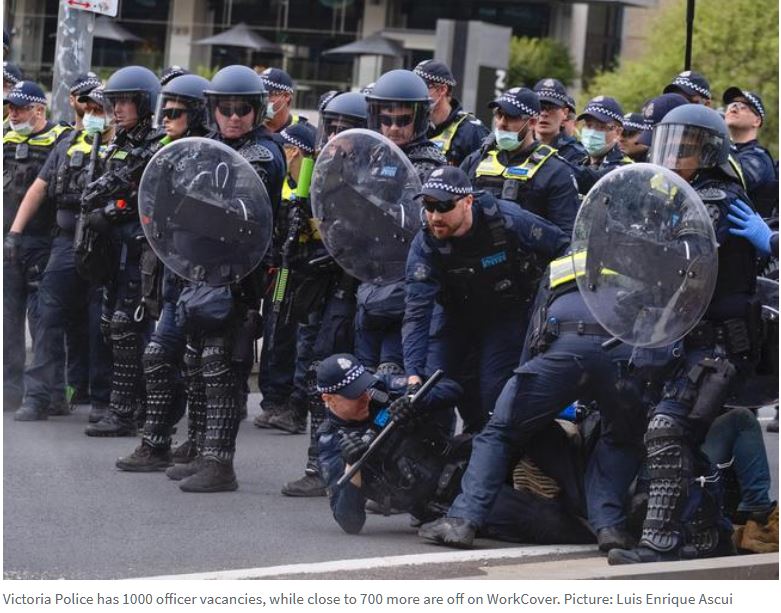
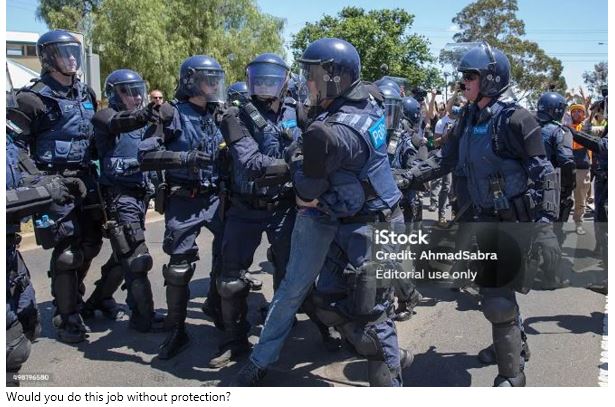





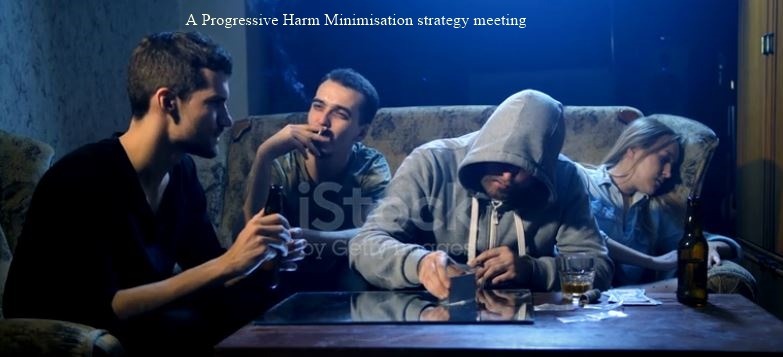

















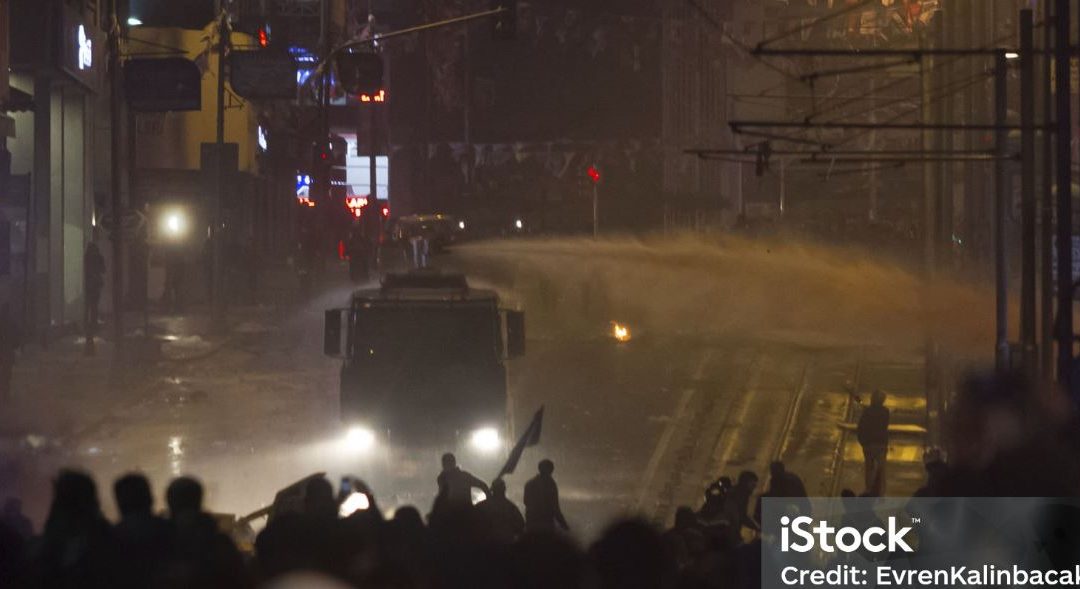
 To assist, go to