
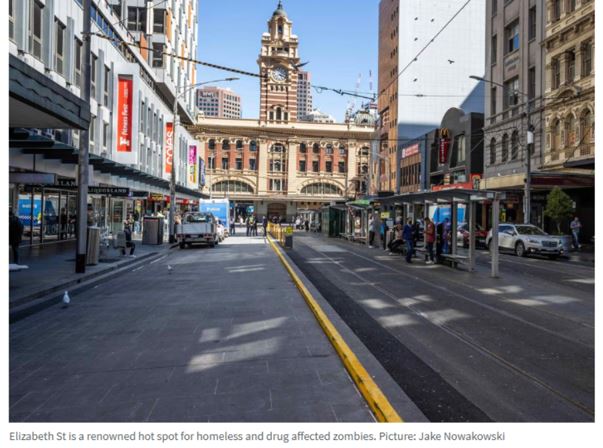
With all the boo-hoo-hah about our wonderful city and how it is being overrun with druggies and the homeless, it has taken Steve Price, a Melbourne Herald Sun journalist, to really nail the issue and perhaps indirectly provide a solution.
Steve recently got himself down to the alleged epicentre of the Melbourne problem to see first-hand what is going on.
This was what gave his article (Herald Sun Saturday 4th April 2006) real authenticity and demonstrated to decision-makers that they should also get off their butts and go down and get firsthand experience.
Then we might get some strategies and decisions that actually work.
“A couple of weeks ago, during mid-morning on Elizabeth St, a confrontation between a couple of police officers and three obviously drug-affected people outside a liquor store had a disturbing outcome.
The three had decided paying for booze wasn’t necessary, so they simply walked out of the shop with any expensive alcohol they could lay their hands on.
Sadly, for them, there were two police on foot patrol right out front. One of the three had already collapsed onto the pavement and was swigging away at whatever she had stolen, one of the others – a bloke – was shirtless, clutching a bottle along with his mate.
This was midmorning in the centre of Melbourne at a renowned hot spot for the homeless and drug-affected zombies that the Melbourne City Council claims they are cleaning up.
What happened next, though, shows there is more than one way to solve a crime problem.”
To avoid confronting this issue, those responsible jump to the avoidance fallback, with great enthusiasm, ‘this is a Community Health problem’. Effectively diverting the focus from the reality that this problem is primarily one of Law and Order, the health component, although important, is secondary.
First and foremost, the community leaders need to accept that there is a problem and that none of the current strategies is working.
Moreover, the problem is not isolated to Elizabeth Street but also affects other areas in the city, inner-city, metropolitan, and rural areas. In other words, it is a Statewide problem.
It is also arguably a National problem; however, shifting responsibility to the National approach only ensures that nothing effective will be done, other than blame shifting.
Recognising the depth and breadth of the issue is but part one, and no solution can be achieved if those who are our community leaders don’t accept reality but remain blissfully oblivious in their comfort zone of denial.
But back to Steve Price’s work.
“As I stood listening to the exchange between the police officers and the thieving druggies, I was amazed when one of the uniformed officers got into the face of the two that were standing and pointed toward a stationary tram at the stop on the corner of Elizabeth and Flinders streets. He told the pair, “Go and get on that tram right now, and catch it to the end of the line and f— off out of here”.
Tactically, not strictly out of the Victoria Police handbook and not doing much for the idea that if you are a homeless druggie, you shouldn’t be stealing from Liquorland, but it solved the immediate problem.
The moral of the story is that despite all the promises from the state government and Melbourne City Council, they still haven’t addressed the issues haunting Melburnians, desperate to claim their once great city back. Broken promise after broken promise and useless media spin-driven solutions are a joke and simply don’t achieve anything”..
The actions of the Police member involved were laudable, exercising his lawful discretionary power in that it immediately resolved a problem, but unfortunately, only relocated it, albeit temporarily. We cannot help but wonder whether the Police member was unduly influenced, given that, in the current administrative climate, charging these thieves was a waste of time.
Which raises the issue of whether it is right both morally and legally for the three druggies not to face court for their thievery.
The theft is distinct from their drug sobriety and must be treated independently, and the impact of drugs on their behaviour must be ignored; drug addicts must not be allowed to blame drugs for their crimes.
Deal with any criminal matters as the priority and then deal with their health issue as a result of their poor life choices separately.
The Courts are not the referral point for treatment, as that lies with Corrections.
In the unlikely event that they are jailed.
The Courts are responsible for instilling accountability. Corrections are responsible for rehabilitation and referring the addict’s health issues to the responsible authority, Health.
Being under the influence of any addiction must never be an excuse for criminal activity.
We have no hope of resolving this blight on society unless the Police can do their job and the Courts do theirs, and once those two sectors are working, then the issue of dealing with the perpetrators’ health can be addressed.
The health approach hasn’t worked and is not likely to, no matter what the apologists for drug addicts committing crimes may think and, unfortunately, espouse.
Compassion for addicts/users deprives those innocent of any wrongdoing, the victims, of justice. It’s the Victims who deserve compassion from the courts, not the perpetrator of a crime.
The solution, as in the case witnessed by Steve Price, has become clear: the health argument has failed, and the only option is a law-and-order approach.
Unfortunately, the police member exercising his discretion failed the sector of the community most impacted by this activity, the victims.
The Police must be encouraged to charge any person associated with the drug scourge for even what is considered a minor crime. If they commit an offence, they must be arrested (assuming there is a power of arrest for that offence) and brought before a court.
If the offence is proven, then the Courts must be directed not to consider their sobriety at the time of the offence as a mitigating factor in sentencing.
This strategy will imbue accountability in the users, the lack of which is a major contributor to the drug epidemic.
Building up convictions for minor matters will eventually end up with the addict being sentenced to prison, if the Courts are doing their job, instead of trying to be social engineers.
This social engineering approach generally leads to failure, failure for the victim and the addict.
Unless there are consequences for unacceptable (criminal) behaviour, there is no motivation for the addicts to change their behaviour or seek help, remembering that they are as addicted to the drug lifestyle as much as their drug of choice.
Tackling the lifestyle by instilling accountability, there is a chance of substantial change for the better, and health outcomes will become effective.
Well done, Steve.
The Community Advocacy Alliance (CAA) is funded by the members and the generous donations from the public. Please consider donating to help us continue to work for you. Simply click on the button below. Thank you – your generosity is very much appreciated.

Absolutely spot on. A a former serving member I find that politics has crept in and unfortunately overshadowed the role of VicPol and its members to serve and protect without fear or prejudice.
The streets are a mess and if left unattended, they will get worse. I am very disappointed to see the police hamstrung by political ideology.
The “F*** OFF” Solution” will only work to hide the principal problem and thereby appease politicians and cheat victims. The first step toward achieving accountability is to bring the offender before the Courts. That is purportedly aimed at ultimately causing the offender to self-correct their behaviour. However, due to political ideology, and a tendency of the Courts to engage primarily in pseudo-social engineering, the offender is commonly able to escape the level of accountability that would lead to their lasting change in behaviour. Many Police recognise that futility. By not achieving genuine accountability in offenders [drugged or not], the Courts are endorsing and effectively encouraging further offending. Detention of offenders serves to protect victims, and is in itself, unlikely or unable to change offender behaviour – as currently demonstrated.
Lasting behaviour change is unlikely to be achieved unless and until the offender FULLY accepts accountability for their circumstances and volunteers a willingness to accept responsibility for changing their behaviour. Addicted offenders may feign acceptance of accountability, so as to return to their addiction – not with a genuine intention to change their offending behaviour. Compassion from others may be seen by the addict as an opportunity to return to their “habit” – rather than as an escape from it. Unfortunately, addicted offenders commonly will sink to extremely low “personal comfort” levels before they will freely and genuinely seek or accept assistance to escape their addiction.
In the meantime society suffers and tolerates an inadequate process.
A fish rots from the head. For over 10 years we have witnessed the Labor Party politicizing every facet and section of the public service, as admitted by outgoing IBAC and Ombudsman officials. Blatant examples of open and clear corruption committed by public officials have gone unchecked. Sadly, Vic Pol has been, at best, indifferent to these crimes. We cannot expect society to adhere to the rule of law when they witness such crimes committed by public officials, who then impede or outright obstruct any attempt to address it.